Foundation Future Industries’ Payroll Failure Changes the Investor Test
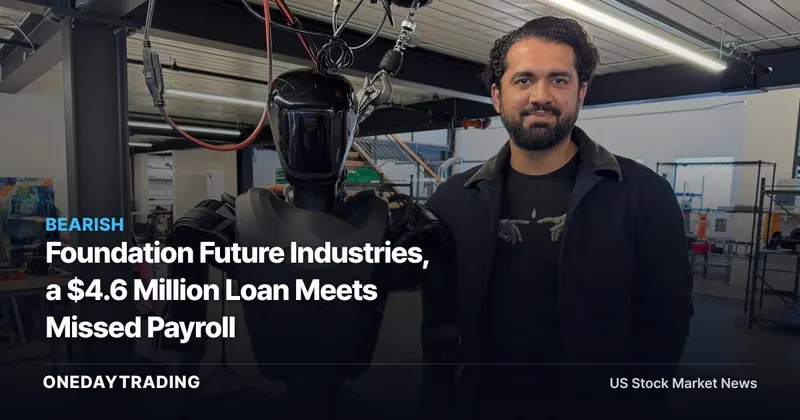
Foundation Future Industries missed its Oct. 30 payroll, turning a defense-robotics story built around ambitious hardware into a test of liquidity, governance and execution. CNBC reported that CEO and co-founder Sankaet Pathak received a $4.6 million company loan last year, while public records show that an LLC naming him as sole principal bought a $4.6 million Sausalito property in October 2025. For investors assessing private robotics and defense companies, the central issue is no longer the promised machine; it is whether capital reaches employees and product development under credible oversight.
Foundation Future Industries is a private company developing military humanoid robots, including the Phantom MK-1. Because the company is not identified as publicly listed, the immediate exposure is to its employees, existing investors and prospective funders rather than to a directly traded stock. The broader sector read-through is cautionary: technical claims and contract headlines cannot substitute for payroll capacity, contract ownership and board accountability.
The $4.6 Million Loan and the Governance Question
People familiar with the matter said Sankaet Pathak is Foundation Future Industries’ sole board member and owns most of its shares. That concentration matters because a board normally tests whether a transaction serves the company, whether conflicts are controlled and whether cash use is consistent with operating needs. In this case, the same company that extended Pathak a $4.6 million short-term loan last year later failed to pay employees after missing the Oct. 30 payroll.
The timing does not by itself prove that the loan caused the payroll failure. It does expose a capital-allocation conflict that prospective investors must evaluate: cash committed to an insider was unavailable for other corporate uses during that period. A spokesman for Pathak acknowledged receiving CNBC’s detailed points and did not provide a response to requests for comment.
This was not the company’s only payroll interruption. Foundation Future Industries also ran out of payroll cash in August; employees received their money about 2 days later after an existing investor supplied a bridge loan. Pathak later told employees that he was seeking money for back wages, leaving the timing of payment and the availability of additional funding unknown.
Foundation Future Industries’ Valuation Versus Operating Evidence
Foundation Future Industries has sought funding at a $3 billion valuation since at least January. A valuation is an investor expectation, not operating cash, and it becomes harder to defend when a company needs outside support to meet basic obligations. The next financing discussion therefore has to reconcile the $3 billion valuation with repeated payroll stress and a governance structure centered on one controlling executive.
The company has also been associated with a claim of $24 million in Pentagon contracts. The relevant distinction is ownership: Foundation Future Industries acquired Boardwalk Robotics in late 2024, and the $24 million in contracts belonged to Boardwalk Robotics rather than having been won directly by Foundation. The company used Boardwalk Robotics’ Alex robot as the basis for the Phantom MK-1, according to a person with knowledge of the matter.
That acquisition provides a tangible product lineage, which is more informative than a slogan about future capability. It still does not establish how contract work converts into cash available for payroll, engineering or further production. Investors need evidence connecting the inherited contracts, the Phantom MK-1 and Foundation Future Industries’ own finances before treating the contract figure as support for the requested valuation.
Political Visibility Does Not Resolve Funding Risk
Eric Trump was introduced during an April television interview as an investor in and chief strategy advisor to Foundation Future Industries. His stake remains unknown. His involvement raises the company’s visibility, while the financial question remains narrower: whether Pathak can secure enough capital to pay back wages and keep the company operating.
Investment vehicles linked to Eric Trump and Donald Trump Jr. backed startups associated with $3.2 billion in government business as of July, according to CNBC. That figure concerns a broader group of startups and must not be treated as Foundation Future Industries revenue, backlog or financing. Political access, government business elsewhere and this company’s liquidity are separate variables.
Eric Trump said in April that the United States had to win in robotics and praised Pathak’s work. Those statements express confidence, not evidence that Foundation Future Industries has funded payroll or completed a financing. The size of his investment and any further financial support remain undisclosed.
Founder History Raises the Due-Diligence Threshold
Pathak previously founded Synapse, which collapsed in 2024. Synapse had enabled fintech companies including Mercury, Dave and YieldStreet to provide financial products with assistance from small community banks. Its collapse locked more than 100,000 Americans out of accounts holding a combined $265 million in deposits.
Bankruptcy trustee Jelena McWilliams said as much as $96 million in Synapse customer funds was missing. The location of those funds remains unknown, and the outcome of the reported federal grand-jury investigation into possible criminal misconduct at Synapse is also unknown. Those unresolved matters should not be converted into a conclusion about Foundation Future Industries, though they increase the importance of independent verification and governance controls.
Pathak took $320,000 in loans from Synapse in 2024, according to the reporting attributed to Jason Mikula. Pathak blamed Evolve for the Synapse problems, while Evolve blamed Synapse. A customer-relief fund of $55 million was opened last year by the Consumer Financial Protection Bureau, underscoring the scale of the earlier breakdown without resolving responsibility for Foundation’s present payroll shortfall.
Defense Robotics: Evidence-Supported Market Read-Through
- Private defense-robotics funding: The bearish signal is the gap between a $3 billion valuation and an inability to meet payroll. New capital could close that gap, although the terms and availability of such funding are unknown.
- Contract diligence: The $24 million figure traces to Boardwalk Robotics contracts acquired with that company. Investors should separate inherited awards from contracts won directly by Foundation Future Industries.
- Humanoid-robot execution: The Phantom MK-1 is based on Boardwalk Robotics’ Alex. The supplied evidence establishes that lineage, not production capacity, deployment or financial contribution.
- Listed-company exposure: Foundation hired some personnel from Tesla and Zoox, the Amazon-owned autonomous-vehicle company. The facts supplied do not establish a financial effect on Tesla or Amazon, so assigning either stock a directional impact would overstate the evidence.
- General Motors claims: CNBC reported in 2024 on claims involving a $300 million General Motors purchase order. The supplied record supports describing the amount as a claim, not as verified business or a basis for General Motors exposure.
What Could Repair—or Deepen—the Bear Case
The constructive scenario begins with employees receiving back wages and the company obtaining additional funding. Greater board independence, transparent treatment of the Pathak loan and a clear distinction between Foundation Future Industries’ own contracts and those inherited from Boardwalk Robotics could make the financing case more credible. None of those outcomes is confirmed.
The adverse scenario is that funding does not arrive while payroll obligations persist. Repeated cash shortages could constrain employee retention and product execution, which would make the $3 billion valuation harder to support. Whether the company will remain operating is unknown, so this is a risk path rather than a forecast.
Investor Checkpoints After the Oct. 30 Miss
- Back wages: Confirm whether employees receive the missed Oct. 30 payroll and whether payment comes from operating cash, another bridge loan or new funding.
- Financing: Look for verified capital commitments and their terms, not only the continued use of a $3 billion valuation.
- Governance: Check whether Foundation Future Industries changes its sole-member board structure or discloses how the $4.6 million short-term loan will be handled.
- Commercial evidence: Separate Boardwalk Robotics’ $24 million in contracts from awards won by Foundation and seek a documented link between the Phantom MK-1, contract work and cash generation.
The decisive next event is not another demonstration or endorsement. It is proof that Foundation Future Industries can fund wages, govern insider transactions and convert acquired technology and contracts into durable operations.
📊 Analysis
Signal Bearish
Why Repeated payroll strain, concentrated governance and uncertainty over fresh funding weaken the outlook for the private defense-robotics company.
This article was independently written by OneDayTrading from public reporting. Read the original (CNBC)