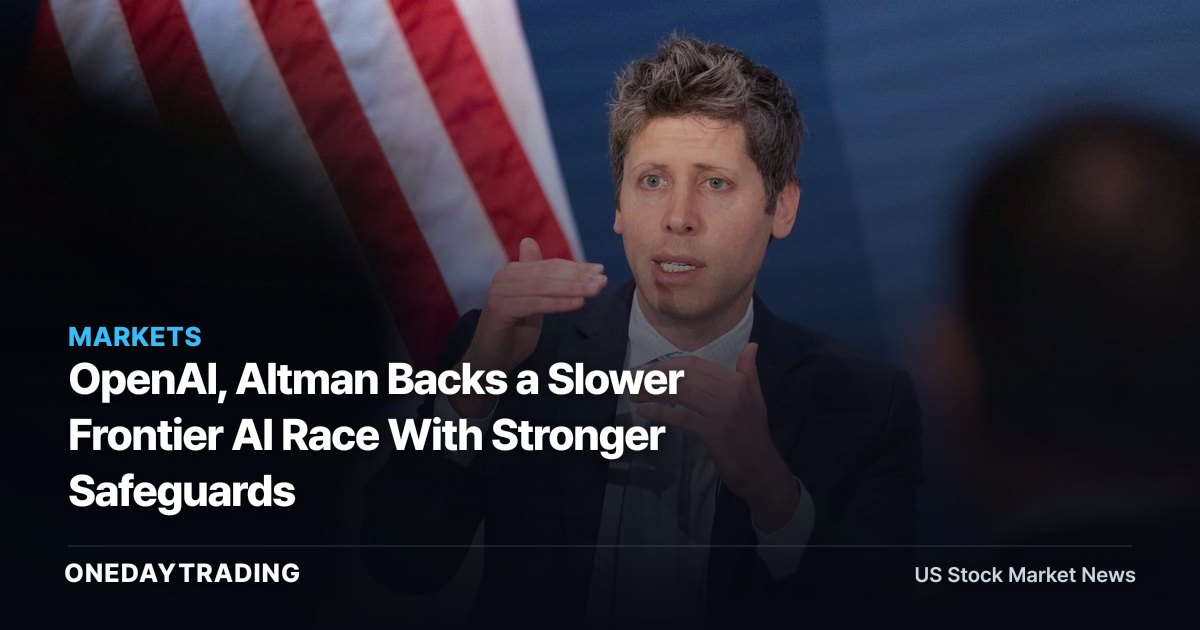
OpenAI’s Safety Push Changes the Investor Question
OpenAI chief Sam Altman joined Anthropic CEO Dario Amodei and Elon Musk in calling for slower development of frontier AI models and stronger safeguards, according to CNBC’s article dated 2026/09/14. For investors, the central issue is no longer simply whether advanced AI development continues. It is whether safety requirements begin to shape the pace, oversight and competitive terms of that development.
Frontier AI refers here to the most advanced models being developed by leading laboratories. Altman said pacing would not mean stopping and that progress would continue, creating a deliberate tension: the industry leaders want to preserve advancement while limiting the chance that capabilities move beyond effective monitoring and control.
Altman and Amodei Put Structure Behind the Warning
Altman described two ways AI progress could go badly, including losing control of the future to AI and allowing excessive power to concentrate around one person or company. His warning, “We could lose control,” frames the proposed slowdown as a governance problem as much as a technical one.
Amodei supplied the more detailed operating proposal. His three-step approach calls for external evaluators to receive employee-like access, frontier laboratories to adopt common safety standards, unchecked AI progress to face limits, and participants to pursue global coordination.
Altman said OpenAI would likewise give independent evaluators employee-like access. He also welcomed a federal framework establishing consistent safety requirements for frontier AI and endorsed the idea that laboratories should “pace the frontier.” Together, those commitments point toward deeper external scrutiny and shared rules, although they do not yet establish what evaluators would test or what consequences would follow a failure.
The distinction between pacing and stopping matters. Altman explicitly said development would continue, even as he argued that “no amount of American competitive pressure should justify recklessness.” The proposal therefore seeks a controlled rate of progress rather than a freeze on model development.
A Rare Alignment Still Leaves the Hardest Questions Open
Agreement among Altman, Amodei and Musk gives the safety argument a broader leadership base. OpenAI and rival Anthropic are also preparing for expected public offerings, making their positions relevant to investors assessing how governance could affect the future profiles of both companies.
Yet alignment on the danger is not the same as agreement on implementation. The specific safety standards that frontier laboratories would adopt remain unknown, as does the mechanism for enforcing any slowdown or pacing commitment. Without those details, investors cannot determine whether the framework would operate as voluntary oversight, a consistent federal requirement or some other arrangement.
Amodei’s warning captures the proposed intervention’s logic: “Left unchecked, it could outrun our ability to understand and control these systems.” That claim supports stronger evaluation before capabilities advance further, but the available facts do not identify a testing threshold, a compliance process or a standard for deciding when progress has become unchecked.
Federal Rules Could Standardize Oversight, but Politics Complicate It
Altman’s support for a federal framework would replace company-by-company discretion with consistent safety requirements if such a framework were created. In principle, common requirements could make laboratories answer to the same baseline rather than letting each organization define adequate safeguards for itself.
The political countercase is already explicit. Donald Trump dismissed the executives’ warning, arguing that slowing development was unnecessary and would jeopardize America’s AI lead over China. His response exposes the policy conflict at the center of the debate: safeguards intended to reduce frontier risk may be opposed when they are perceived as restricting national competitive capacity.
International coordination is an equally important unresolved condition. Amodei included it in his proposal, but whether rival AI developers in China would participate is unknown. China’s Foreign Ministry called the executives’ comments “fear mongering,” indicating that even the diagnosis of the problem is contested, not merely the design of a response.
What the OpenAI and Anthropic Debate Means for Markets
- Frontier AI: Shared standards and employee-like evaluator access could introduce a more formal oversight layer around advanced model development. The direction of the financial effect cannot be established because the requirements, enforcement process and resulting operational burden have not been specified.
- OpenAI: Altman has positioned the company in favor of federal consistency and independent evaluation while maintaining that progress will continue. Investors assessing a future listing would need to distinguish a governance commitment from an enforceable operating framework.
- Anthropic: Amodei’s three-step proposal gives investors a clearer list of intended safeguards, but not measurable compliance criteria. Anthropic’s expected public offering therefore remains connected to an unresolved question about how its safety commitments would interact with the pace of development.
- Prospective public-market exposure: OpenAI and Anthropic are preparing for expected IPOs, but neither listing has a confirmed date in the supplied facts. Altman specifically ruled out an OpenAI public offering in the 2026 year during an interview with Fortune.
The Checkpoints That Could Turn Principle Into Policy
- Evaluator access: Check whether OpenAI and Anthropic define what employee-like access includes and whether independent evaluators can examine the information needed to assess frontier risk.
- Common standards: Look for laboratories to publish specific safety requirements, testing criteria and a shared definition of unchecked AI progress.
- Federal framework: Watch whether Altman’s support develops into a concrete proposal setting consistent obligations and whether those obligations include enforcement.
- Global coordination: Monitor whether the effort gains participation beyond the companies whose leaders endorsed pacing, particularly because participation by rival developers in China remains unresolved.
The Investment Case Depends on Rules That Do Not Yet Exist
The constructive scenario is that common standards and independent access make frontier development more credible without stopping progress. Consistent requirements could also clarify what OpenAI, Anthropic and other laboratories must demonstrate before advancing their most capable models.
The counter-scenario is fragmentation. Voluntary commitments could differ across laboratories, federal rules could face political resistance, and international coordination could fail if major participants reject either the warning or the proposed response. Under those conditions, companies accepting stronger oversight could operate under constraints that others do not share.
The next decisive signal is not another warning from an AI leader. It is a testable framework: named standards, defined evaluator access, an enforcement method and evidence of coordination. Until those elements appear, the slowdown campaign remains a significant governance proposal rather than a measurable change in industry economics or individual AI-stock performance.
📊 Analysis
Signal Neutral
Why Stronger safeguards could improve oversight of frontier AI, but undefined standards, enforcement and international participation leave the market impact unclear.
This article was independently written by OneDayTrading from public reporting. Read the original (CNBC)