Key Takeaways
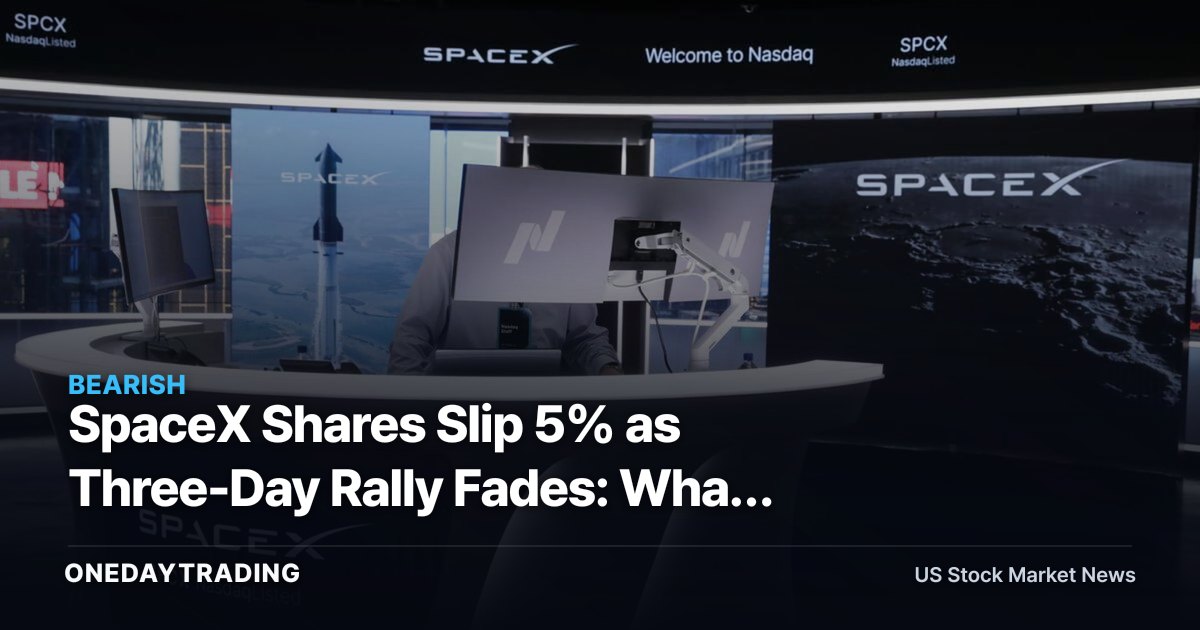
A 5% single-day drop in SpaceX-linked shares ended a three-day advance, a reminder that enthusiasm around the most valuable private space company can reverse quickly. For public investors, the read-through runs mainly through listed vehicles that carry SpaceX exposure, where sentiment swings often outpace any change in the underlying business.
What Happened
Investor bullishness that had powered a three-session rally lost momentum on Wednesday, with shares sinking 5%. After the pullback the price held steady rather than extending losses, suggesting the move looked more like profit-taking into strength than a fundamental rethink.
Because SpaceX itself is privately held, most retail participants access the story indirectly. That structure matters: thinly traded private-market interest and closed-end fund vehicles tend to amplify both the upside chase and the snap-backs, so a 5% daily swing says as much about positioning and liquidity as it does about the company.
Background and Context
SpaceX spans two distinct revenue engines — launch services through its reusable Falcon and Starship programs, and the Starlink broadband network, which has become the larger growth narrative. A rally and quick fade in the shares typically tracks shifts in how the market is pricing Starlink subscriber momentum and the long-runway optionality of Starship, rather than near-term cash flow.
Market and Stock Impact
- Destiny Tech100 (DXYZ) — the closed-end fund counts SpaceX as a flagship holding, so its premium or discount to net asset value tends to move with SpaceX sentiment, often more violently than the underlying mark itself.
- Rocket Lab (RKLB) — as a listed launch peer, it can trade as a sentiment proxy when the space complex rallies or cools, even though its scale and end-markets differ.
- AST SpaceMobile (ASTS) — a direct-to-cell satellite play that competes with the Starlink direct-to-device roadmap; SpaceX enthusiasm can spill into the broader satellite-broadband theme.
- Intuitive Machines (LUNR) — smaller space-economy names often see correlated swings on space-sector risk appetite rather than company-specific news.
Investor Checkpoints
- Whether the post-drop steadiness holds or gives way — a failure to stabilize would signal the rally was purely momentum-driven.
- DXYZ premium or discount to NAV: a wide premium is the clearest sign sentiment has run ahead of the marked value.
- Any new SpaceX private funding round or secondary valuation print, which resets the reference mark for all proxies.
- Starlink subscriber and launch-cadence updates, the operational metrics underpinning the long-term bull case.
Outlook
The bull case rests on SpaceX dominating commercial launch and scaling Starlink into a global utility, with Starship adding optionality few rivals can match. The counterweight is real: private-market and fund-based exposure can trade at stretched premiums detached from fundamentals, liquidity is thin, and a 5% reversal after three up days shows how fast crowd positioning unwinds. Exposure here is a bet on sentiment and valuation discipline as much as on rockets.
Market data check: DXYZ
DXYZ last traded near $29.31 (+1.81%). Our composite signal — blending price momentum and news flow — reads 🟡 neutral. Price momentum scores 64/100 (firm).
Data as of publication. Price via market feeds; for reference only, not investment advice.
📊 Analysis
Signal Bearish
Why A 5% single-day drop snapping a three-day rally signals near-term momentum has faded and positioning is unwinding.
Tickers$DXYZ$RKLB$ASTS$LUNR
This article was independently written by OneDayTrading from public reporting. Read the original (CNBC)