Key Takeaways
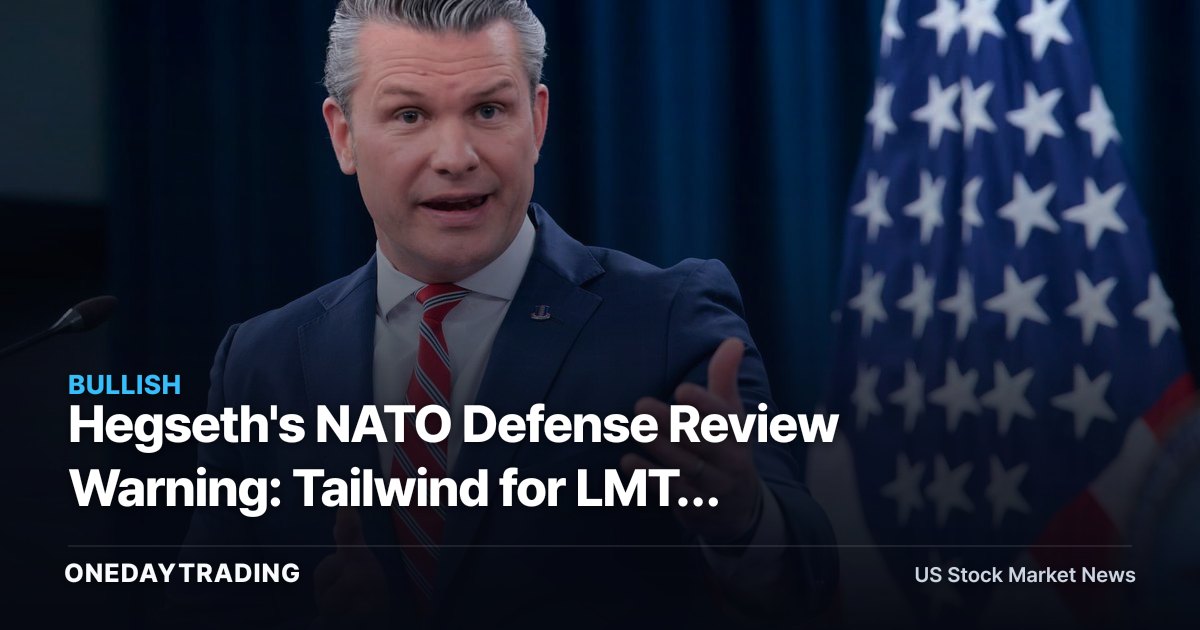
US Defense Secretary Pete Hegseth signaling that some NATO members will not pass a US defense review reframes the burden-sharing debate from rhetoric into a measurable standard, and that pressure flows directly to defense procurement budgets. For investors, the channel is straightforward: when Washington pushes allies to spend more and proves it with audits, the order book for US prime contractors and missile-defense suppliers tends to thicken over multiple years.
What Happened
Hegseth warned NATO allies that certain nations would fail an upcoming US defense review, putting governments on notice that contributions will be graded against US-defined benchmarks rather than self-reported intentions. The framing matters because it converts political commitments into pass-fail assessments that allied capitals must answer to publicly.
He also called it shameful that European allies declined to grant US forces access to bases for strikes on Iran. That detail underscores a widening operational rift: the dispute is no longer only about how much allies spend, but about whether they will support US power projection in the Middle East. Both threads point in the same direction for the defense industrial base — more political momentum behind higher military outlays and faster equipment acquisition.
Background & Context
The US has spent years pressing NATO partners to lift defense spending toward agreed targets, and most major allied procurement still leans on US-built platforms for air defense, fighters, and munitions. A formal review with explicit failing grades gives the administration leverage to accelerate that buying, since allies under scrutiny often respond by signing visible, US-sourced contracts to demonstrate compliance.
Market & Stock Impact
- Lockheed Martin (LMT): F-35 fighters, PAC-3 interceptors, and HIMARS are core to allied rearmament; failing-grade pressure tends to pull forward exactly these big-ticket foreign military sales.
- RTX (RTX): Patriot air-defense systems and missiles are in heavy European demand after the Ukraine war drained inventories, making restocking a multi-year revenue base.
- Northrop Grumman (NOC): Exposure to missile defense, radars, and munitions positions it for allied air- and missile-defense buildouts.
- General Dynamics (GD): Land systems and combat vehicles benefit as European armies modernize ground forces under spending scrutiny.
- Boeing (BA): Defense segment ties to allied aircraft and weapons, though its commercial troubles dilute the pure-play defense signal.
Investor Checkpoints
- Watch the next round of NATO defense ministerial meetings for concrete spending commitments or named contracts.
- Track foreign military sales notifications to Congress as the leading indicator of allied orders.
- Monitor prime contractors next earnings for backlog growth and book-to-bill above one.
- Note any allied policy on US base access, a proxy for how durable cooperation stays.
Outlook
The bull case rests on a structural rearmament cycle: graded reviews and basing disputes keep political pressure on allies, and that historically translates into US-sourced orders with long lead times and visible backlogs. The risk side is real, though. Defense primes already trade at elevated valuations on this thesis, allied budgets can slip with elections and fiscal strain, and a thaw in geopolitical tension could slow the urgency. The source carries no spending figures or contract values, so the near-term move is sentiment-led until hard procurement numbers confirm it.
Market data check: LMT
LMT last traded near $533.33 (+0.19%). Our composite signal — blending price momentum and news flow — reads 🟡 neutral. Price momentum scores 52/100.
Data as of publication. Price via market feeds; for reference only, not investment advice.
📊 Analysis
Signal Bullish
Why US pressure on NATO allies to raise defense spending and buy US equipment is a structural demand tailwind for US defense prime contractors.
Tickers$LMT$RTX$NOC$GD$BA
This article was independently written by OneDayTrading from public reporting. Read the original (CNBC)