Summary
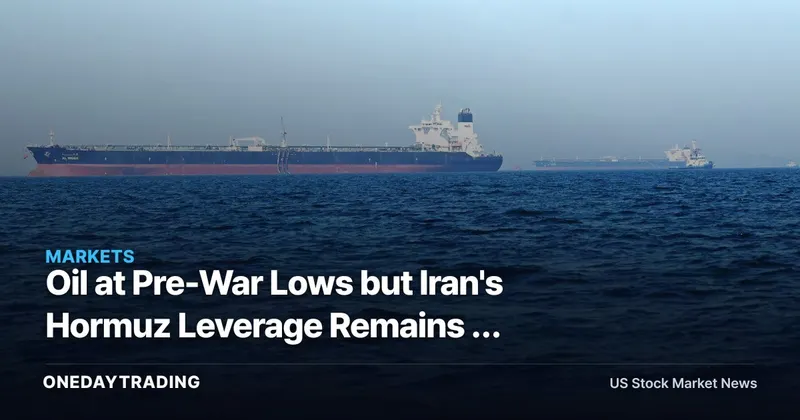
Crude prices have retraced to pre-conflict levels, erasing the geopolitical premium that supply fears once embedded into energy markets. The market has priced out the war. It has not priced out the geography. Commodity strategists are now flagging a structural mismatch: Iranian leverage over the Strait of Hormuz remains intact, and shipping costs are already reflecting an anxiety that spot crude prices are quietly ignoring.
The Full Story
The retreat in oil to pre-war lows communicates one thing clearly: the worst-case supply disruptions the market once feared did not arrive. But the market has taken that conclusion one step too far, treating the absence of disruption as the permanent elimination of disruption risk. Those are different conditions. Iran has not surrendered its capacity to threaten the Strait of Hormuz — through tanker seizures, naval posturing, or escalation — and commodity strategists are making exactly that distinction now, at a moment when prices offer almost no cushion against a rapid reversal.
The signal worth watching is not just crude but shipping costs. When Hormuz transit risk rises, tanker insurance surcharges climb and route premiums expand, driving the landed cost of a barrel in Asia or Europe well above the wellhead price. That spread compresses refiner and downstream buyer margins before it touches E&P revenue lines at all. Analysts flagging persistent supply risk at current price levels are identifying a mispricing: crude has been marked down as though the structural leverage Iran holds over the world's most consequential oil chokepoint has been neutralized. It has not.
Structural Background
The Strait of Hormuz has no scalable substitute routing option. Its position as the mandatory transit corridor for a large share of global seaborne crude and LNG gives Iran asymmetric leverage that does not require a full blockade to move markets — even partial or threatened disruptions force spot prices to reprice rapidly, because supply cannot reroute without material cost and delay. Markets reliably discount this dynamic during periods of price softness and comfortable inventory reads. The current setup — prices at pre-war lows, risk premium stripped out — is precisely the environment where that discount becomes most expensive to hold.
Stock & Sector Ripple
- XOM, CVX, COP — Upstream E&P companies carry direct revenue exposure to crude prices. Pre-war-level oil compresses their top line; a Hormuz-driven rebound flows straight to earnings. These names are the clearest expression of the asymmetric upside strategists are flagging.
- SLB, HAL — Oilfield services firms face lagged exposure: sustained low prices incentivize producers to cut drilling programs, shrinking addressable activity; a price recovery reverses that pressure on volumes and day rates.
- STNG, FRO — Tanker operators on Persian Gulf routes benefit directly when Hormuz transit risk premiums rise. Elevated shipping costs — already flagged by analysts — translate into stronger spot-rate environments for crude tankers with Middle East exposure.
- DAL, UAL — Airlines are the clearest demand-side victims of a crude spike. Jet fuel is a major operating cost line for large carriers; a sharp rebound from pre-war lows would immediately pressure margins and potentially force guidance revisions ahead of quarterly results.
- VLO, PSX — Refiners sit in an ambiguous position: crack spreads can widen or compress depending on whether refined product prices follow crude higher, making the net margin impact from any Hormuz event uncertain rather than directionally clean.
Bull vs. Bear Scenarios
Bull case: Any Hormuz incident — a tanker seizure, a naval standoff, credible escalation — would reprice crude sharply higher from current depressed levels precisely because the market has stripped out the risk premium entirely. Energy stocks would rerate quickly and shipping costs would amplify the move. The asymmetry is real: the market is pricing stability at a level that assumes geopolitical risk is resolved.
Bear case: OPEC+ spare capacity — concentrated in Saudi Arabia and the UAE — provides a meaningful buffer. If producers can rapidly bring additional barrels to market in response to a Hormuz disruption, the price spike caps before it becomes structural. Additionally, demand headwinds from slowing global growth could mean a supply shock produces a muted and short-lived price response, limiting the upside for energy equities even if the incident materializes.
Investor Action Points
- Monitor Hormuz shipping lane developments in real time — any tanker seizure or confirmed naval incident converts the analyst warning into a live market event and is the trigger for rapid crude repricing.
- Track Iran diplomatic and nuclear talks — a comprehensive agreement would structurally reduce Hormuz leverage and allow the current low-price environment to persist; a breakdown accelerates the supply risk repricing that analysts are already flagging.
- Watch OPEC+ spare capacity utilization at the next ministerial review — the degree of available buffer determines whether a disruption produces a sustained price spike or a brief, self-correcting one.
- Check airline and refiner guidance at the next earnings cycle — forward cost assumptions embedded in those figures reveal how much of the current oil risk is already being absorbed into downstream business planning.
📊 Analysis
Signal Neutral
Why Pre-war-level crude prices compress near-term E&P earnings visibility, but commodity strategists flag structurally unpriced Iranian leverage over the Strait of Hormuz that could rapidly reprice oil higher — the absence of a confirmed catalyst keeps the net sector direction uncertain.
Tickers$XOM$CVX$COP$STNG$DAL
This article was independently written by OneDayTrading from public reporting. Read the original (CNBC)