Key Takeaways
Putin's first public acknowledgment that Ukrainian drone strikes have materially constrained Russia's domestic fuel production removes the ambiguity oil markets had quietly discounted. When a wartime government puts infrastructure damage on record, the physical losses are typically already embedded in output data — the question shifts to duration and escalation pace. U.S. independent refiners and integrated majors are the clearest structural beneficiaries if the shortfall proves durable.
What Happened
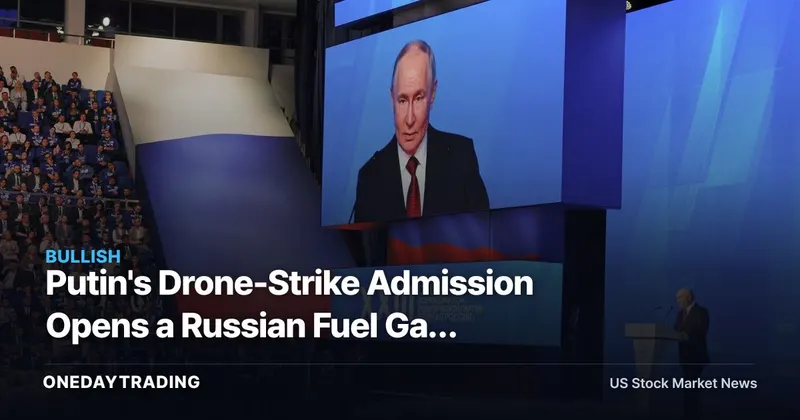
Vladimir Putin publicly detailed Russia's domestic fuel shortages for the first time, directly attributing the disruptions to Ukraine's deep-strike drone campaign targeting Russian energy infrastructure. The statement is a sharp departure from prior Russian messaging, which had minimized the operational impact on refining capacity. That a wartime leader chose to address the damage publicly — rather than contain it — signals the shortfall has reached a scale that can no longer be managed through information suppression alone.
Prior to Putin's remarks, market participants relied on satellite imagery, secondary tanker-tracking data, and inference to estimate the damage. A sovereign admission converts that soft signal into acknowledged fact, raising the probability that supply disruptions are both deeper and more persistent than consensus had modeled. Ukraine's drone campaign has evolved systematically from early military-logistics targets toward energy infrastructure — a strategic shift Putin's statement now formally validates.
Background & Context
Russia is one of the world's largest producers of both crude and refined petroleum products, supplying domestic fuel markets while exporting diesel and fuel oil to global buyers. Refinery disruptions carry a different market signature than upstream production cuts: they tighten product crack spreads before they tighten crude benchmarks, creating a lag that often catches equity investors off-guard. The physical sequence — drone strike, refinery offline, domestic fuel shortage, public admission — suggests the disruption has moved well past the acute phase and into a sustained capacity constraint.
Market & Stock Impact
- Exxon Mobil (XOM) / Chevron (CVX): Integrated majors with significant upstream exposure benefit directly from sustained crude price support. Higher realized prices widen upstream margins without a corresponding cost offset, amplifying cash generation at the segment level.
- Valero Energy (VLO) / Marathon Petroleum (MPC) / Phillips 66 (PSX): Independent U.S. refiners are the structural beneficiaries of tightening global refined-product supply. If Russian fuel exports decline durably, diesel and fuel oil crack spreads widen — a direct tailwind to refinery margins these names capture more purely than integrated peers.
- Energy sector broadly: Geopolitical supply risk historically compresses valuation multiples for energy equities relative to spot prices — that discount narrows materially when supply damage is confirmed by primary sources rather than inferred from secondary data.
Investor Checkpoints
- Diesel crack spreads (U.S. Gulf Coast): Russian refinery damage manifests in product markets before crude benchmarks. A sustained widening in diesel cracks is the clearest market confirmation that the supply signal Putin acknowledged is physically real.
- Brent and WTI curve structure: Watch whether backwardation steepens on the front months — a tightening curve signals physical traders pricing the disruption as near-term and durable, not speculative.
- Refiner earnings guidance (VLO, MPC quarterly updates): Management commentary on forward capture rates and crack spread assumptions will reveal how much of the disruption is already embedded in operating plans versus sitting as unpriced upside optionality.
- Ukrainian drone campaign frequency: Additional strikes — or Russian counter-infrastructure operations — represent the scenario that converts a disruption into a sustained shock. Infrastructure-targeting tempo is the live forward variable.
Outlook
The bull case for energy equities is structurally grounded: Putin's admission validates a supply shortfall that was previously uncertain, removing a bearish tail risk for crude prices and widening the floor under refined-product crack spreads. If the drone campaign continues at pace through the second half of 2026, the disruption compounds precisely when seasonal refined-product demand in the Northern Hemisphere typically firms — a timing dynamic that structurally favors U.S. refiners operating at full utilization.
The counter-scenario is equally concrete. Russia has repeatedly demonstrated capacity to reroute crude flows, shift export mix, and deploy state resources to accelerate infrastructure repair faster than market expectations — particularly when domestic fuel access becomes a political liability. If Moscow restores production materially, the supply premium priced in after this admission deflates quickly. A broader diplomatic de-escalation would simultaneously reprice the geopolitical risk component embedded in crude. The physical supply signal is now official; its duration remains the unresolved — and unpriced — variable.
📊 Analysis
Signal Bullish
Why Putin's first public admission of drone-strike damage to Russian fuel production validates a supply disruption that oil markets had discounted with uncertainty, structurally supporting crude prices and U.S. refiner crack spreads.
Tickers$XOM$CVX$VLO$MPC$PSX
This article was independently written by OneDayTrading from public reporting. Read the original (CNBC)