Moody's Rating Meets a Harder Market Test
Moody's retained France's Aa3 credit rating and negative outlook on Friday, while unrest on Saturday intensified investor scrutiny of the country's fiscal path. According to CNBC, benchmark 10-year French government bond yields had risen 11 basis points Thursday to their highest level since 2002. For investors, the central issue is not the demonstrations alone; it is whether political disruption makes the government's budget objective less credible at the same time that borrowing costs are already rising.
The immediate read-through is bearish for French assets and for businesses tied closely to domestic activity. Higher sovereign yields can raise the return investors demand from equities, compress valuation multiples and make financing more demanding. The tape has already registered part of that concern: France's CAC 40 fell 4.5% over the past month. What prices cannot settle in advance is whether the disruption proves temporary or becomes a sustained confidence shock.
France's Fiscal Target Is the Market's Transmission Point
Sovereign borrowing costs are the interest rates a government must offer on its debt; when they rise, markets are demanding more compensation for fiscal, political or economic risk. France's government aims to reduce its budget deficit from a projected 5.4% of GDP in 2026 to 5% in 2027. That planned improvement is now the hinge between political events and asset prices.
The National Assembly is due to resume debate on the budget's tax measures on Oct. 27. Whether the 2027 budget passes remains unknown. Matthew Ryan, head of market strategy at Ebury, said, “It remains unclear whether the 2027 budget will clear parliament.” The investable distinction is between passage and credibility: approval could reduce one source of uncertainty, while concessions that weaken the intended savings could leave the fiscal concern unresolved.
Alain Durré, head of EMEA economic research at Natixis CIB, identified “two key red flags” for markets: prolonged disruption weighing on GDP growth and political pressure derailing critical spending cuts. France's government could invoke Article 49.3, a mechanism for advancing a bill without a final assembly vote unless lawmakers pass a no-confidence motion. That route could move the budget process forward, though the fact sheet does not establish that it will be used or that it would restore confidence.
Protests Put Growth and Confidence on the Same Balance Sheet
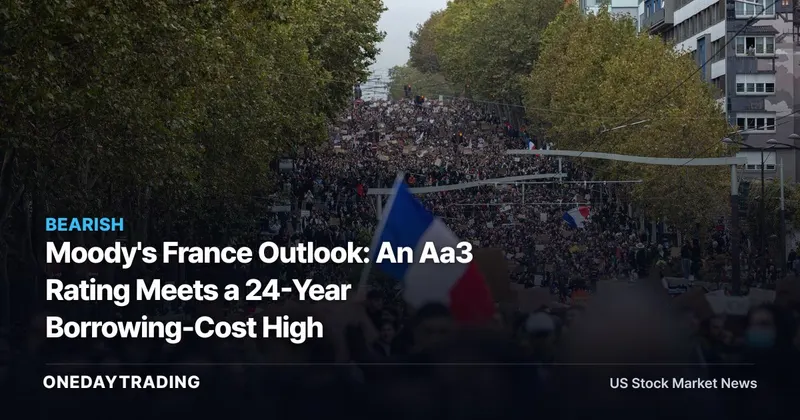
Hundreds of thousands marched across France on Saturday. The Interior Ministry reported 410,000 participants nationwide, while unions put the number at twice as high. The final participation count is unresolved, making the persistence and economic reach of the unrest more important for markets than a single estimate.
Charlotte de Montpellier, senior economist for France and Switzerland at ING, wrote on Oct. 20 that the unrest “adds another layer of uncertainty.” Her growth expectations were already limited to 0.3% GDP growth for France in 2026 and 0.6% in 2027. Further deterioration in confidence, continued unrest or intensified market tension could make growth weaker, although the eventual effect on GDP cannot be quantified from the available evidence.
Past disruptions show the potential scale without providing a forecast. An INSEE estimate indicated that the Yellow Vest movement may have reduced French GDP growth by 0.1 percentage point in the fourth quarter of 2018. Banque de France estimated that industrial action during the spring 2023 pension protests reduced first-quarter GDP growth by around 0.1 percentage point. Those episodes supply context, not a direct template for the current unrest.
The mechanism runs through behavior. If households avoid city centers, tourists postpone visits or companies delay investment, weaker activity can feed into revenue, confidence and ultimately public finances. De Montpellier's sharper warning was that “a lasting loss of confidence can have a bigger impact.” Duration is therefore the variable that connects street disruption to the growth assumptions behind the budget.
Carrefour and LVMH Show Different Equity Exposures
- Carrefour: Carrefour shares fell more than 14% Wednesday after the company reduced its profit outlook and investment. The retailer identified unrest alongside rising energy costs as a drag on consumer sentiment, and CEO Alexandre Bompard described an “unprecedented situation.” For a domestically exposed retailer, weaker visits, closures or cautious spending can affect sales while reduced investment may constrain the operating response.
- Retail, hospitality and tourism: ING identified these sectors among those most directly exposed. Lost shopping traffic can remove sales rather than merely postpone them, while hotels, cafés, restaurants and travel services face activity that customers may not reschedule. The severity depends on how long disruption lasts and whether confidence recovers.
- Transport and logistics: ING also placed transport and logistics among the directly exposed sectors. Continued disruption could interfere with the movement of customers and goods, transmitting localized unrest into a wider operating problem. More than 2,000 businesses had been directly affected by Tuesday, according to ING, citing estimates from France's network of chambers of commerce.
- LVMH: France represented 8% of LVMH's 2025 revenue, limiting its direct domestic exposure relative to its broader sales base. Kevin Thozet, a portfolio advisor and investment committee member at Carmignac, said tax-free purchases accounted for around 20% of LVMH's revenue in France. That creates a narrower tourism channel: disruption may matter less through total French revenue than through visitor-linked spending within it.
The contrast matters for sector selection. Carrefour presents a more direct domestic demand signal, while LVMH's disclosed exposure points to a smaller and more specific French revenue channel. Neither example establishes the final earnings impact of the unrest, and the supplied evidence does not support extending the same sensitivity to companies that were not identified.
What Bond and Equity Markets Have Priced
The 24-year high in French borrowing costs and the CAC 40's 4.5% decline over the past month show that fiscal and growth concerns are no longer theoretical. A higher sovereign yield can flow into equity valuation through the discount rate: when investors can demand more from government debt, the required return on riskier assets may also rise. Companies dependent on domestic demand face a second channel if disruption weakens revenue expectations.
Moody's still classifies the Aa3 rating as “high grade,” which provides the counterweight to the bearish market signal. The agency nevertheless maintained a negative outlook. A return to stable is possible if France's institutions narrow the budget deficit, though neither that outcome nor a future rating decision is known.
Alain Durré said recent pressure on French sovereign debt had been driven primarily by tactical portfolio reallocations, with traditional buy-and-hold investors still on the sidelines. If those investors return as the budget path becomes clearer, some pressure could ease. If they remain absent while fiscal credibility deteriorates, the higher yield required by the market could persist or increase; the fact sheet does not establish either path.
Dates and Metrics That Can Change the Thesis
- Oct. 27: Follow the National Assembly's resumed debate on the budget's tax measures. The key test is whether the process preserves a credible route from a projected 5.4% deficit-to-GDP ratio in 2026 toward the 5% target for 2027.
- Nov. 5: A union-backed national day of strikes and protests is scheduled. Investors should assess whether disruption broadens across retail, tourism, hospitality, transport and logistics rather than treating attendance alone as an economic measure.
- French sovereign debt: Track the direction of benchmark 10-year French government bond yields and their relationship with 10-year German Bunds. The current evidence confirms Thursday's 11-basis-point rise, not the future path of either instrument.
- Company evidence: Watch subsequent guidance from Carrefour and revenue commentary from LVMH for signs that lost traffic, tourism spending or weaker confidence are reaching reported operations. Current facts identify exposure channels, not their final financial magnitude.
The Conditional Case for French Assets
The constructive scenario requires the budget process to reduce uncertainty, preserve the government's planned deficit improvement and prevent temporary disruption from becoming a durable confidence loss. Under those conditions, the Aa3 rating, the prospect of a stable outlook and renewed participation from sidelined long-term investors could challenge the market's bearish positioning.
The downside scenario combines weaker activity with diminished fiscal credibility. Slower growth could complicate deficit reduction, while a disputed or diluted budget could keep borrowing costs and equity discount rates under pressure. Fresh demonstrations were planned for Oct. 24, and the Nov. 5 national action supplies the next dated test of duration. The decisive signal will come from the Oct. 27 budget debate, followed by whether bond yields, corporate guidance and exposed business activity confirm stabilization or a deeper loss of confidence.
📊 Analysis
Signal Bearish
Why Higher borrowing costs, unresolved budget approval and prolonged disruption could pressure French growth, equity valuations and exposed consumer sectors.
This article was independently written by OneDayTrading from public reporting. Read the original (CNBC)