Summary
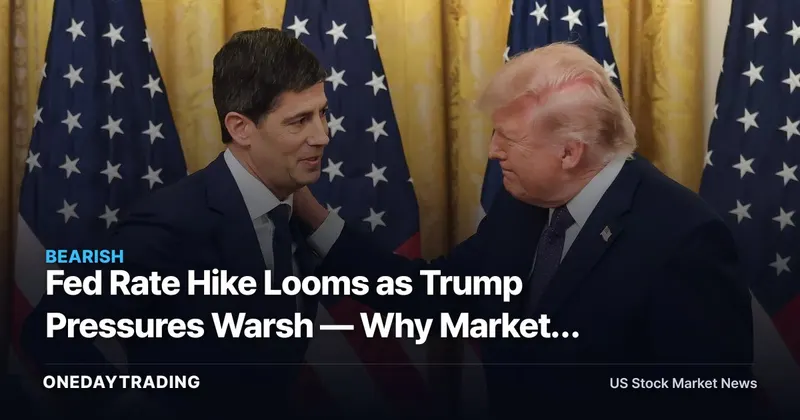
The Federal Reserve faces a political pressure campaign ten days before its next meeting, as the Trump administration seeks to prevent a rate hike and turns up scrutiny of Warsh. For investors, the immediate issue is not a confirmed policy decision but a widening gap between the market’s expectation of tighter policy and the administration’s demand for restraint.
A hike would raise the discount rate applied to future earnings, challenging high-duration technology, real estate and consumer businesses. A pause could support equity multiples, but the political confrontation adds uncertainty to every rate-sensitive trade.
The Full Story
The Trump administration is conducting what CNBC described as a full-court press to halt a potential Federal Reserve rate increase before the meeting scheduled in ten days. The source identifies Warsh as a central target of that pressure, making the personnel and policy debate part of the market signal.
A Federal Reserve rate hike matters because short-term borrowing costs feed into mortgages, corporate financing and the yield investors can earn from cash and government bonds. Higher yields generally reduce the present value of distant profits, while a credible pause can extend the valuation support enjoyed by growth stocks.
The tape therefore has two competing messages. The prospect of a hike argues for tighter financial conditions; the administration’s intervention argues that policy may be constrained by political pressure. Neither message establishes the meeting’s outcome, and investors should distinguish a repricing of probabilities from an actual change in the federal funds rate.
Structural Background
Monetary policy reaches markets through rates first, then multiples and sector leadership. Banks can benefit from higher asset yields when deposit costs and credit losses remain contained, while leveraged property owners, rate-sensitive consumers and companies dependent on cheap refinancing face a more direct burden.
The Warsh controversy adds an institutional-risk channel. If investors begin demanding a larger premium for uncertainty around Federal Reserve independence, Treasury yields and equity risk premiums can move even without a rate change.
Stock & Sector Ripple
- JPMorgan Chase (JPM) and Bank of America (BAC): A hike can lift lending yields, but margin gains depend on funding costs and credit quality; political uncertainty can offset the benefit through wider market risk premiums.
- Real estate and REITs: Higher policy rates raise financing costs and compete with property income, pressuring valuations even if operating demand is unchanged.
- Long-duration technology: A pause can support earnings multiples, while a hike makes future cash flows less valuable and can rotate leadership toward shorter-duration sectors.
- Consumer discretionary: More expensive credit can restrain large-ticket purchases, leaving retailers exposed if financing costs rise faster than pricing power.
Bull vs Bear Scenarios
The bullish path for equities is a policy pause that lowers Treasury yields and preserves valuation support for growth and housing-linked assets. Financial stocks could still hold up if lending demand remains firm and credit costs stay controlled.
The bearish path is a hike accompanied by evidence that political pressure cannot alter the Fed’s course. That outcome would tighten financial conditions, compress high-growth multiples and expose companies with near-term refinancing needs; a prolonged dispute could add a separate confidence discount.
Investor Action Points
- Track Treasury yields and rate futures during the ten days before the next Federal Reserve meeting; the direction of yields will show whether markets price a hike or a pause.
- Separate statements about Warsh and the administration from an announced change in the federal funds rate.
- Review bank net-interest sensitivity alongside credit costs rather than assuming every hike is automatically positive for JPM or BAC.
- Stress-test REIT, consumer and high-duration technology holdings against both a higher-rate and a lower-rate meeting outcome.
FAQ
Why is Trump pressuring the Fed before the next rate decision?
The Trump administration is pressing the Federal Reserve to stop a possible rate hike, according to CNBC, with the next meeting ten days away. The effort makes policy independence and the rate path simultaneous market concerns.
What would a Fed rate hike mean for stocks?
A rate hike would increase the discount rate for future earnings and raise borrowing costs. High-duration technology, real estate and credit-sensitive consumer shares face the clearest valuation pressure, while banks’ benefit depends on funding and credit conditions.
When will investors know whether the Fed hikes rates?
The decision is expected at the Federal Reserve’s next meeting, identified in the source as ten days from the report. Before then, Treasury yields, rate-market pricing and official comments about Warsh will provide the clearest signals of changing probabilities.
📊 Analysis
Signal Bearish
Why The prospect of a Federal Reserve hike and an escalating political dispute create downside risk for rate-sensitive valuations and market confidence.
This article was independently written by OneDayTrading from public reporting. Read the original (CNBC)