Key Takeaways
A reported U.S.-Iran agreement to halt Persian Gulf attacks lifted U.S. stock-index futures Sunday — but crude rising in the same session is the signal that matters. When oil does not give back a war premium on a ceasefire, markets are telling investors the underlying supply risk is still alive. Energy majors catch a direct tailwind; airlines absorb the cost-side hit; the broader equity rally depends entirely on the agreement holding.
What Happened
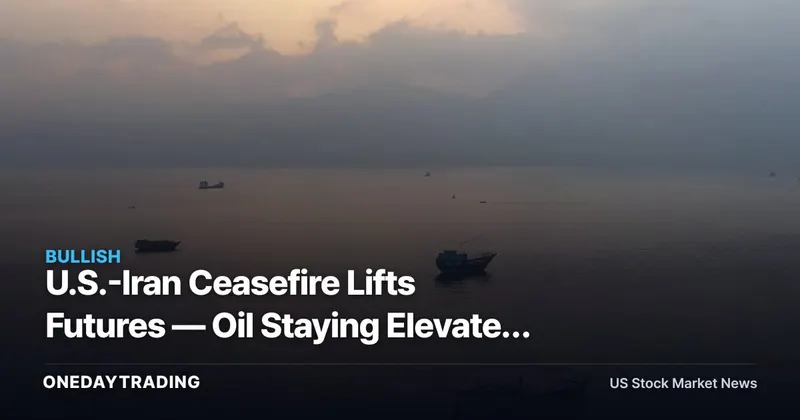
The U.S. and Iran reportedly agreed to cease attacks after trading fire in the Persian Gulf over the weekend. The news drove U.S. stock-index futures higher Sunday, the standard risk-on response to a geopolitical de-escalation. But oil prices also rose rather than retreating — the move that separates a genuine all-clear from a temporary pause.
In a clean de-escalation, crude flushes the war premium and equities rally on lower energy costs. What happened Sunday was different: both moved up together. That configuration typically means one of two things — the ceasefire is too fragile for the physical oil market to trust, or the weekend exchanges of fire were severe enough to leave a structural shift in how traders price Strait of Hormuz supply risk going forward.
Background and Context
Roughly 20% of globally traded oil transits the Strait of Hormuz. Any credible threat to that corridor reprices crude not just on volume expectations but on shipping insurance and rerouting logistics. The weekend events were not a single incident — they involved repeated exchanges of fire, which raises the tail-risk threshold materially above a one-off skirmish. Markets had not fully priced this escalation level before Sunday, which is why futures and crude moved simultaneously: equities were catching up on relief, oil was still pricing residual risk.
Market and Stock Impact
- XOM, CVX (Energy Majors): Sustained crude prices flow directly to upstream realized revenue. Both companies carry Gulf-region exposure and benefit from any durable geopolitical premium in crude. The counter: a ceasefire that holds and fully unwinds the premium reverses this tailwind into the back half of the year.
- OXY (Occidental Petroleum): Higher financial leverage to oil prices means sharper earnings sensitivity on the upside — and the downside if the geopolitical spike proves transient. Watch Oxy for the most amplified read on where the market thinks crude settles.
- DAL, AAL (Airlines): Jet fuel is the dominant variable cost for U.S. carriers. Oil rising on geopolitical disruption rather than demand does not generate offsetting ticket-pricing power, so margin is the direct casualty. A sustained crude bid compresses guidance.
- LMT, RTX (Defense): U.S.-Iran direct exchanges historically reinforce the procurement environment for aerospace and defense. The read-through is indirect and slow, but defense names tend to catch sentiment bids on Persian Gulf escalations.
Investor Checkpoints
- Ceasefire durability within 48-72 hours: Any follow-on incident in the Persian Gulf resets the oil premium higher and pressures the equity futures gain. Silence is the confirmation; noise is the reversal signal.
- WTI front-month vs. deferred spread: Persistent backwardation — near-month crude pricing above deferred contracts — would confirm the market is still pricing near-term supply risk, not a resolved situation.
- Hormuz tanker traffic and shipping insurance rates: Physical market signals lag futures. A spike in Gulf-transit insurance premiums or route diversions would indicate the ceasefire is not translating into normalized supply logistics.
- Official U.S. diplomatic confirmation: A White House or State Department statement defining the ceasefire terms and any conditions would clarify whether this is a structured pause or a tactical halt ahead of further escalation.
Outlook
The bull case is intact as long as the ceasefire holds: equity futures extend gains into the Monday open, the geopolitical premium in crude gradually compresses, and energy stocks give back some of their bid as the risk-on rotation broadens to cyclicals. Airlines recover on lower fuel cost expectations. That path requires both sides to have genuine incentive to sustain the agreement — plausible, but not guaranteed by a single weekend announcement.
The counter-scenario carries real weight. Repeated exchanges of fire over a single weekend suggest both parties tested escalation limits rather than stumbling into a single incident. Ceasefires that follow rapid escalation sequences without a broader diplomatic framework have a poor track record of holding. If the agreement fractures, crude reprices to a new, higher risk floor — one that includes the precedent of direct U.S.-Iran fire exchange — and equity futures reverse sharply. The oil market has already signaled it does not fully believe the all-clear; the next 72 hours of silence or noise in the Persian Gulf will determine which read is right.
📊 Analysis
Signal Bullish
Why Ceasefire reduces acute geopolitical tail risk, lifting equity futures, while elevated oil prices benefit energy majors directly tied to crude benchmarks.
Tickers$XOM$CVX$OXY$DAL$LMT
This article was independently written by OneDayTrading from public reporting. Read the original (MarketWatch)