Summary
Ford Motor’s CATL battery strategy now carries greater policy risk because the Trump administration is questioning whether Chinese technology belongs inside a supply chain intended to strengthen U.S. manufacturing. For Ford stock, the issue is not a quantified financial loss but the possibility that political scrutiny complicates the conversion of licensed technology into battery production and energy-storage capacity.
The distinction matters: Transportation Secretary Sean Duffy’s letter signals the administration’s preferred industrial direction, but the supplied report identifies no prohibition, penalty, formal proceeding or compliance deadline. Investors should treat the dispute as heightened scrutiny whose financial significance depends on what Ford and federal officials do next.
The Full Story
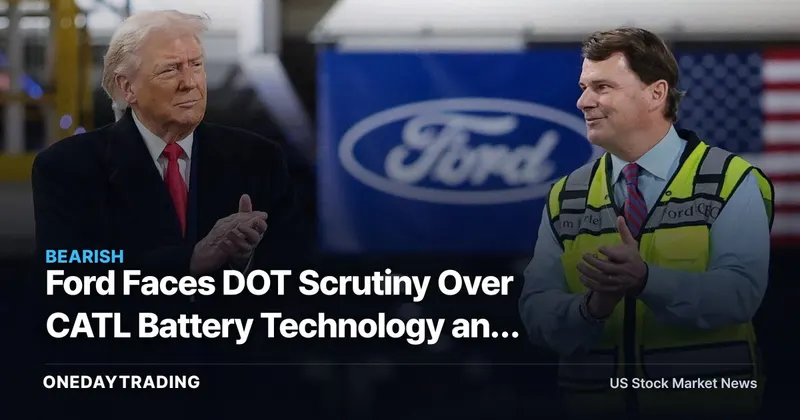
The Trump administration expressed concern Tuesday about Ford’s relationships with Chinese companies. In a letter to Chief Executive Jim Farley, Duffy questioned whether the automaker’s strategy creates exposure to foreign-adversary technology and weakens the integrity or self-reliance of American automotive manufacturing, according to CNBC’s Sept. 8 report.
The central relationship is Ford’s licensing agreement with Contemporary Amperex Technology Co., or CATL. Announced in 2023, the agreement allows Ford to use CATL battery technologies, including technology for producing lithium iron phosphate batteries. LFP, or lithium iron phosphate, is a battery chemistry based on iron and phosphate rather than the nickel- and cobalt-intensive materials used in some other battery formulations.
The arrangement has returned to Washington’s attention amid U.S.-China tensions and Ford’s plan to use the licensed technology for energy-storage systems. That plan expands the policy relevance of the agreement beyond automotive batteries, but the supplied report does not provide a deployment date, production volume, expected revenue or capital-spending figure.
Duffy also cited a framework proposed at a Detroit auto show earlier this year that he said could facilitate Chinese joint ventures on U.S. soil. The report does not establish that Ford entered such a joint venture. Ford had not responded to CNBC’s request for comment when the report was published.
Structural Background
Ford is caught between two definitions of domestic manufacturing. One emphasizes where products are made and which workers build them; the other asks who controls the underlying technology and whether production depends on a company associated with a strategic rival. A vehicle or battery can be manufactured in the United States while still relying on licensed foreign know-how, so domestic location alone may not satisfy policymakers seeking technological self-reliance.
That distinction turns a licensing contract into a capital-cycle question. Battery technology influences equipment, manufacturing processes, engineering validation and the pathway from planned capacity to commercial output. If Ford had to alter that pathway, the economic transmission could run through additional engineering work, revised production schedules or new supplier qualification before reaching volume, cost and margin.
The available evidence does not show that any of those effects has occurred. The report discloses no licensing payments, plant capacity, utilization rate, project timetable or expected energy-storage sales. Without those inputs, investors cannot responsibly calculate the earnings exposure or assume that political criticism will require a strategic reversal.
Stock & Sector Ripple
- Ford Motor: Ford carries the direct exposure because federal officials are challenging its technology and supply-chain choices. The risk would become financially material if scrutiny forces the company to change project scope, timing, sourcing or manufacturing processes.
- U.S. auto manufacturing: Duffy’s emphasis on American workers, allied supply chains and domestic self-reliance indicates the sourcing model the administration favors. The letter could influence how automakers evaluate foreign technology partnerships, although the report identifies no industry-wide rule.
- Battery production: The dispute shows that domestic production and domestic technological control are separate policy tests. Ford may manufacture with licensed CATL know-how, yet officials can still question whether reliance on that technology creates strategic supply-chain exposure.
- Energy storage: Ford’s planned use of the battery technology in energy-storage systems broadens the operational perimeter under scrutiny. Any future restriction covering the underlying technology could therefore affect more than its automotive battery strategy.
The physical manufacturing sequence is the key mechanism. A policy objection has limited earnings relevance until it changes investment, procurement, validation or output; once it affects one of those steps, delays and incremental costs could reach the income statement. Conversely, a structure acceptable to federal officials could preserve Ford’s planned production path while adding safeguards or disclosure requirements.
Bull vs Bear Scenarios
Bull case: Ford could argue that licensing established technology supports U.S.-based production and American employment rather than substituting imported finished products for domestic manufacturing. Farley has praised Chinese competitors while also supporting the administration’s effort to promote U.S. manufacturing, giving Ford a basis to frame technical licensing and domestic industrial policy as compatible.
If Ford demonstrates operational control and addresses concerns about dependence, the political exchange may lead to clarification or safeguards instead of changes to production. In that case, the principal market effect would be uncertainty rather than a lasting impairment to the battery strategy.
Bear case: Duffy questioned Ford’s broader strategic direction, suggesting the administration’s concern extends beyond a single shipment or contract detail. If officials determine that licensed technology still creates unacceptable reliance on a Chinese state-backed enterprise, Ford could face pressure to narrow the relationship or move toward U.S. and allied alternatives.
Changing a technology pathway can be harder than replacing a commodity input because production systems must work reliably at commercial scale. The bearish scenario therefore centers on execution: revised engineering, supplier qualification or project timing could consume capital and postpone output. Its probability and magnitude remain impossible to quantify from the figures disclosed.
Investor Action Points
- Examine Ford’s formal response: Management needs to clarify the scope of the CATL license, Ford’s operational control and whether Duffy’s letter changes any battery or energy-storage plan.
- Use the next earnings update as the financial checkpoint: Listen for revisions to capital commitments, project schedules, battery-production plans or the energy-storage strategy. A change explicitly linked to federal policy would create the first measurable bridge from scrutiny to financial performance.
- Track the form of government action: A regulation, investigation, funding condition, sourcing restriction or deadline would carry different operational consequences. Investors should identify the precise mechanism before estimating cost or delay.
- Watch for technology or supplier substitution: If Ford emphasizes U.S. or allied alternatives, the critical questions will be whether the replacement requires additional validation, changes the manufacturing schedule or alters the planned scope of LFP deployment.
FAQ
What is Ford’s agreement with CATL?
Ford has a licensing agreement allowing it to use CATL battery technologies, including technology for producing lithium iron phosphate batteries. The agreement was announced in 2023, but the supplied report does not disclose its financial terms, duration or production scale.
Why is the Trump administration concerned about Ford and China?
Transportation Secretary Sean Duffy questioned whether Ford’s relationships with Chinese companies increase supply-chain exposure and reliance on foreign-adversary technology. He urged the automaker to favor American workers, allied supply chains and greater domestic automotive self-reliance.
What could the CATL scrutiny mean for Ford stock?
The immediate read-through is higher policy and execution uncertainty around Ford’s battery strategy, not a known earnings charge. The stock impact would become more concrete if Ford changes capital spending, project timing, technology sourcing or planned production in response to federal action.
📊 Analysis
Signal Bearish
Why Federal scrutiny increases policy and execution risk around Ford’s CATL-linked battery plans, although the DOT has announced no binding action.
This article was independently written by OneDayTrading from public reporting. Read the original (CNBC)