Key Takeaways
India's strategy of racing to AI leadership by building applications on top of foreign foundational models just hit a structural snag. Anthropic-style usage curbs underline a dependency risk that investors in app-layer and IT-services names cannot ignore, while the providers behind those models hold the leverage. The debate is less about hype and more about who controls the rails.
What Happened
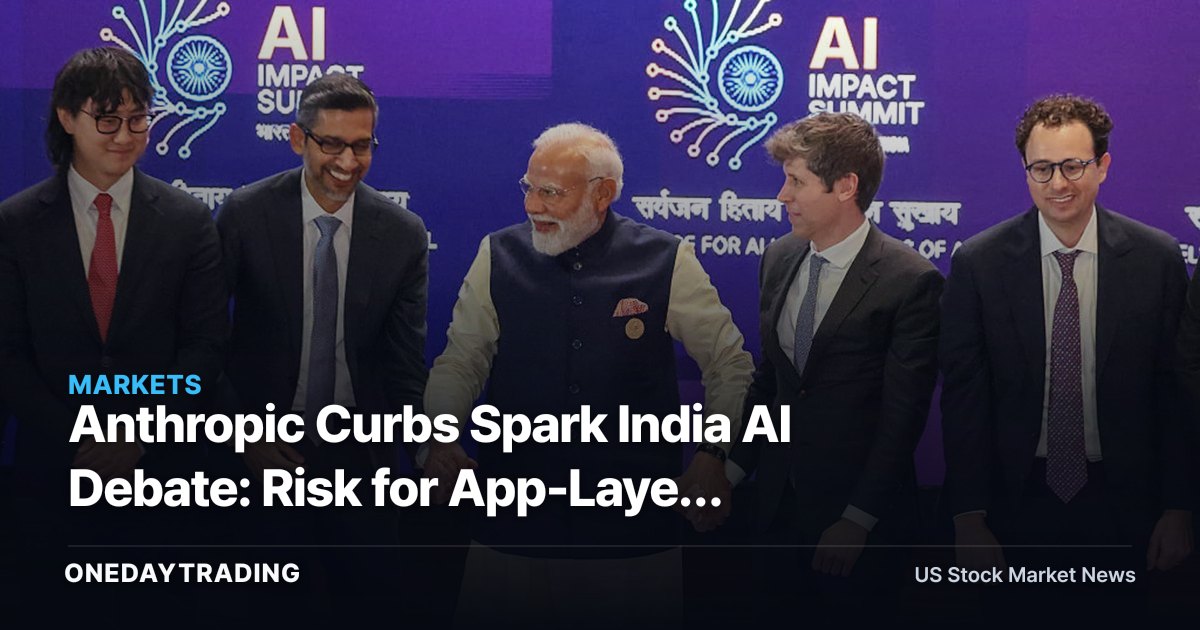
A CNBC India briefing flagged that curbs tied to Anthropic have ignited a sharp debate over the country's AI direction. Critics quoted in the piece argue domestic efforts are too slow and way too small relative to India's stated goal of becoming a global AI innovation hub.
The core tension: India has leaned on building products and services atop foreign foundational models rather than training its own large models from scratch. When the owner of a model changes access terms, pricing, or permitted use, every downstream application inherits that constraint. That is the vulnerability now being publicly questioned.
Background and Context
Foundational models are capital-intensive to train, so most national and corporate AI ambitions ride on a handful of US-based labs. Anthropic is backed heavily by Amazon and Google, meaning the commercial terms of model access ultimately route through deep-pocketed cloud incumbents. India's app-first approach was pragmatic and fast, but it concentrates control of the underlying technology offshore.
Market and Stock Impact
- AMZN — As a primary Anthropic backer and the cloud host for much of its capacity, Amazon captures recurring inference and hosting revenue when third parties build on these models; tighter curbs reinforce pricing power.
- GOOGL — Also an Anthropic investor and a rival model supplier via Gemini, Google benefits from any shift where developers seek alternative or additional model access.
- INFY and WIT — Indian IT-services exporters monetize AI mainly through integration and delivery layered on foreign models; access restrictions raise input-cost and continuity risk for their generative-AI service lines.
- MSFT — As the OpenAI-aligned hyperscaler, Microsoft is the obvious switching destination if buyers diversify away from a single model provider.
Investor Checkpoints
- Watch for formal Indian policy on domestic model funding or compute incentives — a sovereign-model push would reprice local AI exposure.
- Track commentary on AI revenue mix and model-dependency in the next Infosys and Wipro results.
- Monitor whether hyperscalers tighten or loosen API terms, a direct margin signal for AMZN and GOOGL.
- Note any multi-model adoption trend that favors MSFT and OpenAI as a hedge.
Outlook
The bull case for the model owners is durable: controlling foundational access turns every downstream app into a toll-paying customer, supporting AMZN, GOOGL and MSFT cloud economics. The counter-scenario is real, though. If curbs push large markets like India toward open-weight or homegrown models, the long-run pricing power thins and services firms gain bargaining room. The unresolved variable is capital — building competitive foundational models is expensive, and until that funding materializes, dependency, not autonomy, defines the trade.
Market data check: AMZN
AMZN last traded near $237.5 (-3.46%). Our composite signal — blending price momentum and news flow — reads 🟡 neutral. Price momentum scores 22/100 (soft).
Data as of publication. Price via market feeds; for reference only, not investment advice.
📊 Analysis
Signal Neutral
Why The story is a policy and dependency debate without a concrete earnings or guidance catalyst, with mixed read-through across providers and India-exposed services firms.
Tickers$AMZN$GOOGL$INFY$WIT$MSFT
This article was independently written by OneDayTrading from public reporting. Read the original (CNBC)