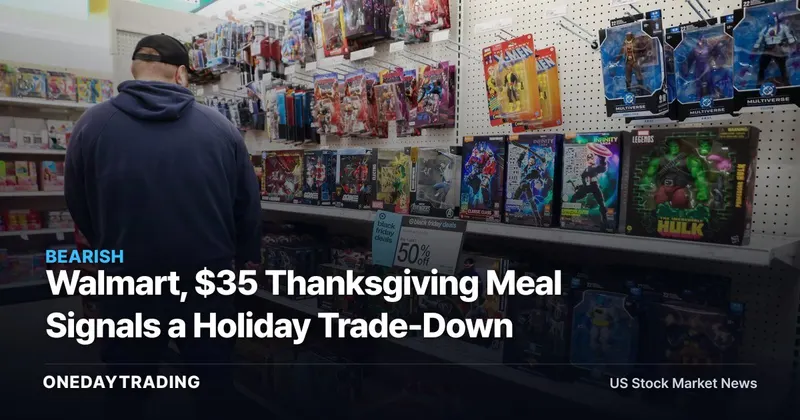
Walmart’s $35 Meal Captures the 2026 Holiday Trade-Down
Walmart’s $35 Thanksgiving meal for 10 captures the central investor tension of the 2026 holiday season: Americans are still spending, though higher food, travel, heating and gift costs are forcing them to buy less, simplify celebrations or seek cheaper formats. For retailers, travel businesses and consumer platforms, the relevant question is no longer whether holiday dollars will be spent, but which companies can capture increasingly selective demand without relying on unsupported assumptions about volume or margins.
Holiday trade-down is the shift toward lower-cost products, smaller baskets or fewer purchases when household budgets cannot absorb higher prices. CNBC reported that Amanda Brecht abandoned a drive across Michigan and planned Thanksgiving with her husband and three children, while Wendy Cooper limited gifts for each of her three adult children. Those decisions turn an abstract inflation story into a demand-mix story: value can gain relevance even as the broader consumer sector faces weaker purchasing power.
Thanksgiving Food Costs Raise the Value Stakes
The American Farm Bureau Federation reported that a Thanksgiving dinner for 10 rose 6% to $58.63 in 2026. Walmart’s competing proposition was a $35 bundle advertised to feed 10 people, while Walmart and Aldi both offered holiday meal bundles. The comparison does not establish sales, traffic or profitability, though it shows why a clearly priced package may resonate with households reducing menu choice.
The broader grocery backdrop is severe. Bureau of Labor Statistics figures showed food prices up 24% over the last five years, with coffee and ground beef each rising more than 40% over the same period. Joe Bruseulas, chief economist at RSM, argued that a standardized discount meal does not erase the disappointment consumers may feel when higher prices narrow their choices.
Pressure is also visible outside commercial retail. The Salvation Army said some food pantries supplied double or triple the groceries in October 2026 compared with the same month a year earlier. Feeding America’s Linda Nageotte said, “Far too many of them have empty shelves.” For investors, that evidence supports caution about treating nominal holiday spending growth as proof of healthy household demand.
AAA and Hopper Show Travel Taking a Second Hit
AAA reported that slightly fewer Americans would travel at least 50 miles around Thanksgiving in 2026, the first year-over-year decline since 2020. The article did not provide the exact number of travelers. About 9 out of every 10 Thanksgiving travelers were expected to go by car, while gas prices were 18% higher year over year.
Air travelers faced an even steeper comparison. Hopper reported that roundtrip domestic airfare was 31% higher around Thanksgiving 2026 and 23% higher around Christmas 2026 than a year earlier. Hayley Berg, Hopper’s lead economist, warned of “significant shell shock” for travelers, with the effect more noticeable on routes previously served by Spirit, which shut down in May.
The transmission mechanism is direct but not uniform. Higher trip prices can reduce travel, shorten plans or redirect money away from gifts and meals; they can also lift the dollars paid by travelers who proceed. Without company-level bookings, capacity, revenue or margin data, the evidence supports a cautious travel-demand reading rather than a definitive earnings conclusion.
Heating Bills Compete With Gifts Before Checkout
The National Energy Assistance Directors Association expected the average American household to spend 7% more on heating this winter than last year. That implied about $66 more for a typical family and a seasonal bill above $1,000. Heating oil was up 70% year over year, making the pressure uneven across households and heating types.
That bill matters because it competes with discretionary purchases before a consumer enters a store or opens an app. Wendy Cooper, 56, searched Five Below for lower-priced gifts and capped purchases at one gift for each of her three adult children. Amanda Brecht delivered DoorDash orders and sold clothes while saving for presents, illustrating how households may combine trade-down, additional income and credit rather than abandon the holiday altogether.
Nominal Retail Growth Masks the Volume Question
Bain & Company expected 2026 holiday retail sales to grow almost 5% and exceed $1 trillion. That forecast is the bull case for the sector, but it was an expectation rather than a realized result. The critical qualification is that higher prices can increase sales dollars without demonstrating that consumers bought more products.
Gift categories show the same tension. Bureau of Labor Statistics data placed toy prices more than 9% above the prior year and at their highest level since 2019. Chris Byrne said shoppers were emphasizing gift quality over quantity, a pattern that could preserve spending on selected items while reducing unit demand elsewhere.
Morning Consult found that 16% of respondents planned to spend more during the 2026 holiday season than a year earlier. Separately, TSG and the Electronic Transactions Association found that 5% of Americans planned to buy no presents, up three percentage points from the prior year. The surveys’ sample sizes and methodologies were not provided, so they are directional indicators rather than precise population estimates.
Market Read-Through for Walmart, Five Below and DoorDash
- Walmart: The $35 meal for 10 gives the retailer a concrete value message when the benchmark Thanksgiving dinner costs $58.63. That can support customer relevance, though the supplied evidence contains no sales, traffic, basket or margin result from the offer.
- Five Below: Wendy Cooper’s search for budget-friendly gifts demonstrates the appeal of value retail as households reduce gift counts. One shopper’s behavior cannot establish broader company performance, and the facts provide no comparable sales or profitability figures.
- DoorDash: Amanda Brecht used deliveries to supplement funds for holiday gifts. This identifies a household-income use case for the platform, not a measured change in orders, revenue or worker participation.
- Consumer and travel sectors: Higher food, airfare, fuel, heating and toy costs create competition for the same household budget. The downside is weaker unit demand; the counter-scenario is that price increases and spending by consumers who proceed can keep reported sales dollars elevated.
Investor Checkpoints After the Holiday
- Separate dollars from units: Compare realized 2026 holiday retail sales with Bain & Company’s expectation of almost 5% growth and more than $1 trillion, then determine whether growth reflected higher purchasing volume or mainly higher prices.
- Test the value-retail thesis: In the next available company results, examine whether Walmart’s meal offer and demand for budget gifts translated into sales or traffic. The fact sheet provides the offers and shopper behavior, not those outcomes.
- Track travel follow-through: Compare actual holiday travel with AAA’s reported decline and Hopper’s airfare increases. Exact Thanksgiving traveler totals are absent from the supplied evidence.
- Check household financing pressure: TSG and the Electronic Transactions Association found that about one-third of Americans expected holiday debt, roughly 74% more than in 2025. The next useful evidence is whether expected borrowing materialized, because the survey does not establish realized debt.
The Holiday Outlook Hinges on Mix, Not Just Spending
The constructive scenario is that consumers continue celebrating while concentrating purchases at value-focused retailers and accepting smaller baskets, fewer gifts or simpler meals. That would be consistent with Bain & Company’s forecast for rising retail sales and with the concrete appeal of Walmart’s discounted package.
The risk is that nominal growth conceals deteriorating purchasing power. Higher travel and heating bills arrive alongside food and toy inflation, while Morning Consult found limited intent to increase spending and TSG’s polling pointed to greater expected debt. Final 2026 holiday sales and winter heating bills were not available, leaving mix, unit demand and realized borrowing as the decisive next evidence rather than the headline spending total alone.
Market data check: Walmart Inc.
Walmart Inc. last traded near $133.37 (+1.08%). Our composite signal — blending price momentum and news flow — reads 🟡 neutral. Price momentum scores 67/100 (firm).
Data as of publication. Price via market feeds; for reference only, not investment advice.
📊 Analysis
Signal Bearish
Why Higher food, travel, heating and gift costs are pushing consumers to reduce plans, seek discounts and consider debt, creating broad pressure on discretionary holiday demand.
This article was independently written by OneDayTrading from public reporting. Read the original (CNBC)