Meta’s Shopping Push Meets Amazon’s Gatekeepers
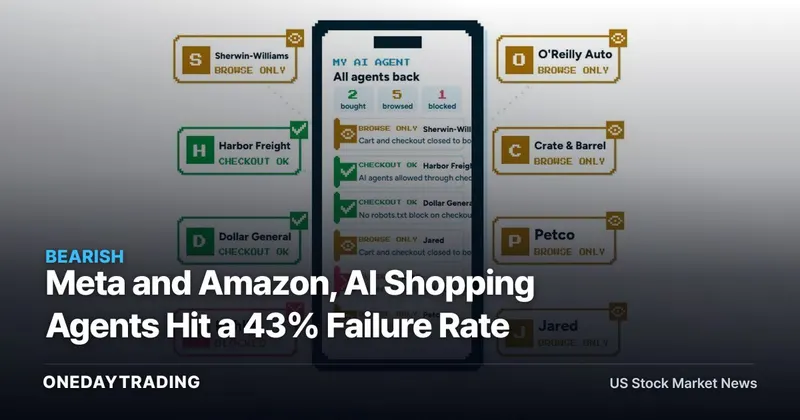
Meta, OpenAI, Google and Instinct are pushing shopping agents into retail, but CNBC reports that restrictions and technical failures are keeping the technology far from dependable commerce. The investor read-through is bearish for near-term adoption across retail platforms, internet companies and payments: an agent cannot generate durable transaction volume if it cannot enter a store, complete checkout or establish who is responsible when an order fails.
Agentic commerce means software acting for a user to find products and execute purchases. Its promise is a shorter path from product discovery to payment; its current constraint is that every part of that path depends on retailer permission, reliable execution, verified consent and accepted liability.
A 43% Failure Rate Tests the Conversion Story
Earlier this month, a Visa study tested 22 models from 12 AI labs and found that shopping agents failed about 43% of test runs, according to CNBC. That result matters more than the promotional narrative because a shopping interface must convert intent into the correct completed order. A failure can interrupt checkout, while an incorrect purchase can introduce refunds, customer support demands and disputes over responsibility.
The experience of Maia Bittner, chief product officer at Imprint, shows the problem at the individual-order level. Last month, Meta’s Muse spent about 17 hours on a windshield-wiper request before AutoZone canceled the order because of an unspecified error. The evidence does not identify the source of that error, so it cannot establish whether the failure originated with the agent, the retailer or another part of the transaction.
Product selection presents a separate trust test. Last week, Muse suggested a Crazy Hobby Supply product marked 75% off; Bittner said, “I don’t think we’re there yet.” The supported conclusion is narrow but important: an agent’s usefulness depends on more than locating a product or displaying a discount. Users also need confidence in the recommendation and the merchant behind it.
Retail Access Splits the Agentic-Commerce Market
Walmart and Sephora have opened their sites to shopping agents, and Walmart announced a partnership with Meta. Amazon, eBay, United Airlines and Kohl’s instead restrict agent actions or block them. Coach and Gap permit browsing without checkout, while Target has sometimes blocked agents by accident, according to an audit by Billions Network.
This fragmented access creates an incomplete shopping universe. Emily Pfeiffer, a principal analyst at Forrester, described the market as “a very mixed bag.” For consumers, missing retailers can reduce choice; for agent providers, restricted checkout can separate product discovery from the transaction that demonstrates commercial value.
Amazon represents the sharpest access conflict. It blocked Meta’s Muse from shopping on its platform in September and sued Perplexity last November, alleging that the company concealed its Comet agent. Andy Jassy has said Amazon expects to partner with third-party agents over time, subject to an appropriate value exchange, leaving partnership terms—not technological availability alone—as a potential gate to broader access.
Security and Liability Sit Inside the Payment Flow
Retailers and financial institutions need to distinguish authorized agents from fraudulent bots. Skyfire CEO Amir Sarhangi framed the requirement directly: “We want to know who the end user is, and we want to know it’s a real human.” For investors, identity and consent are therefore core transaction infrastructure, not peripheral features.
Responses across payments remain uneven. Stripe’s Link digital wallet is integrated with Muse. American Express has offered protection for eligible customers from charges tied to AI-agent error, while JPMorgan Chase blocked external agents from acting for customers last month because of security concerns.
Best Buy places responsibility on the user in its terms, stating, “Best Buy is not responsible for conduct, errors, actions, or inaction by any Digital Agent.” There is no broad consensus on who bears responsibility when an agent transaction fails. Until that question is resolved, shoppers, retailers, agent developers and payment providers face different incentives to approve or reject automated purchases.
Transaction Data Remain Smaller Than the Forecast
Earlier this month, Bain & Co. found that agentic purchases represented 0.4% of global e-commerce transactions and 0.2% of global e-commerce value. The gap between transaction share and value share indicates that the disclosed footprint remains limited; it does not establish how quickly adoption will change.
Usage outside conventional retail also remains modest in the available disclosures. Uber said agents booked 504 rides and Uber Eats orders during its busiest week in October. DoorDash has recorded several hundred agent orders so far, while Airbnb reported little agent volume.
The upside case rests on user engagement and order values. In October, Mark Zuckerberg said a quarter of Muse’s 10 million users were shopping online through an AI agent, with spending of 200 dollars per order. Earlier this month, Instinct CEO Noah Shinn said its users exceeded 500 dollars per person in average transaction value.
McKinsey and ICSC forecast that U.S. agentic-commerce revenue could reach as much as 1 trillion dollars by 2030. That is a forecast, not a realized outcome. The investable question is whether expanding user interest can overcome retailer exclusions, execution failures and security controls quickly enough to turn engagement into completed transactions.
Retail, Platforms and Payments: Bull and Bear Cases
- Bull case: Walmart’s partnership with Meta and the access granted by Sephora show that retailer participation is possible. Higher completed-order volume could strengthen the case for agents as a new interface between consumer intent and checkout.
- Bear case: Amazon, eBay, United Airlines and Kohl’s can restrict the inventory and services agents reach. If large merchants retain those barriers, an agent may offer convenience without comprehensive selection.
- Execution case: A lower failure rate in future tests would support the conversion thesis. Continued failures near the level reported by Visa would keep human intervention and customer-service risk inside the shopping process.
- Payments case: Wider agreement on identity, consent and error protection could reduce merchant resistance. JPMorgan Chase’s block and Best Buy’s liability language show why adoption cannot be assessed through user demand alone.
The Next Checkpoints for Agentic-Commerce Investors
- Track whether future Visa testing improves on the 43% failure rate across shopping tasks and whether agents more consistently satisfy user requirements.
- Watch for policy changes from Amazon and other retailers that currently restrict agents, especially any partnership terms governing access and value exchange.
- Compare subsequent disclosures from Meta, Instinct, Uber, DoorDash and Airbnb for completed transactions, order values and evidence that usage extends beyond experimentation.
- Monitor whether retailers, agent developers and payment companies converge on standards for human consent, bot identification, refunds and liability.
The decisive signal will not be another shopping-agent launch. It will be evidence that agents can reach major retailers, complete the intended order and assign responsibility when something breaks. Noah Shinn said businesses “just need time”; investors still need the operating metrics that show what that time produces.
📊 Analysis
Signal Bearish
Why Retailer restrictions, failed shopping tasks, security controls and unresolved liability constrain near-term adoption despite substantial growth forecasts.
This article was independently written by OneDayTrading from public reporting. Read the original (CNBC)