Costco and the Emergency-Spending Signal
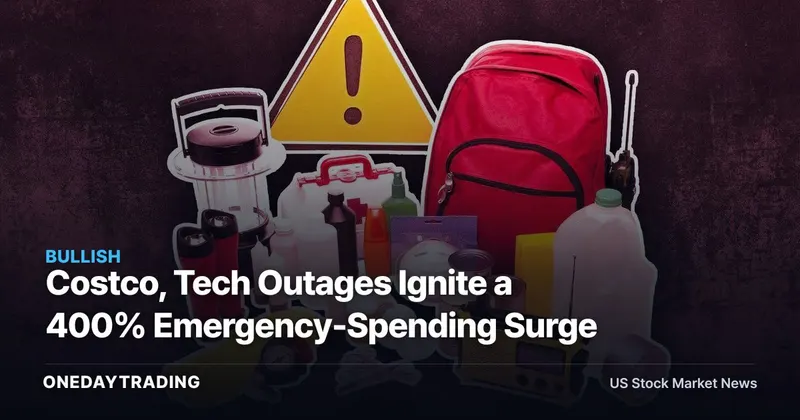
Costco and emergency-product sellers gained a sudden demand signal between Nov. 12 and Nov. 17, when major U.S. technology outages coincided with a sharp increase in preparedness spending. Consumer Edge card data analyzed exclusively for CNBC showed spending at emergency-product brands rose about 400% from the same period a year earlier. For investors, the central question is whether this was a brief fear-driven purchase cycle or the start of a more durable change in household inventory behavior.
Emergency-preparedness spending means purchases intended to help households or businesses operate through disruptions, including survival kits, stored water and shelf-stable food. The investable read-through starts with retail demand, extends to the ability of suppliers to replenish constrained products, and reaches cybersecurity only if companies respond by committing more spending. The outages established the catalyst; they did not establish how long any of those channels will last.
What the Costco Read-Through Actually Shows
Mizuho told clients that concern about the outages drove emergency-supply purchases at Costco, where the relevant November sales-growth measure was above 10%, according to CNBC. That is the clearest listed-company exposure in the evidence: shoppers were buying preparedness products through an established retailer rather than merely expressing concern online.
The composition of demand matters as much as its pace. RBC said the effect was concentrated in a small group of products, including shelf-stable proteins, water-purification goods and dry-pantry food. Concentration can generate a visible lift in selected categories without proving that the same strength extends across Costco’s wider merchandise base.
For the retailer, the next useful checkpoint is category persistence. Investors should look for evidence that emergency-related buying continues after the immediate outage period, spreads beyond the narrow basket identified by RBC, or appears in Costco’s subsequent sales commentary. Without those checks, the above-10% November measure is a strong demand observation rather than proof of a lasting earnings change.
Consumer Edge and Ready America Quantify the Rush
Consumer Edge measured an about 400% increase in spending at emergency-product brands from Nov. 12 through Nov. 17 compared with the same period a year earlier. Ready America separately reported a roughly five-fold increase in e-commerce sales in recent days. The two observations point in the same direction through different lenses: card spending across specialized brands and order activity at an individual preparedness supplier.
Ready America asked suppliers to increase production, turning the demand spike into a capacity test. A shortage of water-purification tablets forced the company to direct shoppers toward alternatives such as prepackaged water pouches. That substitution is commercially important because strong demand creates revenue only when inventory is available or shoppers accept another product.
Trevyn Reese described a large increase in people seeking to prepare because of what they were seeing in the news. The next operational checkpoint is therefore supply availability: whether production scales, water-purification tablets return to stock and alternative products continue converting demand into sales. Exact Ready America sales totals are not available, so the roughly five-fold rate cannot be translated into a dollar contribution.
Preparedness Demand Extends Beyond Pantry Goods
NSSF said gun sales increased about 8% in October from the same month a year earlier. That period predates the Nov. 12-to-Nov. 17 outage cluster, which prevents the October comparison from being treated as a direct measurement of the outages’ effect. It does show that preparedness-related purchasing was not confined to the later card-data window.
American Hartford Gold reported increased customer inquiries during the week. Max Baecker said some interest followed concern about dependence on digital financial networks after a JPMorgan Chase transaction disruption. Inquiries are not confirmed sales, so this evidence supports a change in customer attention rather than a quantified revenue benefit.
Richard McWhorter, a private wealth advisor at SRM, said clients were buying bulk goods and generators and asking how to prepare for disruption to the financial system. His observation adds a household-finance dimension to the retail data, while remaining anecdotal. It cannot establish how many consumers participated or how broadly the behavior spread.
Global X Cybersecurity ETF (BUG) Reflects a Separate Bet
The Global X Cybersecurity ETF (BUG) rose around 3% over the past two weeks, according to CNBC. Bilal Hafeez said investors could press companies to accelerate cybersecurity spending because of concern about rogue AI agents. That is a conditional pathway from anxiety to corporate budgets, not evidence that new cybersecurity contracts have already been signed.
Jay Clayton told CNBC that the outages were neither a cyberattack nor a coordinated foreign effort. His statement weakens the case for interpreting the incidents themselves as proof of hostile cyber activity. It does not eliminate the possibility that corporate buyers review resilience spending in response to the operational disruption and public reaction.
The distinction is crucial for BUG. The fund’s around-3% advance captures improved market interest in cybersecurity exposure, while the fundamental checkpoint is actual customer spending. Investors need evidence from subsequent company orders, guidance or reported demand before treating the price move as confirmation of durable industry growth.
Search Activity Shows Attention, Not Revenue
U.S. Google search volume for “prepping” more than doubled over the past month from the same period a year earlier. YouTube queries for “survivalism” increased more than 5,000% over the same comparison period. Those figures demonstrate an exceptional rise in information-seeking, although they do not reveal how many searches became purchases.
Sabrina Cepeda summarized the motivation by saying, “We rely so much on technology.” Her concern helps explain why outages can prompt households to value supplies that function outside digital or electrical systems. Search traffic becomes financially relevant only when it converts into sustained transactions, repeat purchases or larger corporate security budgets.
Mark Warner said people were alarmed by the outages, while JD Vance attended meetings concerning them. Those responses establish that the episode attracted public and government attention. They do not identify the specific causes of the individual outages or provide a complete list of affected technology providers.
Investor Risk Check: Duration, Breadth and Attribution
- Duration: The Consumer Edge comparison covers Nov. 12 through Nov. 17, and future demand for preparedness products is unknown. A sharp burst can fade after the catalyst passes.
- Breadth: RBC identified a narrow basket of benefited products. Strength in stored food, water treatment and related goods does not establish an equivalent effect across all retail categories.
- Supply conversion: Ready America’s tablet shortage shows that inventory can limit realized sales even when shopper interest is strong. Alternative products partly address that constraint only if customers accept them.
- Cybersecurity attribution: Clayton rejected a cyberattack or coordinated foreign action as the explanation for the recent outages. BUG’s market move should therefore be separated from any unsupported claim about the cause of the disruptions.
Costco’s Upside Meets an Evidence Gap
The bullish case is strongest where transactions are already visible: Consumer Edge recorded about 400% growth at emergency-product brands, Ready America experienced a roughly five-fold e-commerce increase, and Mizuho connected consumer concern with purchases at Costco. The risk is that concentrated, fear-driven buying exhausts itself once households finish stocking up.
The next evidence should come from three places: Costco’s category and sales commentary, Ready America’s inventory and supplier response, and confirmed cybersecurity orders rather than ETF performance alone. Persistence across those checkpoints would support a broader preparedness economy. Weak repeat demand, unresolved supply shortages or a lack of corporate security commitments would leave this as an intense but temporary spending episode.
📊 Analysis
Signal Bullish
Why The surge in emergency-product spending supports near-term demand for Costco and preparedness suppliers, although its duration and broader financial impact remain unknown.
This article was independently written by OneDayTrading from public reporting. Read the original (CNBC)