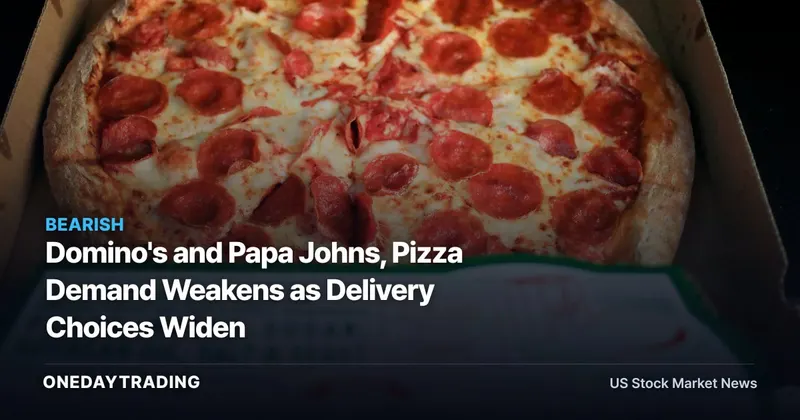
Domino's Leads a Pizza Market Losing Momentum
Domino's, Papa Johns and Pizza Hut entered 2026 with sharply different operating momentum after U.S. pizza demand weakened in 2025. CNBC reported that Domino's increased U.S. annual same-store sales by 3% in 2025, while Papa Johns recorded a 2.5% decline in North American same-store sales and Pizza Hut posted a 5% decline in U.S. same-store sales.
The investor read-through is not simply that consumers have stopped eating pizza. It is that restrained spending, broader delivery competition, changing dining preferences and increased GLP-1 use are forcing the largest chains to compete harder for each order. Domino's showed that growth remained possible, but the gap between its result and those of Papa Johns and Pizza Hut makes execution and product relevance more important than category exposure alone.
The U.S. Pizza Category Contracted in 2025
The pressure extends beyond one brand. Technomic data cited by CNBC showed that sales at U.S. pizza restaurants declined 0.3% in 2025, with independent pizzerias down 0.4% and chains down 0.3%. Because chains account for about two-thirds of domestic pizza category sales, their performance carries substantial weight in the overall market.
The restaurant base has also narrowed. U.S. pizza locations peaked at 83,035 in August 2019, and Datassential data showed that more than 9,600 pizzerias had closed as of July 2026. That contraction establishes the scale of the category pressure, although the supplied evidence does not provide future restaurant-closure outcomes.
This pizza-chain slowdown is a demand problem shaped by several overlapping pressures rather than a single shock. The available evidence does not quantify how much weaker consumer spending, delivery competition, nutritional preferences or GLP-1 use individually contributed to the sales declines, so investors cannot responsibly assign the entire shortfall to one factor.
Delivery Platforms Changed the Competitive Set
Third-party delivery platforms widened the range of meals available to customers ordering at home. Domino's and Papa Johns now compete with McDonald's and Chick-fil-A for orders placed through DoorDash and Uber Eats, turning a delivery occasion that once favored pizza into a broader contest among fast-food choices.
That dynamic matters because the competitive pressure occurs at the point of purchase. A customer opening a delivery platform can compare pizza with other restaurant options, making menu appeal and the customer experience more consequential when discretionary spending is restrained. The evidence supports stronger competition for orders, though it does not measure how many transactions moved from any pizza chain to a specific rival.
Price-sensitive consumers also have alternatives outside restaurant delivery. The average large cheese pizza cost almost $17 in 2026, according to the PMQ Pizza Pizza Power Report. NielsenIQ reported that retail sales of single- and multi-serve frozen pizza increased 2.9% in the 52 weeks ended Nov. 7 compared with the same period in 2022.
David Portalatin of Circana framed the spending mechanism directly: when consumers seek the least expensive eating occasion, food already stored in the pantry, refrigerator or freezer wins. That observation helps explain why frozen pizza can remain relevant even as restaurant pizza sales weaken, without establishing the exact amount of demand transferred between the two channels.
GLP-1 Use Adds a Distinct Demand Risk
GLP-1 use is another pressure, not a complete explanation for the category decline. A 2026 PwC survey found that spending at pizza quick-service restaurants fell 22.2% per GLP-1 household after six to eight months of medication use. The survey result identifies a material behavioral difference within those households, although the number of households surveyed is not supplied.
The large chains have shown limited evidence of adapting their products to changing nutritional preferences. Among the four biggest chains, Papa Johns was the only one to test a pizza crust with added protein, and that test covered one Atlanta restaurant for a single day. Its narrow scope provides no basis for concluding that a broader menu response has been validated.
The category is not facing disappearance. David Portalatin said total pizza servings declined only about 1% in 2026 and emphasized that American consumers still love pizza. The tension for investors is therefore between enduring product appeal and a restaurant format facing more competition for spending occasions.
Stock Performance Reflects the Execution Gap
- Domino's: Its 3% increase in U.S. annual same-store sales in 2025 made it the only one of the three publicly traded pizza chains that year to report growth. Even so, Domino's shares gained only about 2% from March 2020, compared with an increase of about 150% for the S&P 500 over the same period.
- Papa Johns: A 2.5% decline in North American same-store sales in 2025 accompanied a loss of about two-thirds of the stock's value since March 2020. Its November turnaround plan focuses on food consistency and restaurant operations, making subsequent same-store sales the clearest test of whether that plan changes customer behavior.
- Pizza Hut and Yum Brands: Pizza Hut's U.S. same-store sales fell 5% in 2025. Yum Brands sold the chain to LongRange Capital and Yum China in 2026 after about two decades of stagnating sales; the transaction value and closing date are not supplied. Wells Fargo analyst Zachary Fadem wrote in September that Pizza Hut had detracted from Yum Brands.
- Casey's General Stores: Bank of America Securities analyst Sara Senatore wrote in June that geographic overlap suggests Casey's General Stores is taking share from Pizza Hut. That assessment identifies a competitive relationship, not a quantified transfer of sales.
Product Responses Face Their First Tests
The chains are responding through different levers. Domino's launched the Domino in August, a customizable Detroit-style personal pizza intended to attract solo diners. Papa Johns announced its turnaround plan in November, while Pizza Hut is running a holiday-themed meal deal.
- Domino's U.S. same-store sales: Check whether the chain can preserve growth after its 3% increase in 2025 and whether the Domino supports demand from solo diners.
- Papa Johns North American same-store sales: Track whether food consistency and restaurant operations improve after the November plan, following the 2.5% decline in 2025.
- Pizza Hut U.S. same-store sales: Measure whether the holiday-themed meal deal changes the trajectory after the 5% decline in 2025.
- Category demand: Compare future restaurant sales and total servings with the 2025 sales contraction and the about 1% decline in 2026 servings, while monitoring competition from frozen pizza and delivery platforms.
Pizza's Bull Case Is Loyalty; Its Risk Is Fewer Restaurant Orders
The constructive case rests on the category's persistent appeal and Domino's demonstrated ability to grow within a shrinking market. Total servings fell only about 1% in 2026, and each major chain is using a product, operational or value response to address demand.
The bearish case is more immediate in the reported figures. Restaurant and chain sales declined in 2025, Papa Johns and Pizza Hut posted negative same-store sales, delivery platforms broadened the competitive field, and PwC identified lower pizza quick-service spending among GLP-1 households. The next investable signal is not another slogan about pizza's popularity; it is whether same-store sales show that product changes and operating plans can convert that popularity into more restaurant spending.
📊 Analysis
Signal Bearish
Why Category sales contracted as restrained spending, broader delivery competition, changing preferences and GLP-1 use pressured demand, despite Domino's relative strength.
Tickers$DPZ$PZZA$YUM$CASY
This article was independently written by OneDayTrading from public reporting. Read the original (CNBC)