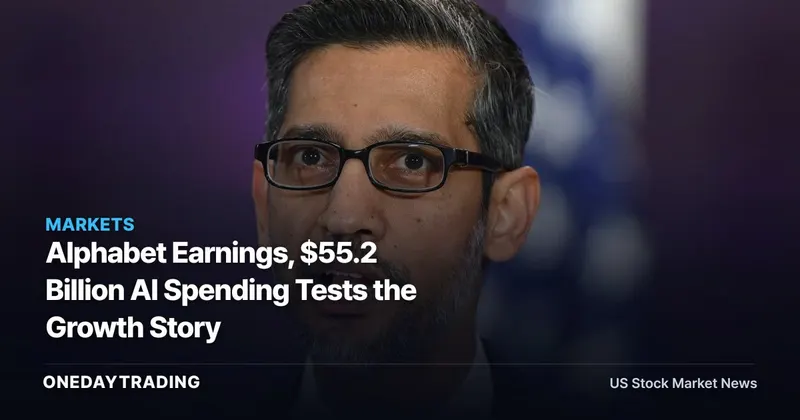
Alphabet Earnings Put Growth Against Cash Consumption
Alphabet reports third-quarter results after the bell on Wednesday, and the central investor test is whether accelerating revenue can justify a much heavier AI investment cycle. CNBC reports that the LSEG consensus expects Alphabet revenue to rise 25% year over year in the third quarter, the fastest growth rate for any period since 2021. The result will matter across Google Search, cloud computing and AI infrastructure because each business sits on a different side of the same spending decision.
- Growth: LSEG’s consensus calls for Alphabet revenue to increase 25% year over year in the third quarter.
- Investment: FactSet expects Alphabet’s third-quarter capital expenditure to rise 130% year over year to $55.2 billion.
- Cash flow: Analysts expect Alphabet to post negative free cash flow of $2.27 billion for the third quarter, with the gap widening during each of the next 4 quarters.
The Alphabet Thesis Now Has Two Ledgers
Alphabet’s earnings debate can no longer be reduced to revenue growth alone. Investors must read the operating ledger, where Google cloud and AI offerings are expected to expand rapidly, beside the cash ledger, where capital expenditure is climbing and free cash flow has turned negative. A strong top line would support the demand side of the AI strategy; it would not by itself establish that the spending program is producing an attractive financial return.
Capital expenditure is the money committed to long-lived infrastructure, and in this case it is the clearest numerical expression of Alphabet’s AI buildout. The company raised its full-year forecast in July to between $195 billion and $205 billion, above prior guidance of as much as $190 billion. That increase makes the quality of growth as important as its pace: the report must show how revenue expansion sits alongside the larger capital burden.
The share performance adds pressure without explaining the cause. Alphabet shares declined in 5 of the past 6 sessions through Tuesday and were down about 7% in October, according to CNBC. Those moves establish a skeptical setup, while the supplied evidence does not identify why the stock fell or what expectations the market has already priced.
Google Cloud Is the Main Revenue Counterweight
Google’s cloud division, which houses its AI offerings, is projected to grow 90% in the third quarter to $28.7 billion. That is the most direct revenue evidence offered for the investment case: Alphabet is spending heavily while the business containing its AI products is expected to expand at a rapid rate. The key analytical distinction is that cloud growth measures commercial expansion, whereas capital expenditure and free cash flow reveal the resources required to support it.
Google is adding Gemini models and services to its enterprise offerings and increasing sales of its custom tensor processing units. Those actions connect software distribution with infrastructure sales inside the cloud strategy. Google’s tensor processing units compete with Nvidia’s graphics processing units, so the earnings discussion can clarify whether Alphabet presents its custom silicon primarily as internal infrastructure, an enterprise offering, or both; the fact sheet does not supply that breakdown.
Amazon Web Services and Microsoft Azure are described as larger rivals to Google. Microsoft reports earnings on Wednesday, followed by Amazon on Thursday, creating adjacent checkpoints for the cloud market. Comparisons should remain disciplined because the supplied evidence provides Alphabet expectations, not equivalent growth, spending or cash-flow figures for Microsoft or Amazon.
The Spending Curve Is Steeper Than the Revenue Curve
FactSet analysts expect Alphabet’s third-quarter capital expenditure to increase 130% year over year to $55.2 billion. That expected rate is materially above the 25% year-over-year revenue growth in the LSEG consensus, making investment intensity the defining tension in the quarter. The comparison does not prove that spending is excessive; it shows why revenue growth alone cannot settle the debate.
The longer-range estimates keep that tension alive. Annual capital expenditure is expected to exceed $200 billion before surpassing $300 billion in 2027. Alphabet also reported negative free cash flow for the first time, and analysts project negative free cash flow of $2.27 billion in the third quarter, followed by a wider gap in each of the next 4 quarters.
For investors, the mechanism is straightforward: cloud expansion can strengthen the commercial case for AI infrastructure, while persistent negative free cash flow can keep attention fixed on the cost of that expansion. The earnings release therefore needs to be read as a bridge between demand and investment, not as separate headlines about revenue and spending.
Search Competition Complicates the AI Payoff
The investment case has another fault line outside cloud. Google’s core business faces pressure from OpenAI and Anthropic as new agents increase competition. This means Alphabet is funding AI expansion while AI-based alternatives are also challenging an established business, leaving execution dependent on both commercializing new offerings and adapting the core platform.
Citizens analysts, who recommend buying the stock, wrote that “Google continues to be well-positioned across AI.” They also warned: “That said, execution risk exists, and we are incrementally cautious on Search as we believe competition is increasing with agents and requires another pivot.” The paired statements capture the balance better than a simple positive or negative label: Alphabet has AI assets across cloud, Gemini and custom chips, alongside a competitive transition in Search.
No supplied metric quantifies the effect of OpenAI, Anthropic or agents on Google’s core business. That prevents a numerical judgment about the size of the pressure. Management’s framing of Search competition is therefore a qualitative checkpoint, distinct from the measurable tests in revenue, cloud growth, capital expenditure and free cash flow.
Who Gains and Where the Pressure Falls
- Alphabet: Expected third-quarter revenue growth of 25% and projected Google cloud growth of 90% support the expansion case. Capital expenditure of $55.2 billion and negative free cash flow of $2.27 billion create the opposing cash-return test.
- Google cloud: The division is projected to reach $28.7 billion in the third quarter and contains Google’s AI offerings. Its growth is the clearest operating counterweight to the spending increase.
- Amazon Web Services and Microsoft Azure: Both are larger cloud rivals to Google. Microsoft’s Wednesday report and Amazon’s Thursday report provide nearby sector evidence, although no comparable figures are supplied here.
- Nvidia: Google’s custom tensor processing units compete with Nvidia’s graphics processing units. Increased TPU sales establish competition, not a quantified effect on Nvidia.
- OpenAI and Anthropic: Their pressure on Google’s core business makes Search execution part of the Alphabet earnings debate, even though the financial impact is not provided.
What Could Change the Reading After the Bell
- Revenue conversion: Compare Alphabet’s actual third-quarter result with the LSEG expectation for 25% year-over-year growth. The actual result is not known before the release.
- Cloud durability: Test Google cloud’s reported performance against the projected 90% growth and $28.7 billion in third-quarter revenue.
- Investment discipline: Compare reported capital expenditure with FactSet’s $55.2 billion third-quarter estimate and management’s full-year forecast of $195 billion to $205 billion.
- Cash consequences: Check free cash flow against the expected negative $2.27 billion and listen for any discussion of the projected widening during the next 4 quarters.
- Competitive response: Listen for management’s treatment of Gemini, tensor processing unit sales and pressure on the core business from OpenAI, Anthropic and agents.
The 4:30 p.m. ET Call Must Connect the Metrics
Alphabet executives are scheduled to speak with analysts at 4:30 p.m. ET on Wednesday. The strongest case would connect cloud expansion and enterprise AI adoption to the scale of the infrastructure commitment, while addressing how Google plans to navigate greater competition in Search. The risk case is not merely high spending; it is a widening separation between spending, free cash flow and evidence of durable commercial returns.
The quarter begins with credible growth expectations and an unusually demanding capital profile. Alphabet can support the AI thesis by showing that the projected strength in Google cloud is translating the buildout into business volume. Until actual results arrive, the balanced reading is neutral: the revenue opportunity is visible, the cash cost is measurable, and the return on that investment remains the decisive unresolved variable.
Market data check: Alphabet Inc.
Alphabet Inc. last traded near $325.97 (+1.68%). Our composite signal — blending price momentum and news flow — reads 🟡 neutral. Price momentum scores 63/100 (firm).
Data as of publication. Price via market feeds; for reference only, not investment advice.
📊 Analysis
Signal Neutral
Why Strong expected revenue and cloud growth are balanced by sharply higher capital expenditure, negative free cash flow and rising competition in Search.
This article was independently written by OneDayTrading from public reporting. Read the original (CNBC)