At a Glance
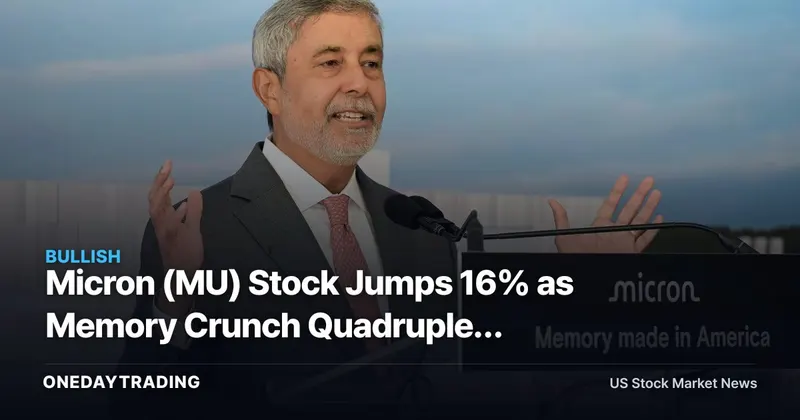
Micron (MU) shares jumped 16% after the memory maker reported that surging prices from a tightening supply crunch led to a quadrupling of revenue. The move extends a remarkable run in which MU has climbed roughly 700% over the past year, recasting a historically cyclical commodity-chip name as a core AI infrastructure play.
Why It Matters Now
The headline here is pricing, not just volume. Memory has long been the most boom-and-bust corner of semiconductors, where DRAM and NAND behave like commodities and margins collapse the moment supply outruns demand. A quadrupling of revenue driven by soaring prices signals the opposite condition — demand running well ahead of available bits — which is the single most powerful lever for a memory company because incremental price flows almost directly to gross margin once fabs are built and running.
The demand engine is AI. High-bandwidth memory (HBM) sits beside every advanced GPU, and each new accelerator generation stacks more memory content per system, pulling capacity away from conventional DRAM and tightening the entire market. That spillover is why a crunch in one product line lifts pricing across the board. The 700% one-year move tells you the market has already re-rated MU from a cyclical trough valuation toward an AI-leverage multiple — which raises the bar for what these results must sustain.
For investors, the read-through extends beyond Micron. Tight, expensive memory raises the bill of materials for AI servers, supports pricing power for rival memory makers, and pressures cloud and hardware buyers who must secure supply. The same dynamic that rewards suppliers can squeeze the margins of companies that consume large volumes of memory.
FAQ
- Why did revenue quadruple? A supply crunch pushed memory prices sharply higher, and because pricing drops largely to the bottom line in memory, revenue and profitability rose together.
- Is this a sustainable trend or a cyclical peak? AI-driven HBM demand is structural, but memory remains cyclical — the key question is whether new capacity eventually catches up and cools pricing.
- Why does the stock move so much? Memory earnings are highly operationally leveraged; small price changes swing margins dramatically, so estimates and sentiment reprice fast.
- Who pays for higher memory? AI server builders, cloud providers and device makers absorb the cost, which can pressure their hardware margins.
Related Stocks & Sectors
- Micron (MU) — Direct beneficiary; pricing power on DRAM, NAND and HBM drives the revenue and margin surge.
- Nvidia (NVDA) — HBM is a critical input for its GPUs; tight memory both validates AI demand and adds cost to its platforms.
- Samsung and SK Hynix (memory peers) — A crunch lifts industry-wide pricing, benefiting the broader DRAM and HBM supply base.
- Cloud and server hardware — Hyperscalers and OEMs face higher memory bills, a potential margin headwind on AI buildouts.
- Semiconductor equipment — Sustained tightness incentivizes new fab and capacity investment over time.
What to Watch
- Next-quarter guidance on DRAM and HBM pricing and bit shipments — the clearest signal on whether the crunch persists.
- Gross margin trajectory; the speed of expansion shows how much pricing is reaching the bottom line.
- HBM capacity commitments and qualification with major GPU customers.
- Any signs of new industry supply coming online, which historically marks the turn in memory cycles.
Overall Outlook
The bull case is straightforward: AI is converting memory from a commodity into a constrained strategic input, and Micron has the pricing leverage to compound that into outsized earnings. The risk is symmetry — the same operating leverage that magnifies upside magnifies the downside if capacity catches demand or AI order pace cools. After a 700% advance, much optimism is already priced, so the durability of HBM demand and the timing of new supply, not the latest beat, will decide the next leg.
Market data check: MU
MU last traded near $1,201.26 (+14.21%). Our composite signal — blending price momentum and news flow — reads 🟡 neutral. Price momentum scores 95/100 (firm).
Data as of publication. Price via market feeds; for reference only, not investment advice.
📊 Analysis
Signal Bullish
Why A memory price crunch quadrupled revenue and drove a 16% stock jump, with structural AI-driven HBM demand supporting Micron's pricing power.
This article was independently written by OneDayTrading from public reporting. Read the original (CNBC)