At a Glance
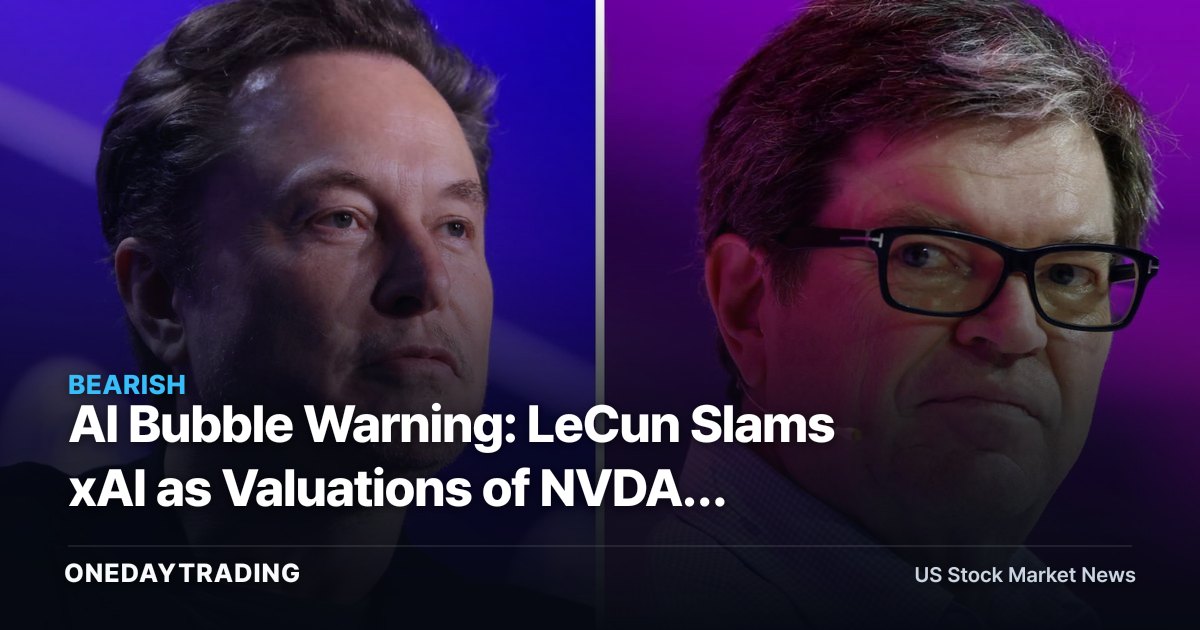
Yann LeCun, often called a godfather of AI, publicly dismissed Elon Musk's xAI as a failure and warned that AI labs are inflating a bubble that could burst. The remarks reopen his long-running feud with Musk and, more importantly for investors, question the lofty valuations attached to the largest AI-exposed names.
Why It Matters Now
When a researcher of LeCun's stature flags a bubble, the signal is less about any single startup and more about how capital is being priced across the entire AI complex. The market has rewarded companies that sit closest to model training and deployment with premium multiples on the assumption that compute demand keeps compounding. A credible insider arguing those expectations are overshooting introduces narrative risk precisely where positioning is most crowded.
The channel runs through sentiment first, fundamentals second. Names like Nvidia have re-rated on the belief that frontier labs will keep buying accelerators at scale. If investors start to doubt that the labs themselves can convert spending into durable economics, the order-book visibility that underpins those multiples becomes harder to defend. LeCun's position at Meta also sharpens the irony, since Meta is among the heaviest spenders on AI infrastructure and is itself judged by whether that capital earns a return.
The counterpoint is that bubble calls are not the same as demand collapse. Cloud capex guidance from hyperscalers, not a researcher's critique, still drives the hardware order flow. A war of words between rival camps does not by itself change shipment schedules or enterprise adoption curves.
FAQ
- Who is making the claim? Yann LeCun, a leading AI scientist, who called xAI a failure and warned of a possible bubble explosion across AI labs.
- Is xAI publicly traded? No. xAI is private, so the read-through for public investors flows to listed AI infrastructure and platform stocks rather than to Musk's venture directly.
- Does this change AI fundamentals? Not mechanically. It pressures sentiment and valuation assumptions; actual demand still depends on hyperscaler spending and enterprise uptake.
- Why does LeCun's employer matter? He works at Meta, a top AI spender, which makes his skepticism notable but also colored by competitive rivalry.
Related Stocks & Sectors
- NVDA — Most exposed to any reset in lab spending expectations, since its premium rests on sustained accelerator demand from AI builders.
- META — LeCun's own employer and a heavy AI capex spender; the bubble debate directly questions whether its investment pays off.
- MSFT, GOOGL — Hyperscalers whose multiples embed AI monetization; valuation skepticism weighs on the cloud-plus-AI thesis.
- AMD — A secondary accelerator play that moves with the same demand narrative as Nvidia.
- Semiconductors broadly — The sector trades as a single AI beta, so headline risk spreads across suppliers and equipment makers.
What to Watch
- Next hyperscaler earnings and AI capex guidance from Microsoft, Alphabet and Meta as the real demand signal.
- Nvidia's forward data-center revenue commentary and any change in customer concentration disclosure.
- Whether other prominent researchers or fund managers echo the bubble framing, which would amplify the sentiment shift.
- AI-name valuation multiples versus actual free-cash-flow conversion, the metric that separates hype from durable returns.
Overall Outlook
The bull case is intact on hard demand: hyperscaler budgets remain large and enterprise AI deployment is early, which supports continued accelerator orders regardless of rhetoric. The risk is that valuations have priced a near-flawless adoption path, leaving crowded AI leaders vulnerable to any crack in the demand story or a broader de-rating. A high-profile skeptic does not pop a bubble, but it raises the bar for the next round of results to justify the multiples already in the price.
Market data check: NVDA
NVDA last traded near $209.49 (+2.36%). Our composite signal — blending price momentum and news flow — reads 🟡 neutral. Price momentum scores 69/100 (firm).
Data as of publication. Price via market feeds; for reference only, not investment advice.
📊 Analysis
Signal Bearish
Why A prominent AI insider questioning lab economics and valuations pressures sentiment around richly priced AI-exposed stocks.
Tickers$NVDA$META$MSFT$GOOGL$AMD
This article was independently written by OneDayTrading from public reporting. Read the original (CNBC)