Key Takeaways
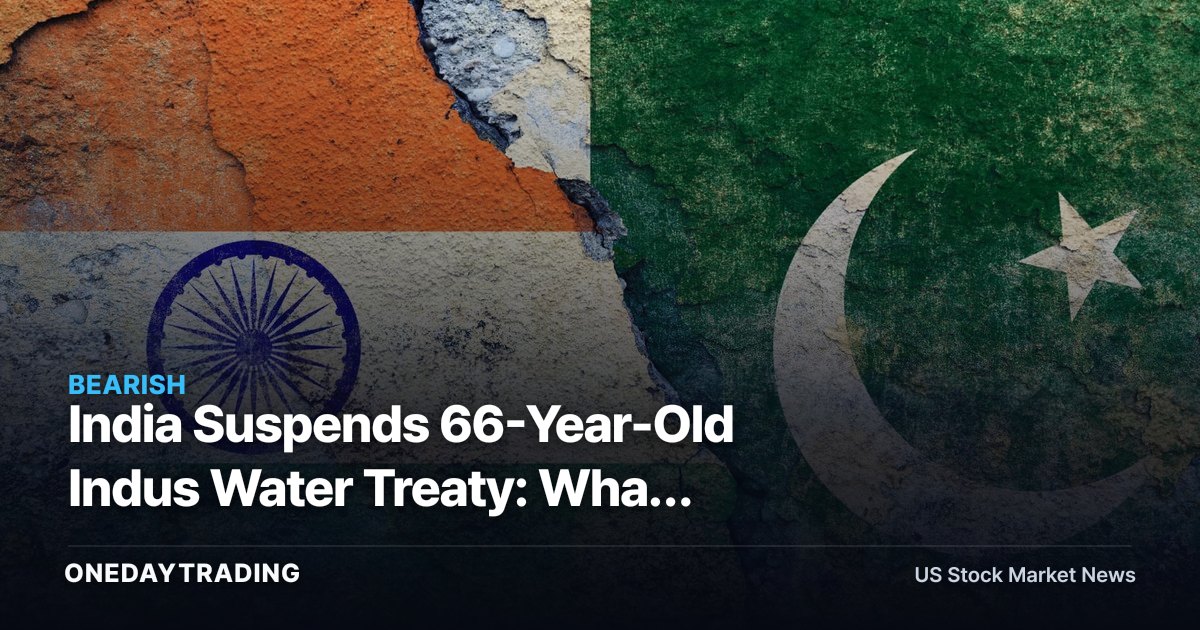
New Delhi suspending a 66-year-old water-sharing pact with Islamabad is less a one-day headline and more a structural shift in South Asian risk pricing. The cleanest market read is a wider geopolitical risk premium on emerging-market exposure, with the sharpest pressure point sitting on Pakistan, where river water from the Indus system underpins farm output and the textile supply chain.
What Happened
India and Pakistan are now in open dispute after New Delhi put the Indus Water Treaty into suspension. The agreement is 66 years old, dating to 1960, and has historically governed how the two neighbors split the Indus river system even through past conflicts. Treating it as expendable removes one of the few durable guardrails between two nuclear-armed states.
For markets, the signal matters more than the immediate hydrology. Water cannot be turned off like a tap overnight, so the near-term economic hit is gradual. But the willingness to weaponize a 1960 settlement tells global allocators that the tail risk of escalation just got fatter, and tail risk is what equity and currency risk premia are built to price.
Background and Context
The treaty was brokered to depoliticize a shared resource, and its endurance through prior crises is precisely why suspension is being read as an escalation rather than routine friction. Pakistan sits downstream and is structurally dependent on Indus flows for irrigation, making any threat to that water a direct input-cost and food-security question rather than an abstract diplomatic spat.
Market and Stock Impact
- PAK (Global X MSCI Pakistan ETF): Most directly exposed. Water uncertainty feeds straight into agriculture and the cotton-to-textile chain that drives Pakistan exports, while the headline raises the country risk discount applied to an already thin, illiquid market.
- INDA and EPI (India ETFs): India carries the escalation risk rather than the water risk. A larger, more diversified market can absorb geopolitical noise, but a sustained standoff lifts the risk premium on Indian equities and the rupee.
- EEM (broad EM ETF): South Asian instability is a marginal drag on broad emerging-market sentiment and can nudge flows toward lower-beta EM exposure.
- Textile and agricultural-input names: Any supply disruption to Pakistani cotton ripples into regional textile sourcing and pricing.
Investor Checkpoints
- Watch for formal Pakistani response or international mediation headlines, which would mark either de-escalation or a step up.
- Track the Indian rupee and Pakistani rupee for the cleanest real-time read on perceived escalation odds.
- Monitor PAK ETF volume and discount-to-NAV as a stress gauge given its thin liquidity.
- Follow cotton and regional textile pricing for the first tangible economic transmission.
Outlook
The bull case is mean reversion: prior India-Pakistan flare-ups have repeatedly faded without lasting damage to Indian equities, and India growth fundamentals are the dominant driver for INDA holders, not border noise. The risk case is that suspending a six-decade treaty changes the baseline, keeping a structural risk premium on the region and leaving Pakistan-linked assets exposed to both water stress and capital flight. The key variable is whether this becomes a negotiating lever that is later restored, or a permanent removal of a stabilizing mechanism.
📊 Analysis
Signal Bearish
Why Suspending a six-decade water treaty raises India-Pakistan escalation risk and threatens Pakistan agriculture and textiles, widening the geopolitical risk premium on regional EM assets.
This article was independently written by OneDayTrading from public reporting. Read the original (CNBC)