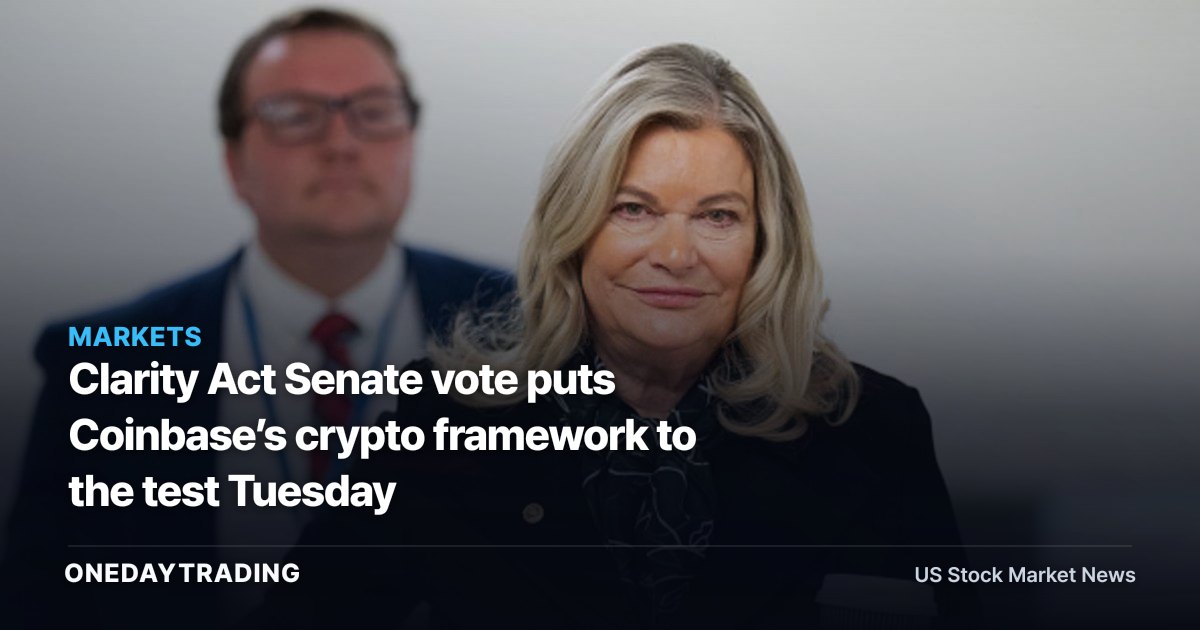
Clarity Act Vote Tests Whether Crypto Can Convert Lobbying Into Law
Coinbase and the wider crypto market face a binary policy checkpoint on Tuesday, when the U.S. Senate holds a preliminary vote on the Clarity Act. The bill could give digital-asset businesses a new regulatory structure, but the investor read-through is less about a guaranteed law than about whether competing banking and ethics demands can produce 60 Senate votes.
CNBC reported the scheduled vote and the unresolved negotiations. With full attendance, at least seven Democratic senators would need to support the preliminary measure, compared with two Democrats who voted to advance it in the Senate Banking Committee. That gap makes the vote a measure of coalition-building, not a reliable forecast of final passage.
What Tuesday’s Preliminary Vote Actually Decides
The Clarity Act is market-structure legislation intended to establish a new regulatory structure for cryptocurrencies and other digital assets. It cleared the Senate Banking Committee in May, then stalled while leaders sought the 60 votes required for Senate approval.
Senate Majority Leader John Thune scheduled Tuesday’s preliminary vote before the August recess. Republican leaders describe the latest text as an effort to meet Democratic demands, while a Democratic aide characterized the vote as a “free vote” to keep the bill moving. Under that framing, senators could advance debate and still seek amendments before any final-passage vote.
Sen. Bernie Moreno, one of the bill’s leaders, stressed that distinction on Sunday, saying, “This is not a vote on final passage.” His political connection to the issue is part of the debate: crypto interests financially backed his 2024 campaign to oust former Sen. Sherrod Brown.
Two Unresolved Mechanisms Drive the Coalition Fight
Banks are focused on stablecoin rewards that resemble interest or yield. Their concern is that such payments could pull deposits away from community banks, reducing the funding base for local lending. The updated bill directs the Treasury secretary to restrict stablecoin rewards if deposit flight from community banks occurs on a substantial scale, but banking groups say that safeguard does not resolve the underlying loophole.
The American Bankers Association led nearly 80 banking groups in a Thursday letter to Thune and Senate Minority Leader Chuck Schumer, urging stronger stablecoin provisions. The Independent Community Bankers of America has also opposed or sought changes to the language. Brooke Ybarra, the ABA’s senior vice president for innovation and strategy, said bankers are pressing senators to preserve deposits that support lending to small businesses, farmers and families.
Democratic objections center on ethics requirements for federal officials and Donald Trump’s family, whom Democrats say must not profit from crypto ventures. Republican leaders said the revised bill incorporates major elements of an agreement brokered by Sens. Thom Tillis and Ruben Gallego, including allowing state attorneys general to enforce ethics requirements on federal officials. Whether that language satisfies enough Democrats is unknown.
Coinbase’s Position Shows the Industry’s Policy Trade-Off
Coinbase has publicly supported the Clarity Act because a defined framework could reduce uncertainty over how digital assets are regulated. CEO Brian Armstrong told CNBC on Thursday that the legislation was ready for Senate support, while also arguing that regulatory clarity will arrive even if the vote fails. He cited the Securities and Exchange Commission and Commodity Futures Trading Commission as ready to publish rulemaking on the 15th or within the following day or two.
That alternative matters for investors. A failed preliminary vote would weaken the bill’s legislative momentum, yet Armstrong’s timetable implies that Coinbase’s operating environment could still change through agency action. The two routes are not equivalent: legislation would set a new statutory structure, while agency rulemaking would provide clarity through regulators’ existing authorities.
Coinbase also reached an agreement with financial-services provider Moov on Thursday to give community banks access to stablecoin capabilities. The arrangement appears designed to address fears that crypto payment infrastructure could bypass smaller banks. It does not, by itself, settle the deposit-retention dispute over rewards.
Market and Stock Impact: COIN Carries the Direct Read-Through
- Coinbase (COIN): Advancement of the Clarity Act could improve the visibility of Coinbase’s U.S. compliance and product roadmap by defining the regulatory structure for digital assets. The direct benefit depends on the bill surviving amendments and ultimately becoming law; neither outcome is confirmed.
- Digital-asset market structure: A Senate vote to advance would preserve a legislative path for exchanges and other crypto businesses, while failure would shift attention toward SEC and CFTC rulemaking. The source does not establish a final vote count or the specific agency rules.
- Community banks and banking groups: Stablecoin-reward restrictions are intended to address deposit-flight concerns, but the ABA and other groups argue that stronger language is needed. That conflict could influence the bill’s final design and the competitive terms for bank access to stablecoin services.
Investor Checkpoints Before the Next Decision
- Tuesday’s preliminary tally: Compare the result with the 60-vote requirement and the seven-Democrat threshold implied by full attendance. The vote’s passage or failure will show whether the coalition exists to continue debate, not whether the bill will become law.
- Amendment language after advancement: Check whether ethics enforcement, including state attorneys general authority, remains intact and whether further White House concessions are specified. The promised concessions after a successful preliminary vote are not yet known.
- Stablecoin safeguards: Read any changes to the Treasury secretary’s authority and the trigger tied to substantial community-bank deposit flight. The ABA’s nearly 80-group letter indicates that banking opposition remains active.
- Agency timing: Armstrong said SEC and CFTC rulemaking could bring clarity on the 15th or a day or two afterward. Investors should distinguish those publications from statutory changes under the Clarity Act.
Outlook: A Policy Catalyst With Two Failure Modes
The constructive case for Coinbase and crypto infrastructure is straightforward: a successful preliminary vote keeps a bipartisan market-structure bill alive, and the revised text attempts to bridge both ethics and community-bank concerns. Cynthia Lummis, one of the bill’s leaders, called it “a good bill” and said it was time for it to become law. The White House press office likewise said Congress must pass the measure to keep the United States ahead of foreign competitors and lead in innovation.
The countercase is equally concrete. Chris Van Hollen said, “We can’t let this pass,” arguing that the bill’s consumer-protection presentation masks unresolved problems. Banks continue to oppose or seek changes to the stablecoin provisions, and the source does not establish whether enough Democrats or Republicans will support the package. Even if Tuesday’s vote fails, the bill could technically return in amended form, but lawmakers’ available time before the end of this Congress is uncertain.
For investors, Tuesday is therefore a test of legislative durability rather than a clean approval signal. The key evidence will be the preliminary vote, the text of any subsequent amendments and the SEC and CFTC rulemaking Armstrong referenced. Until those checkpoints arrive, COIN’s policy upside remains conditional on which regulatory channel delivers first and how much of the banking and ethics conflict survives.
📊 Analysis
Signal Neutral
Why The bill could provide Coinbase and digital-asset markets with a clearer framework, but unresolved bank and ethics disputes leave the vote and final legislation uncertain.
This article was independently written by OneDayTrading from public reporting. Read the original (CNBC)