Key Takeaways
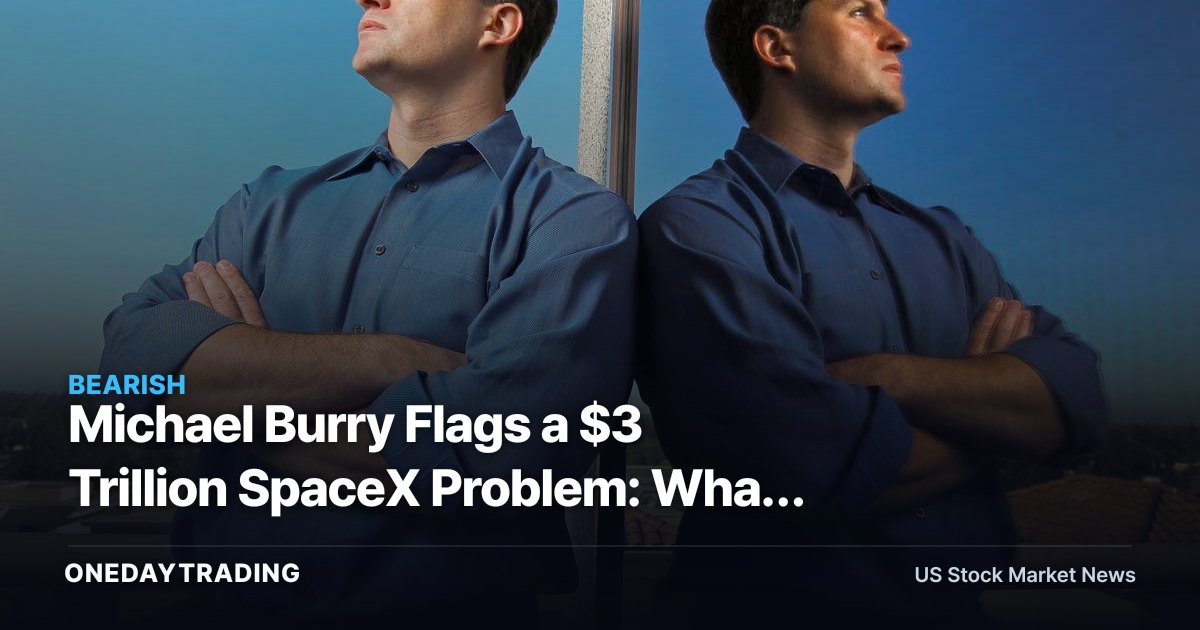
Michael Burry, the investor known for shorting the 2008 housing bubble, has publicly questioned what he frames as a $3 trillion problem connected to SpaceX. Because SpaceX is privately held, retail investors cannot trade it directly, so the cleanest listed proxy for the sentiment is Tesla (TSLA) and the broader Elon Musk ecosystem.
What Happened
Burry, who runs Scion Asset Management and built his reputation on contrarian bets against crowded consensus, has turned his skepticism toward the valuation narrative surrounding SpaceX. The headline figure he attaches to the concern is $3 trillion, a number that signals he sees a gap between private-market enthusiasm and the cash flows that would justify it.
The mechanism matters more than the soundbite. SpaceX commands premium private valuations on the strength of Starlink subscriptions and a dominant share of global launch cadence. When a respected short-seller publicly anchors a story to a multi-trillion-dollar tag, it pressures the entire halo of Musk-linked equities, where sentiment and the founder premium often move together.
Background and Context
Burry has a long history of bearishness on richly valued, narrative-driven assets, including past positions against Tesla. Private companies like SpaceX cannot be bought on an exchange, which means the market expresses optimism or doubt through adjacent listed names. That makes TSLA the de facto barometer, since investors treat Musk-company momentum as a single trade even when the underlying businesses are legally separate.
Market and Stock Impact
- Tesla (TSLA) carries the heaviest read-through: its multiple already embeds a founder and innovation premium, so any high-profile challenge to Musk-ecosystem valuations can compress sentiment and amplify volatility.
- Listed space names such as Rocket Lab (RKLB) trade partly on the same launch-economy theme; a cooling of private space enthusiasm can spill into their multiples even though their fundamentals differ.
- Satellite and connectivity peers compete with or depend on Starlink dynamics, so shifts in how the market prices SpaceX growth can re-rate the segment.
- Speculative growth and momentum baskets are exposed because a credible bubble call from Burry tends to weigh on the highest-multiple, story-driven corners first.
Investor Checkpoints
- Watch whether TSLA reacts to the headline or shrugs it off, a tell for how much Musk-ecosystem sentiment is priced in.
- Track Burrys disclosed positioning in regulatory filings rather than headlines, since his actual book is what carries weight.
- Monitor Starlink subscriber and launch-cadence updates as the real drivers behind any SpaceX valuation debate.
- Gauge multiple compression across high-beta growth names as a sign the skepticism is broadening.
Outlook
The bull case is that SpaceX dominance in launch and satellite broadband is genuine, and a single skeptic does not change end demand or backlog. The risk is that stretched valuations built on private-market optimism are fragile to confidence shocks, and a prominent contrarian voice can accelerate a repricing in the listed proxies. With no direct way to trade SpaceX, the practical exposure runs through TSLA and the space complex, where narrative and fundamentals are easy to confuse.
Market data check: TSLA
TSLA last traded near $395.12 (-1.34%). Our composite signal — blending price momentum and news flow — reads 🟡 neutral. Price momentum scores 39/100 (soft).
Data as of publication. Price via market feeds; for reference only, not investment advice.
📊 Analysis
Signal Bearish
Why A high-profile short-seller publicly questioning a $3 trillion valuation pressures sentiment across Musk-linked and high-multiple space stocks.
This article was independently written by OneDayTrading from public reporting. Read the original (Yahoo Finance)