Summary
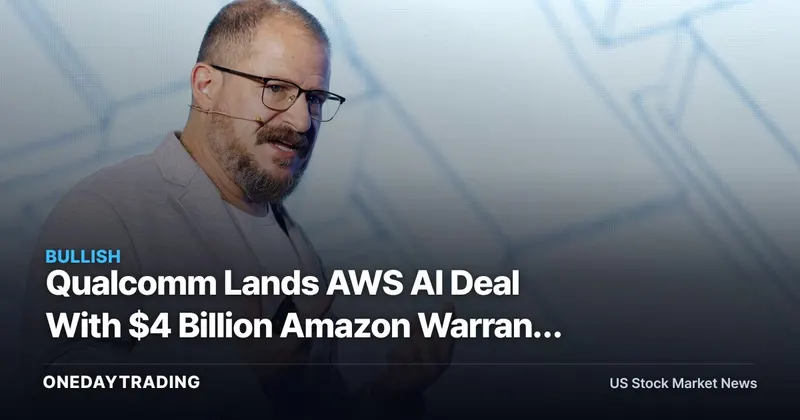
Qualcomm’s AWS AI infrastructure deal gives the chipmaker something more valuable than an ambitious market forecast: a second named hyperscaler partner for its data-center push. Qualcomm shares rose 4% on Tuesday after the announcement, signaling that investors viewed the Amazon relationship as additional validation of a strategy targeting $15 billion in data-center sales in fiscal 2029.
The commercial structure still demands discipline. Amazon received warrants covering 25 million Qualcomm shares at $161.26 each, but vesting occurs in tranches tied to specified commercial arrangements and purchases of up to $60 billion in Qualcomm server chips and other technology.
The Full Story
Qualcomm disclosed in a Securities and Exchange Commission filing that the warrants represent an exercise value of about $4 billion and expire on Sept. 3, 2036. The companies separately announced work across multiple generations of customized silicon for Amazon Web Services, concentrating on AI inference infrastructure.
AI inference is the process through which a trained model generates answers or performs tasks in production. Each additional query consumes computing resources, making processing cost, memory bandwidth and energy efficiency important as usage expands.
That workload fits Qualcomm’s engineering heritage. The company is best known for processors used in smartphones and other mobile devices, where performance must coexist with tight power and thermal limits. Translating that expertise into a data center could help AWS manage electricity and cooling demands, but only if Qualcomm also meets hyperscale requirements for computing performance, reliability, software support and system integration.
Structural Background
Qualcomm widened its data-center campaign in June when it unveiled the Dragonfly C1000 central processing unit. Meta plans to use the processor when production begins in 2028. Qualcomm said the CPU was built for agentic AI—systems designed to carry out multistep tasks—and emphasized computing performance without excessive power consumption.
The company’s road map extends beyond one CPU. Qualcomm has also identified an AI chip and technology intended to connect multiple chips, suggesting it wants to address a broader portion of the AI system. The AWS agreement’s multigeneration scope matters because data-center platforms require long development, qualification and deployment cycles; a single design win would provide less visibility than a product sequence adopted over time.
A CPU uses a relatively small number of powerful cores for sequential, general-purpose work, while a GPU distributes parallel calculations across thousands of narrower cores. Nvidia dominates the GPU market used for sophisticated model training and heavy AI workloads, but growing agentic activity can also increase the orchestration and general computing assigned to CPUs.
Bank of America estimates that the CPU market could expand from $27 billion in 2025 to $60 billion by 2030. That forecast means Qualcomm can pursue a growing pool rather than rely solely on taking existing business, although Intel, Advanced Micro Devices and Nvidia are already responding to the same demand.
Stock & Sector Ripple
- Qualcomm: AWS joins Meta as a named hyperscaler partner, strengthening the credibility of a business meant to diversify Qualcomm beyond mobile processors. The economic payoff will depend on how quickly development work produces qualified systems, shipments and revenue at sustainable margins.
- Amazon: Customized Qualcomm silicon may give AWS another way to optimize inference price-performance and energy consumption. The warrant structure links Amazon’s potential equity benefit to commercial progress, but the disclosed facts provide no deployment volume, pricing or expected cost savings.
- Meta: Its planned adoption of the Dragonfly C1000 in 2028 remains Qualcomm’s disclosed production reference for the new CPU. The AWS partnership reduces the strategic dependence on a single named hyperscaler relationship, though it does not change Meta’s disclosed production schedule.
- Nvidia: Qualcomm is entering an AI infrastructure market shaped by Nvidia’s GPU leadership, but the immediate overlap is partial. CPUs handle different tasks from GPUs; competition would become more direct if Qualcomm’s planned AI accelerator and chip-linking products win hyperscale deployments.
- AMD and Intel: Both are experiencing surging demand for data-center CPUs, according to the source. Qualcomm adds another potential supplier in a market that Bank of America expects to more than double, creating both an expanding opportunity and a new contest for future processor spending.
Bull vs Bear Scenarios
Bull case: AWS and Meta provide two large-scale proving grounds for Qualcomm’s power-efficient server architecture. Successful qualification across multiple chip generations could turn mobile-derived design expertise into a durable data-center franchise and support the company’s $15 billion fiscal 2029 sales target.
A broader product portfolio could reinforce that path. CPUs perform general-purpose tasks, the planned AI chip could address accelerated workloads, and chip-linking technology could help Qualcomm assemble larger systems. If these elements operate together, Qualcomm may compete for more infrastructure content than a standalone CPU would capture.
Bear case: The agreement discloses neither shipment commitments nor a schedule for the purchases associated with warrant vesting. It also provides no benchmarks, manufacturing yields, product margins or software-adoption data. The long period before the warrants expire in 2036 allows the relationship to mature, but leaves considerable uncertainty around the timing and scale of its financial contribution.
Competition raises the execution threshold. Nvidia already leads in GPUs, AMD and Intel serve the data-center CPU market, and Nvidia detailed agentic-optimized CPUs in March. Qualcomm’s efficiency claims will not be sufficient on their own if customers face weaker software compatibility, integration problems or inadequate performance on real workloads.
Investor Action Points
- At Qualcomm’s next earnings report, look for quantified data-center development revenue, orders, spending requirements and timing behind the fiscal 2029 sales target.
- Track subsequent filings for warrant tranches that vest and the commercial or purchasing milestones attached to them. The pace of vesting can indicate whether the partnership is moving beyond development.
- Before Dragonfly C1000 production begins in 2028, assess disclosed performance-per-watt benchmarks, software support, customer qualification and expected shipment volumes.
- Watch whether AWS identifies the Qualcomm technology’s role inside its infrastructure—CPU, accelerator, interconnect or a combination—because the component supplied determines both the addressable content and competitive overlap.
FAQ
What warrants did Qualcomm issue to Amazon?
Qualcomm issued Amazon warrants to acquire 25 million shares at $161.26 per share, an exercise value of approximately $4 billion. They expire on Sept. 3, 2036, and vest in stages tied to commercial arrangements and qualifying purchases.
Does the Qualcomm AWS deal guarantee $60 billion in sales?
No. The filing ties warrant vesting to purchases of up to $60 billion in Qualcomm server chips and other technology. It does not provide a purchase period, guaranteed minimum, shipment schedule or amount of recognized revenue.
Why does AWS need Qualcomm chips for AI inference?
Inference demand increases compute, storage, networking, memory-bandwidth and power requirements as trained models serve more tasks. Qualcomm is positioning its power-efficient processing and system-integration expertise for that workload, subject to demonstrating competitive performance and reliable deployment at AWS scale.
📊 Analysis
Signal Bullish
Why The multigeneration AWS partnership strengthens Qualcomm’s data-center ambitions, although its financial value depends on future execution and purchases.
Tickers$QCOM$AMZN$META$NVDA$AMD$INTC
This article was independently written by OneDayTrading from public reporting. Read the original (CNBC)