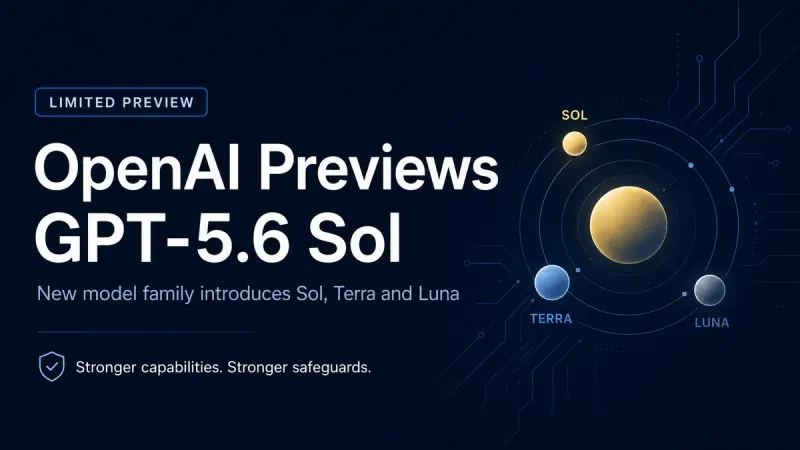
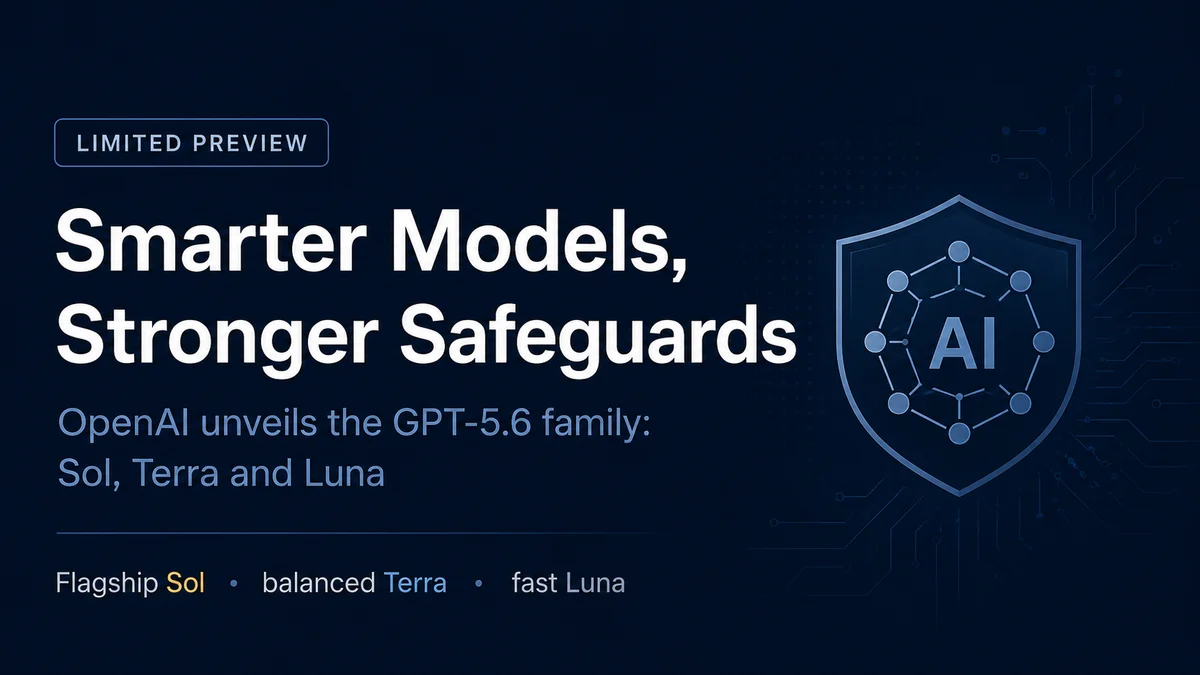
OpenAI has pulled the next turn of its roadmap into view, previewing GPT-5.6 not as a single monolithic model but as a three-tier family — and the structure itself is the signal for investors. Flagship Sol anchors the top of the stack, a balanced Terra sits in the middle, and a fast, low-latency Luna targets high-volume, cost-sensitive workloads. The phrase OpenAI is leading with — stronger capabilities, stronger safeguards — tells you where the frontier fight has moved: away from raw benchmark bragging rights and toward the harder commercial problem of shipping more powerful models that enterprises can actually deploy at scale without unacceptable risk.
OpenAI's GPT-5.6 family spans three tiers: flagship Sol, balanced Terra and fast Luna.
A tiered family is a deliberate cost-and-latency strategy
Splitting a generation into flagship, balanced and fast variants is how the leading labs are industrializing inference economics. Most production AI workloads do not need the absolute frontier on every call; they need the right capability at the right price and latency. Sol is for the hardest reasoning, agentic and research-grade tasks where accuracy justifies cost. Terra is the workhorse for mainstream enterprise and developer traffic. Luna is built for scale — chat front-ends, routing, classification and the long tail of high-frequency calls where speed and unit cost dominate. The strategic payoff is model routing: send the cheap query to Luna, escalate only when needed. That mix is what bends the cost curve for both OpenAI and its customers, and it is the same playbook investors are watching across the model providers.
AD
Why "stronger safeguards" is the enterprise unlock
Capability without controllability does not close enterprise deals. By foregrounding safeguards alongside capability, OpenAI is addressing the single biggest blocker to deeper enterprise adoption — the governance, reliability and risk concerns that keep frontier models in pilots rather than production. If GPT-5.6 ships with materially better guardrails, instruction-following and predictability, the addressable market widens into regulated and risk-averse verticals that have so far moved slowly. For the ecosystem, safer-by-default frontier models are bullish: they convert experimentation into recurring, mission-critical usage, and usage is what monetizes the entire stack beneath the model.
⚡ Quick briefing
4 min read
OpenAI previews a three-tier GPT-5.6 family — flagship Sol, balanced Terra and fast Luna — pairing stronger capabilities with stronger safeguards.
Here's the market read for AI stocks.
The market read-through: compute, the Microsoft axis and the competitive set
The most direct public-market exposure runs through OpenAI's closest partner. Microsoft (MSFT) remains the primary distribution and infrastructure beneficiary — through Azure capacity, Copilot surfaces and its commercial relationship with OpenAI — so a stronger, more deployable model family feeds directly into Microsoft's enterprise AI narrative. The compute layer is the next read: a new generation that pushes both training and inference volume is constructive for Nvidia (NVDA), with AMD positioned as the credible second source as customers diversify accelerators. On the demand side, sustained model progress keeps hyperscaler capex — Amazon (AMZN), Alphabet (GOOGL), Microsoft — pointed higher, even as those same players compete at the model layer. The competitive counter-read matters too: GPT-5.6 raises the bar Alphabet's Gemini and Anthropic must clear, intensifying a capability race that, for now, pulls more spending into AI infrastructure rather than less.
What to watch next
Pricing and availability — per-tier token pricing and rollout pace will decide how fast Luna-class economics expand the usage base.
Benchmarks and the system card — independent results and the safety documentation will validate the "capabilities + safeguards" claim.
Latency and throughput — Luna's real-world speed is the swing factor for high-volume, agentic and consumer applications.
Enterprise traction — net-new regulated-industry deployments are the clearest signal that safeguards are translating into revenue.
For now, GPT-5.6 reads as confirmation that the model cycle is still accelerating — and that the durable value is increasingly captured not only in the frontier model itself, but in the compute, distribution and safety tooling built around it. That is the lens long-term investors should apply as the Sol, Terra and Luna details fill in.
📝 OneDayTrading Editorial Standards
Published by OneDayTrading under its editorial team’s standards. External outlets and institutions named in the article identify reference sources.
Methods, review and corrections
Method
We develop articles and analysis from available public materials, filings and market data, using AI in writing and evidence comparison. Automated checks do not guarantee accuracy. Human review of an individual article is confirmed only when separately indicated.
Analysis basis
We focus on related stocks, sectors, earnings impact, and short-term price catalysts from an investor’s perspective.
Data source
Quotes and foreign/institutional flow data are provided by Korea Investment & Securities (KIS).
Disclaimer
This content is for informational purposes only and is not investment advice or a solicitation to trade.