Berkshire’s chair changes, but the investment case still turns on execution
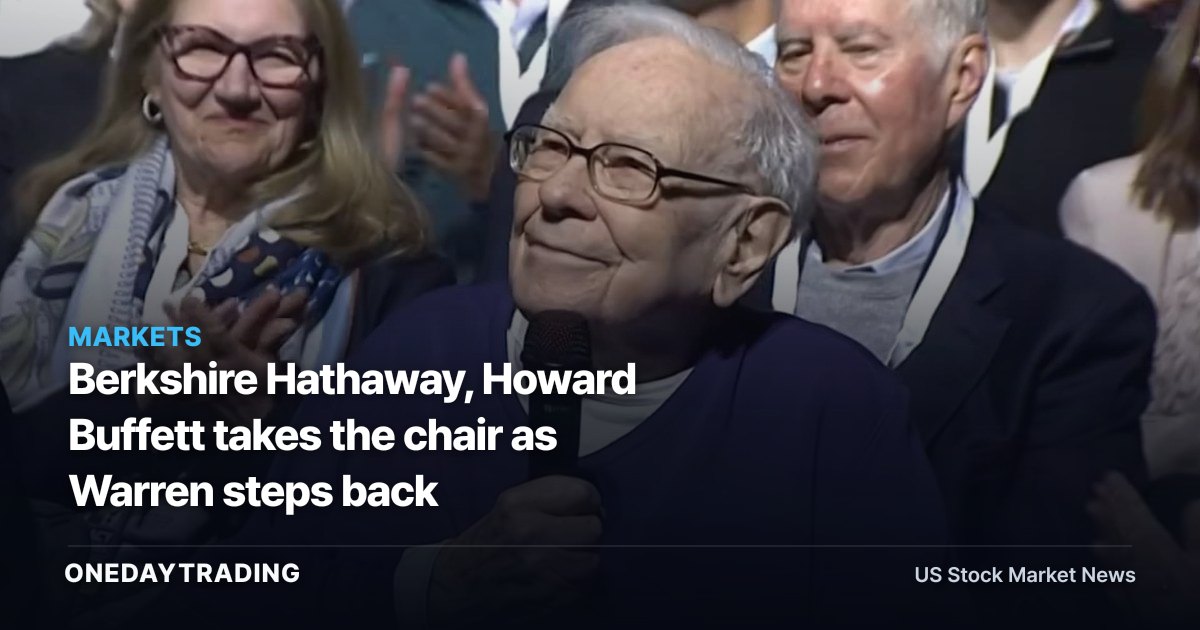
Berkshire Hathaway is moving Warren Buffett out of the chairman’s seat and installing his son Howard as chairman, a governance change that matters less as a trading trigger than as a test of whether the company’s culture can operate without Buffett’s formal authority. Buffett, 96 in 2026, will remain on Berkshire’s board as chairman emeritus and continue to offer what he called his “valued judgment and perspective.” Greg Abel remains chief executive, so operating decisions and capital allocation still have a defined executive center.
CNBC’s reporting places the move inside a succession sequence that began with Abel running Berkshire’s operating companies, followed by Buffett’s May 2025 announcement that he would leave the CEO role at the end of 2025. The exact effective date of Howard Buffett’s chairmanship is not specified in the available facts. Investors therefore have a confirmed change in title, but not a confirmed change in the working rhythm between Buffett and Abel.
Why Howard Buffett’s appointment is a continuity signal
Howard Buffett has served as a Berkshire Hathaway director for 33 years. Warren Buffett has said the chairman’s central duty is to “guard [Berkshire’s] culture and values – both worth more than anything on our balance sheet,” while Abel said those values would remain at the company’s core and that Howard would be their guardian. The appointment thus assigns the chair a stewardship mandate rather than an operating brief.
The family connection is explicit. Warren Buffett said Howard is receiving the role because he is his son, and Howard has said he is prepared because his father prepared him. That does not establish how the board will handle future disagreements, but it clarifies the rationale Berkshire has presented for choosing a nontraditional corporate chairman.
Howard’s background is broader than a conventional executive résumé. He began operating a 400-acre farm north of Omaha in 1986 and also operates a 1,500-acre farm in Illinois. He began county sheriff service in 2017 after more than 3,300 hours of patrol and training and 76 weapons qualifications. His foundation gave away $700 million last year, including $350 million to Ukraine in 2025 and $1.1 billion since Russia’s invasion in 2022. Those facts describe his activities; they do not by themselves predict Berkshire’s future returns.
He is also familiar with public-company oversight, having served as a director of Coca-Cola, Coca-Cola Enterprises and ConAgra Foods. That board experience is relevant to governance, while the operating authority remains with Abel as CEO.
The live question is Buffett’s role after the title change
Since Abel became CEO, Buffett has said he still comes into the office five days per week and that the two men discuss company matters at least every few days. Buffett described the relationship as one in which neither acts without the other’s approval, while Abel is the decider. The chairman-emeritus designation could leave that arrangement intact or could mark a more passive phase for Buffett; the available facts do not resolve which.
The distinction matters because Berkshire has made consequential capital decisions during the transition. Berkshire invested $37 billion in Alphabet’s artificial-intelligence ambitions, a move widely associated with Abel until Buffett said he initiated it with Abel’s approval. The episode shows how responsibility can be shared in practice even when the CEO has final authority.
For shareholders, the mechanism to monitor is not the title alone. It is whether Abel’s decisions, board oversight and capital deployment continue to reflect the discipline Buffett has emphasized. That assessment requires future disclosures and operating results, not assumptions about family succession.
What the market has already priced
Berkshire’s Class A and Class B shares initially fell after the announcement and then ended nearly unchanged, according to the reported account. Since Buffett’s May 2025 CEO-succession announcement, Berkshire shares are down 5%, while the S&P 500 is up 34%. Since the beginning of 2026, Berkshire’s B shares have underperformed the benchmark by 10 percentage points.
That relative performance indicates that investors have already been repricing the Buffett premium. It does not prove that the chairman change caused the underperformance, nor does it establish what the market will do next. The neutral immediate reaction is consistent with a transition that was expected rather than a surprise operating event.
Berkshire’s scale also shapes the sensitivity of the stock. The company’s reported market capitalization is $1,090,754,504,023. Its cash was $365.5 billion on June 30, down 8.0% from March 31; excluding rail cash and subtracting Treasury bills payable, the figure was $359.2 billion, down 3.8%. Berkshire repurchased $4.5 billion of its shares in the second quarter of 2026. Those figures give investors concrete markers for judging how Abel and the board deploy capital after the leadership handoff.
Key debates for Berkshire shareholders
- Stewardship versus operating control: Howard Buffett’s stated responsibility is protecting culture and values, while Greg Abel is Berkshire’s CEO and decision-maker. The unresolved issue is how much influence Warren Buffett will retain as chairman emeritus.
- Continuity versus key-person risk: Berkshire has designed a succession structure around institutional culture, but the future effect of the leadership change on prospects is unknown. Investors must distinguish a documented governance plan from proof that returns will persist.
- Cash discipline versus deployment pressure: June 30 cash remained $365.5 billion, or $359.2 billion under the adjusted measure, while second-quarter repurchases totaled $4.5 billion. Future filings will show whether capital deployment changes in pace or composition.
- Portfolio decisions under Abel: The $37 billion Alphabet investment demonstrates that major technology exposure can fit Berkshire’s portfolio when approved by both leaders. Its existence does not establish a broader AI strategy or guarantee a result for Berkshire shareholders.
Related stocks and sectors
- Berkshire Hathaway (BRK-B and BRK-A): The company is the direct subject. The relevant indicators are board continuity, Abel’s capital allocation, repurchases, cash balances and the treatment of Buffett’s continuing advisory role.
- Alphabet (GOOGL): Berkshire’s $37 billion investment links Alphabet’s AI ambitions to Berkshire’s disclosed portfolio. The fact establishes exposure, not a forecast for Alphabet’s earnings or share price.
- Coca-Cola (KO) and ConAgra Foods (CAG): Howard Buffett has served as a director of Coca-Cola, Coca-Cola Enterprises and ConAgra Foods. Those governance relationships explain why the companies are relevant to his board background, not that their operating outlook changes with Berkshire’s succession.
- Financials: Berkshire’s balance sheet, cash holdings, share repurchases and governance structure make the financial sector the appropriate classification for this story. The supplied evidence does not support a sector-wide forecast.
What to watch after the chair transition
- Effective date and board disclosures: Berkshire has not specified the exact date Howard Buffett formally becomes chairman. Corporate filings and shareholder communications should establish the timing and any stated changes in responsibilities.
- Buffett-Abel operating cadence: Investors should look for evidence of whether Buffett continues working five days per week and discussing decisions with Abel every few days, or whether his activity level changes.
- Capital allocation: Compare future cash balances, adjusted cash excluding rail cash and Treasury bills payable, and share repurchases with the June 30 figures and the $4.5 billion Q2 2026 buyback.
- Portfolio reporting: Berkshire’s publicly traded holdings were reported for June 30, 2026, in a 13F filing dated August 14, 2026. Subsequent filings can show whether Alphabet exposure or other disclosed positions change.
Outlook: a planned handoff with a demanding proof point
The constructive case is institutional continuity. Buffett remains available as chairman emeritus, Howard has decades of board tenure and Abel already runs Berkshire as CEO. The company also retains substantial cash and has demonstrated willingness to repurchase shares and make large investments.
The risk is that culture is easier to describe than to measure. Berkshire’s future effect from the leadership change is unknown, and the facts do not establish whether Buffett’s relationship with Abel will change. Underperformance of 5% since the May 2025 announcement versus a 34% S&P 500 gain, plus a 10-percentage-point B-share gap since the start of 2026, shows that investors are already evaluating Berkshire without assuming the old premium will return.
The next useful evidence is operational: the formal chair transition, the board’s disclosed responsibilities, subsequent cash and repurchase figures, and the next publicly reported portfolio holdings. Until those arrive, the announcement is best read as the completion of a planned governance step—not as proof of a new Berkshire strategy.
Market data check: Berkshire Hathaway Inc. New
Berkshire Hathaway Inc. New last traded near $509.77 (+0.11%). Our composite signal — blending price momentum and news flow — reads 🟡 neutral. Price momentum scores 51/100.
Data as of publication. Price via market feeds; for reference only, not investment advice.
📊 Analysis
Signal Neutral
Why The succession formalizes a long-signaled governance transition, while the facts do not establish a change in Berkshire’s operating outlook or Buffett’s day-to-day involvement.
Tickers$BRK-B$GOOGL$KO$CAG
This article was independently written by OneDayTrading from public reporting. Read the original (CNBC)