Summary
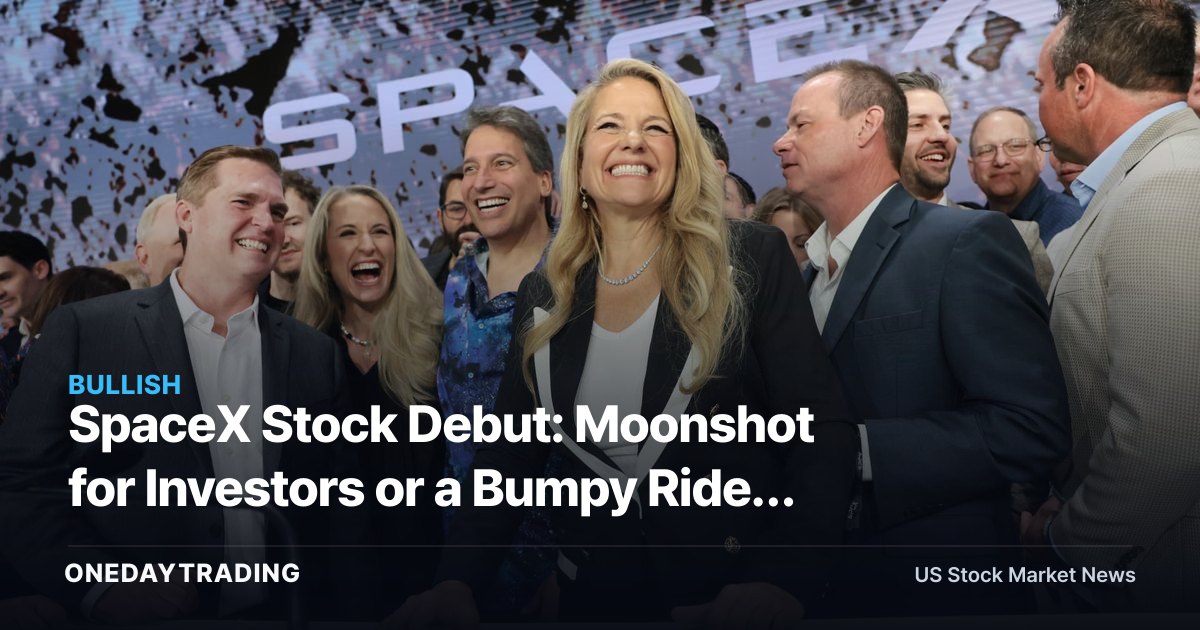
SpaceX has captured intense investor enthusiasm, with its first-day share price signaling that the market remains highly optimistic on the company. Experts, however, caution that the path ahead may be far from smooth. The debut reframes how retail investors can access the high-profile space economy.
The Full Story
For years, SpaceX was the most coveted private company that ordinary investors could not touch. Its arrival in the public arena changes that, and the early trading reaction suggests pent-up demand. If the opening session is any guide, sentiment skews firmly bullish, with buyers treating the name as a long-term bet on launch dominance, satellite connectivity and human spaceflight.
Yet analysts quoted by CNBC stress a more measured view. Strong first-day moves often reflect scarcity and hype rather than a clean read on fundamentals. The question for newcomers is whether the valuation already prices in flawless execution, or whether there is genuine room for the business to grow into expectations over multiple years.
The setup is classic for a marquee debut: a globally recognized brand, a charismatic founder, and a story that blends national-security launch contracts with a fast-scaling broadband franchise. That combination can fuel powerful momentum, but it can also amplify volatility when the narrative meets quarterly reality.
Structural Background
The commercial space sector has shifted from government-led programs to private operators competing on cost-per-launch and reusable hardware. SpaceX sits at the center of this transition, which is why its public-market arrival is treated as a bellwether for the entire industry rather than a single-stock event.
Retail access to space exposure has historically been limited to smaller launch and satellite players. A flagship listing concentrates attention and capital, potentially lifting peers while also raising the bar for what investors expect from the category.
Stock & Sector Ripple
- SpaceX — the core story; first-day optimism sets the tone but invites valuation scrutiny.
- RKLB (Rocket Lab) — a direct launch peer that may see sentiment spillover and renewed comparison on cost and cadence.
- TSLA (Tesla) — shares the same founder; investor crossover and brand-halo effects can influence flows.
- ASTS, LUNR — smaller space-economy names that often trade on sector momentum and narrative.
Bull vs Bear Scenarios
Bull: Strong day-one demand reflects a durable, category-defining franchise with launch leadership and a scaling broadband business; early buyers are positioning for years of growth.
Bear: Scarcity-driven hype can inflate the opening price beyond fundamentals, leaving latecomers exposed to sharp pullbacks if execution or guidance disappoints.
Investor Action Points
- Separate brand enthusiasm from fundamentals — examine revenue mix, contract backlog and margins before chasing momentum.
- Size positions for volatility; high-profile debuts often swing hard in early sessions.
- Watch sector peers like RKLB for relative-value signals and read-through on industry demand.
- Consider staggered entry rather than committing fully into first-day strength.
📊 Analysis
Signal Bullish
Why Strong first-day share price and persistent investor optimism point to a positive demand-driven catalyst, despite valuation caution.
Tickers$RKLB$TSLA$ASTS$LUNR
This article was independently written by OneDayTrading from public reporting. Read the original (CNBC)