Summary
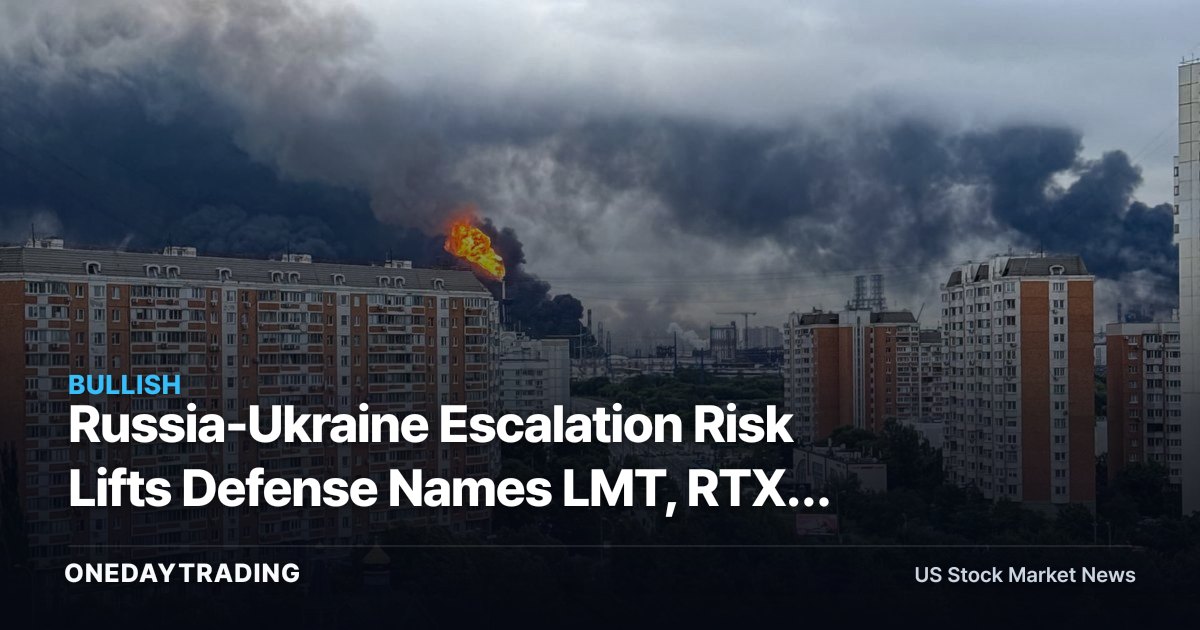
Ukraine launched its largest-ever drone barrage on Moscow, and Russia has pledged frequent and massive group strikes in response. For investors, a fresh escalation cycle revives two familiar trades: a sustained order pipeline for Western defense primes and a renewed geopolitical risk premium on crude. Neither is a guaranteed move, but the direction of travel is clear.
The Full Story
The exchange marks a step-change in the conflict. Kyiv striking the Russian capital with the heaviest drone volume to date signals that the war is no longer confined to front-line territory, and Moscow's pledge of repeated large-scale retaliation implies the munitions burn rate on both sides stays elevated. That matters to markets because modern attritional warfare consumes interceptors, air-defense rounds, drones and precision munitions far faster than peacetime production can replace them.
The channel to equities is procurement. Every wave of strikes and counter-strikes pressures NATO members to refill depleted stockpiles and accelerate multi-year defense budgets. That converts a battlefield event into a multi-year revenue stream for the companies that build interceptors, radar, and the drones now central to the fight.
Structural Background
Since 2022, European defense spending has trended toward and past the 2 percent of GDP NATO target, and air defense has become the priority line item. The current escalation reinforces that demand is structural, not a one-quarter spike. Separately, roughly a tenth of global oil supply still flows from Russia, so any threat to its energy infrastructure or export logistics keeps a bid under crude even when demand is soft.
Stock and Sector Ripple
- Lockheed Martin (LMT) - prime supplier of PAC-3 interceptors and missile systems; sustained strike tempo directly supports its missiles and fire-control backlog.
- RTX (RTX) - maker of Patriot and NASAMS-linked effectors; air-defense demand is the cleanest read-through here.
- Northrop Grumman (NOC) and General Dynamics (GD) - exposure to munitions, artillery and combat systems being consumed at scale.
- ExxonMobil (XOM) and Chevron (CVX) - benefit from any war-risk premium on oil if Russian supply or energy infrastructure is threatened.
Bull vs Bear Scenarios
The bull case: escalation cements above-trend NATO procurement, and defense primes already trade on multi-year backlogs that this news only lengthens. The bear case is twofold. Defense valuations have already re-rated since 2022, so much of the rearmament theme is priced in, and the trade is headline-driven and prone to sharp fade on any ceasefire signal. On oil, weak global demand and ample non-Russian supply have repeatedly capped geopolitical spikes, so an energy pop may prove short-lived.
Investor Action Points
- Watch defense primes' next earnings for book-to-bill above 1.0 and explicit backlog growth - that confirms orders, not just sentiment.
- Track NATO and European national budget announcements for fresh air-defense and munitions allocations.
- Use crude (WTI) as the live escalation gauge; a premium that holds rather than fades signals the market is pricing real supply risk.
- Treat headline-driven pops with discipline - de-escalation or ceasefire talk can reverse these moves quickly.
Market data check: LMT
LMT last traded near $510.95 (-4.01%). Our composite signal — blending price momentum and news flow — reads 🟡 neutral. Price momentum scores 18/100 (soft).
Data as of publication. Price via market feeds; for reference only, not investment advice.
📊 Analysis
Signal Bullish
Why Renewed escalation and Russia's pledge of repeated large-scale strikes sustain elevated munitions consumption and procurement demand, a tailwind for defense primes and a risk premium for oil.
Tickers$LMT$RTX$NOC$GD$XOM$CVX
This article was independently written by OneDayTrading from public reporting. Read the original (CNBC)