Summary
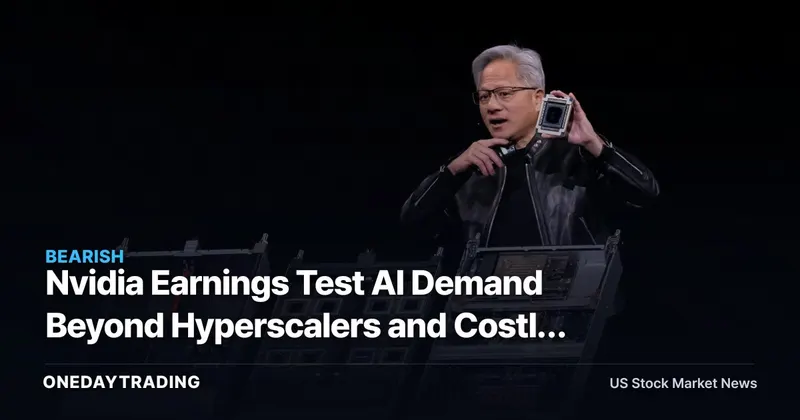
Nvidia stock faces an earnings test because CNBC's provided report says Nvidia depends heavily on hyperscalers while trying to broaden demand with financing options for customers that need help buying expensive AI systems. The investor issue is not whether AI demand exists; the issue is whether Nvidia can turn demand outside the largest cloud buyers into durable revenue.
Hyperscalers are large cloud-computing operators that buy massive data-center infrastructure, and Nvidia's exposure to that customer group makes earnings quality as important as headline growth. If financing becomes a bridge to new buyers, Nvidia gains a wider AI infrastructure market; if financing becomes a subsidy for weaker demand, the multiple has a harder question to answer.
The Full Story
CNBC's source item frames Nvidia's earnings report around customer concentration, not product leadership. Nvidia has built its AI data-center business around costly systems that hyperscalers can afford, and the company's effort to create financing options shows management wants demand to stretch beyond the largest technology infrastructure budgets.
That matters because AI hardware revenue is lumpy when a small set of large buyers controls purchase timing. Nvidia can post strong reported sales while investors still question whether orders are broad enough to support the valuation through a slower cloud capex cycle.
The financing push changes the read-through. Nvidia is not only selling GPUs and systems; Nvidia is trying to shape the purchasing capacity of customers that might otherwise delay or reduce orders because the systems are expensive.
Structural Background
Nvidia sits at the center of AI infrastructure because its systems power data-center workloads that require high-performance parallel computing. The CNBC report does not provide shipment figures, margin data, order size, or earnings dates, so the clean analytical point is the channel mix: hyperscaler concentration versus broader enterprise and institutional demand.
Financing can expand the addressable buyer pool, but financing also shifts attention from demand intent to customer affordability. In semiconductors, that distinction matters because backlog quality, payment terms, and repeat purchases determine whether revenue converts into resilient earnings.
Stock & Sector Ripple
- NVDA: Nvidia is the direct subject because CNBC says Nvidia's reliance on hyperscalers faces a test in the earnings report, while financing options aim to help more customers purchase costly systems.
- AI infrastructure: The sector benefits if Nvidia proves demand is moving beyond the largest cloud buyers, because broader purchasing supports longer data-center investment cycles.
- Cloud platforms: Hyperscaler spending remains the central swing factor because the CNBC item identifies those buyers as Nvidia's key dependence point.
- Semiconductors: Chip sentiment will key off whether Nvidia's earnings show end-demand breadth or simply another quarter tied to a narrow buyer base.
Bull vs Bear Scenarios
The bull case is straightforward: Nvidia financing options lower the purchasing hurdle for costly AI systems, and non-hyperscaler customers add incremental demand without replacing the core cloud buyer base. In that scenario, Nvidia's earnings report would support the view that AI infrastructure spending is widening.
The bear case is equally concrete: Nvidia financing options signal that expensive systems need help clearing the market outside hyperscalers. If the earnings report shows dependence on the same large cloud customers, investors will question whether revenue growth is broad enough to defend the stock's premium.
Investor Action Points
- Check Nvidia's earnings commentary for customer concentration, especially any language separating hyperscaler demand from other buyers.
- Track whether Nvidia describes financing as a growth accelerator or as a necessary tool to close purchases of costly systems.
- Watch guidance quality, not only reported results, because forward demand breadth is the variable CNBC's source item puts under scrutiny.
- Listen for order durability and repeat-purchase signals from non-hyperscaler customers in the next earnings call.
FAQ
Why is Nvidia hyperscaler dependence important for investors?
Nvidia hyperscaler dependence matters because CNBC's provided report says Nvidia's earnings report will test reliance on large cloud buyers. Concentrated demand can lift revenue quickly, but concentrated demand also makes Nvidia more exposed to cloud capex timing.
What are Nvidia financing options for AI systems?
Nvidia financing options are purchasing structures that CNBC says Nvidia is creating so more clients can buy costly systems. The financing effort suggests Nvidia wants AI infrastructure demand to extend beyond customers with the largest technology budgets.
What should investors watch in Nvidia earnings?
Nvidia investors should watch customer mix, guidance language, and management's explanation of financing options in the earnings report. The key test is whether Nvidia shows broader AI system demand or continued dependence on hyperscalers.
Market data check: NVDA
NVDA last traded near $213.86 (+0.38%). Our composite signal — blending price momentum and news flow — reads 🟡 neutral. Price momentum scores 53/100.
Data as of publication. Price via market feeds; for reference only, not investment advice.
📊 Analysis
Signal Bearish
Why The CNBC item highlights concentration risk and the need for financing to broaden demand for expensive Nvidia systems, which makes the earnings setup more vulnerable than a simple AI demand story.
This article was independently written by OneDayTrading from public reporting. Read the original (CNBC)