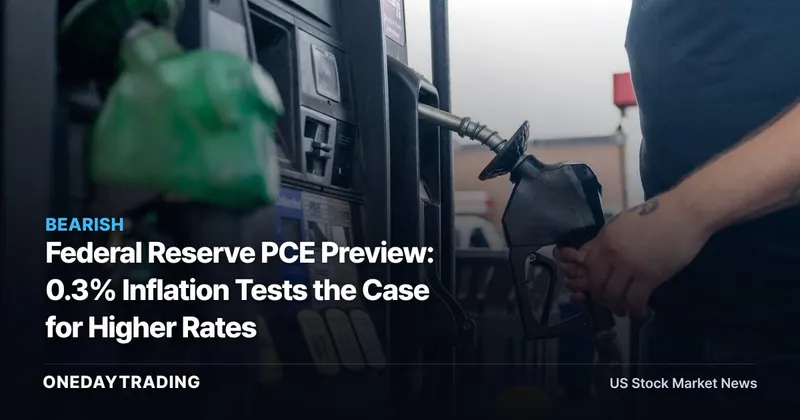
Why Wednesday’s Federal Reserve Inflation Report Matters
The personal consumption expenditures price index is the Federal Reserve’s primary inflation gauge; core PCE excludes food and energy costs to provide a view less exposed to those categories. Wednesday’s report therefore carries two signals for investors: the pace of prices and the strength of the consumer demand accompanying them.
The sharpest market read is not simply whether inflation remains elevated. It is whether the combination of inflation and spending gives policymakers enough reason to keep considering higher rates. For equities, that distinction matters because a higher expected path for the borrowing benchmark can increase the rate used to value future earnings, creating greater pressure on businesses whose valuations depend heavily on profits expected farther ahead.
The actual Wednesday readings remain unknown. That prevents the consensus figures from being treated as an outcome and makes the gap between the release and expectations the first checkpoint. The relevant comparison is specific: 0.3% for the all-items measure and 0.3% for core PCE in the data due Wednesday.
Dow Jones Forecasts Put Inflation Above the Federal Reserve Target
On an annual basis, the Dow Jones consensus expected all-items PCE inflation of 3.7%, unchanged from July, and core PCE inflation of 3.3%, also unchanged from July. Both expected rates exceed the Federal Reserve’s 2% target, leaving the anticipated report with no clear evidence of a return to target.
Dan North, senior economist at Allianz Trade, summarized the policy tension directly: “It’s still way above target.” His observation focuses attention on core inflation because a stable core reading would offer policymakers less confirmation that underlying pressure is receding.
The monthly and annual figures answer different investor questions. The 0.3% monthly expectations describe the pace in the report due Wednesday; the expected 3.7% all-items and 3.3% core readings show how far the annual measures remain from the Federal Reserve’s 2% objective. A result near consensus could therefore preserve the policy debate rather than settle it.
Federal Open Market Committee Signals Leave the Rate Path Open
The Federal Reserve approved a 0.25-percentage-point rate increase at its September meeting, placing its borrowing benchmark at 3.75%-4%. Among the 18 Federal Open Market Committee officials who submitted September forecasts, all except 2 anticipated at least 1 additional rate move by the end of 2026.
Those forecasts establish policy inclination, not a guaranteed decision. Whether the Federal Reserve will raise rates in October, December or January is unknown, as are the exact timing and size of any future adjustment. Wednesday’s inflation figures must therefore be read as new evidence entering an unresolved decision process.
Kevin Warsh, Chairman of the Federal Reserve, said he would be “hard pressed to describe broad financial conditions as restrictive.” That assessment suggests policymakers are evaluating whether the existing benchmark is sufficiently constraining demand, even after the September move.
Federal Reserve Governor Michael Barr offered a firmer inflation warning: “I don’t yet see a clear trend toward a timely return to 2%.” John Williams, President of the New York Fed, supplied the counterweight, saying “there is no need for urgency, and we have time to gather more information.” Williams nonetheless expected that 1 further upward adjustment of interest rates may be necessary this year.
Consumer Spending Keeps the Inflation Signal Complicated
The consensus expected consumer spending to increase 0.8% in August after a 0.2% rise in July. That acceleration, if confirmed, would matter because continued spending can give the Federal Reserve less evidence that tighter policy has meaningfully restrained demand.
Bank of America’s card data reinforce the resilience side of the argument. Debt and credit card spending rose 6.9% year over year for the week ended Sept. 19, including a 26.5% increase in gasoline spending. Excluding gasoline, spending still increased 5.7% from a year earlier for that week.
The composition is important. Gasoline accounted for a much stronger increase than spending excluding gas, so the headline card figure should not be read as a uniform measure of demand. Even after removing gasoline, though, the reported 5.7% gain leaves consumer activity as a live input to the rate discussion.
Bureau of Economic Analysis Revisions Could Improve the Past, Not Resolve the Present
The Bureau of Economic Analysis was changing its methodology retroactively to 2021 for prices of legal services, software and computer accessories, and portfolio management services. The revisions could reduce July annual PCE inflation readings by 2 or 3 tenths of a percentage point, possibly bringing the July 12-month reading to 3%.
That creates a measurement risk for investors: a lower revised July figure could make the historical inflation path look more favorable without determining the result due Wednesday. The final revised July PCE reading is unknown, so any apparent improvement must be separated from the fresh monthly and annual data.
Goldman Sachs described the prospective sequence as “somewhat less favorable before a more benign trend reasserts itself.” That view provides a counter-scenario to an indefinitely worsening inflation picture, while still allowing for less favorable readings before any improvement appears.
Potential Equity Winners and Losers From the PCE Result
- Rate-sensitive equities: A reading that sustains expectations for higher Federal Reserve rates could pressure valuations through a higher discount rate. A softer reading could ease that mechanism, although the release alone would not determine the next policy decision.
- Consumer-facing sectors: Expected consumer spending growth of 0.8% in August and Bank of America’s 5.7% gain excluding gasoline indicate continued activity. The risk is that persistent demand coincides with inflation that remains above the Federal Reserve’s 2% target, keeping financing conditions in focus.
- Financials: The Federal Reserve borrowing benchmark is already 3.75%-4%, and another adjustment remains possible. The fact sheet does not provide bank margins, credit costs or earnings data, so no company-specific benefit can be established from the rate outlook.
- Long-duration growth sectors: Their sensitivity comes through valuation rather than any company result in the report. The supplied evidence contains no earnings, revenue or guidance figures for individual companies, preventing a stock-specific conclusion.
Risk Check Before the PCE Release
- Consensus is not the result: The 0.3% all-items and 0.3% core figures are expectations for data due Wednesday, not reported readings.
- Revisions may blur comparisons: The Bureau of Economic Analysis methodology change could lower prior annual readings, making the revised July baseline essential when interpreting the new release.
- Spending has an energy component: Bank of America reported a 26.5% rise in gasoline spending, materially stronger than the 5.7% increase excluding gasoline for the week ended Sept. 19.
- Policy views are not uniform: Michael Barr emphasized the absence of a clear return toward 2%, while John Williams said policymakers had time to collect more information.
The Next Macro Checkpoint
Wednesday’s PCE release must clear three tests: the 0.3% consensus for all-items inflation, the 0.3% expectation for core inflation, and the revised July comparison produced by the Bureau of Economic Analysis. Investors should then weigh those figures against the expected 0.8% August increase in consumer spending and the Federal Open Market Committee’s projected 1 additional move by the end of 2026. A softer inflation result could weaken the case for further tightening; persistent inflation paired with resilient spending would leave that case intact, without fixing the timing or size of the next decision.
📊 Analysis
Signal Bearish
Why Persistent inflation expectations and resilient spending leave room for higher interest rates, a potential valuation headwind for rate-sensitive equities.
This article was independently written by OneDayTrading from public reporting. Read the original (CNBC)