Kevin Warsh Leaves Wall Street With a Conditional Rate Signal
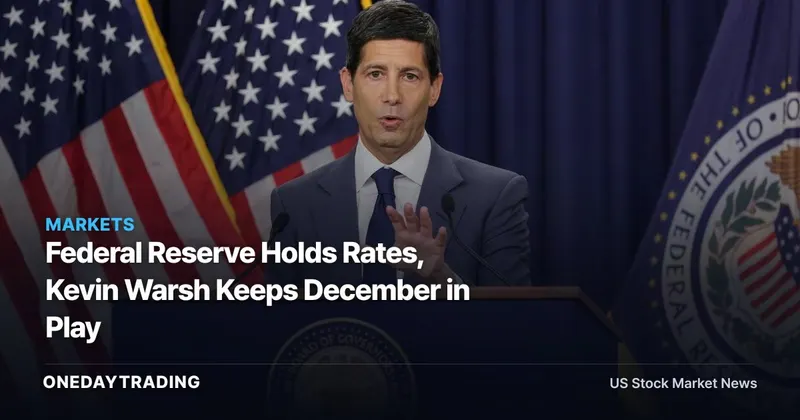
The Federal Reserve held interest rates unchanged this week, while chairman Kevin Warsh indicated a preference for higher rates without committing the Federal Open Market Committee to a preset course. For investors, the immediate message is restrictive but unresolved: policy may tighten if incoming information supports that choice, while December remains an open decision rather than a promised increase.
CNBC reported the decision and Warsh’s remarks in an article dated 2026-10-29. The distinction between a policy preference and a policy commitment matters because the former can influence expectations without binding the FOMC before it receives the information available ahead of its next meeting.
Monetary-policy optionality is the ability to preserve more than one credible course of action until economic evidence supports a decision. Warsh is using that optionality in both directions: he rejected the idea of a fixed path while stating that financial conditions had become tighter without qualifying as tight.
The Federal Reserve’s 2% Line Is the Hard Signal
The clearest anchor is inflation. Kevin Warsh said the Federal Reserve’s inflation target is 2% flat, rejecting the notion that policymakers would tolerate a target somewhere above that level. That statement establishes the standard against which the December decision will be assessed, even though the fact sheet does not establish whether inflation will remain elevated before the meeting.
The policy sequence reinforces the tension. The FOMC held rates flat in June and July, raised them in September, and declined to raise them this week. Those decisions show that neither an unchanged rate nor an increase should be treated as automatic at the next meeting.
Warsh captured that approach by saying, “If we had a firm conclusion about the conduct of monetary policy, we'd announce it to much fanfare today.” The remark removes a guaranteed path without removing the possibility of tighter policy. His separate assessment that financial conditions were tighter, though not tight, explains why the higher-rate preference remains live.
Why the December Decision Matters for Valuation
For Wall Street, the relevant transmission channel runs from the expected policy path to the rate assumptions used in asset valuation. A credible higher-rate lean can pressure valuations that depend heavily on future cash flows; a decision to remain unchanged can have the opposite effect if investors had expected more tightening. The fact sheet supplies no prices, yields, index moves, or sector returns, so it cannot establish what markets have already discounted.
That limitation makes conditional analysis more useful than a directional trade call. If the information available before December strengthens the case for tighter policy, the valuation pressure associated with a higher expected rate path could persist. If that information weakens the case, Warsh’s insistence that policy is not preset gives the FOMC room to hold without contradicting his stated framework.
No specific listed company is identified in the evidence, and attributing a stock-level benefit or loss would exceed the record. The investable issue is therefore the policy sensitivity of portfolios, not a supported call on an individual equity. Investors should separate exposure to the rate path from confidence about the next vote; the first is a mechanism, while the second remains unknown.
The FOMC Is Changing the Calendar, Not Its Meeting Frequency
Warsh also announced a plan to reduce scheduled interest-rate votes over the next two years. CNBC reported that the FOMC will continue holding eight meetings per year, so the institutional change concerns when rate changes receive scheduled votes rather than how often officials meet.
One FOMC meeting in 2027 will omit a scheduled vote on whether to change rates, and two FOMC meetings in 2028 will do the same. The chairman retains authority to call an impromptu meeting when he sees a need to change rates, preserving a route for action outside the reduced scheduled-vote calendar.
This design may concentrate attention around meetings carrying scheduled decisions. It can also reduce the immediate policy relevance of commentary delivered as much as three months before a rate decision. Regional Federal Reserve presidents receive one fewer scheduled vote during their one-year rotations, which changes the formal opportunity to participate in a scheduled rate decision.
The calendar reform does not itself reveal whether rates will move higher or lower. Its practical significance lies in the timing and weight of communication: investors will need to distinguish general policy views from remarks tied closely to an actionable vote.
The Core Debate: Flexibility Versus Transparency
- Policy flexibility: Warsh has rejected a fixed monetary-policy course, allowing the FOMC to evaluate information arriving before December.
- Restrictive preference: His view that financial conditions are tighter but not tight, combined with the Federal Reserve’s 2% inflation target, leaves a higher-rate option credible.
- Decision accountability: Robert Sockin, chief U.S. economist at PGIM, called the unchanged decision a “policy mistake,” arguing against the choice to hold.
- Communication uncertainty: It is unknown whether officials who tempered market expectations acted at Warsh’s direction, limiting conclusions about how centrally the message was coordinated.
Sockin’s criticism identifies the principal risk in waiting: a gradual approach may prove inadequate if the case for tighter policy strengthens. Warsh’s counterweight is optionality, since committing too early would reduce the committee’s ability to respond to information received before the next decision. The evidence does not resolve which approach will produce better economic consequences.
What Investors Should Check Before December
- The decision language: Determine whether the FOMC continues to reject a preset course or moves toward a firmer policy conclusion.
- Warsh’s description of financial conditions: A shift from “tighter” toward “tight,” or continued refusal to use that description, would clarify how he assesses the need for additional restraint.
- The inflation commitment: Check whether Kevin Warsh continues to frame the Federal Reserve target as 2% flat and how that standard informs the next choice.
- The voting calendar: Track how the FOMC implements one omitted scheduled rate vote in 2027 and two in 2028 while preserving eight meetings per year.
The unknowns should remain explicit. The fact sheet does not determine whether the Federal Reserve will raise rates in December, whether inflation will stay elevated before that meeting, or what economic consequences will follow from Warsh’s approach. Those are the variables capable of changing the interpretation; none should be treated as a reported outcome now.
Federal Reserve Outlook: A Hawkish Lean Without a Promise
The balanced reading is neutral rather than complacent. Warsh has supplied a restrictive bias through his higher-rate preference, his assessment that conditions are not tight, and his defense of the 2% target. He has simultaneously protected the committee from being locked into a December increase.
That combination keeps the next decision consequential for rate-sensitive valuations without supporting a definitive bullish or bearish stock call. The live trigger is December: investors should test the eventual decision against the incoming-policy logic Warsh has established, then judge whether the Federal Reserve preserved useful flexibility or merely postponed a necessary choice.
📊 Analysis
Signal Neutral
Why A preference for higher rates is a restrictive signal, while the absence of a preset course leaves the next decision dependent on information not yet available.
This article was independently written by OneDayTrading from public reporting. Read the original (CNBC)