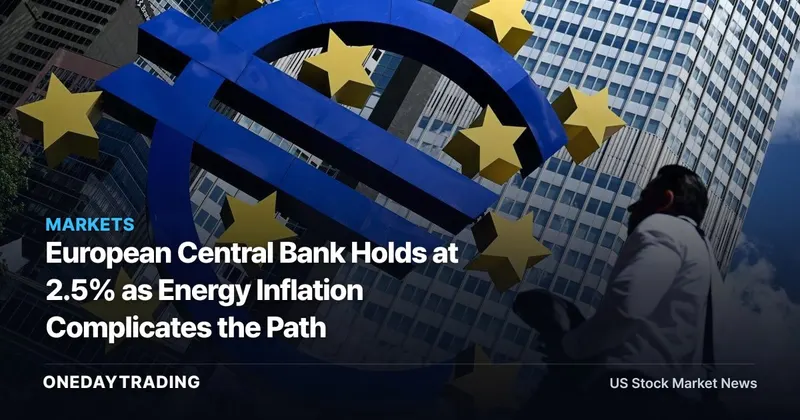
European Central Bank Holds at 2.5%—and Preserves Both Policy Risks
The European Central Bank held its deposit facility rate at 2.5% on Thursday, leaving investors with a policy pause rather than a clear end to tightening. CNBC reported the decision on 2026-10-29. The immediate equity-market relevance lies in the tension behind the vote: energy inflation is pressing upward while tighter financing conditions are pressing against growth.
The deposit facility rate is the interest rate the European Central Bank applies to qualifying overnight deposits from banks. It remained at 2.5% after the European Central Bank raised it by 25 basis points in September. A steady rate therefore does not mean financial pressure has disappeared; the Governing Council said financing conditions had tightened since its previous meeting.
For equity investors, that distinction matters more than the word “hold.” A pause removes an additional rate increase at this meeting, while the existing level and tighter financing conditions can still constrain borrowing, investment and valuation support. The decision is neutral rather than clearly positive or negative because the confirmed evidence points to restraint from two directions: inflation limits room for easier policy, and financing conditions limit room for tighter policy without added growth risk.
Energy Inflation Keeps the European Central Bank’s Problem Open
CNBC reported that euro-area headline inflation reached 3.8% last month, its highest level since September 2023. Energy price inflation reached 18.8%. Those figures explain why holding the rate cannot be read as confirmation that inflation pressure has passed.
The Governing Council identified rising energy prices as an upside risk to inflation and a downside risk to growth. That is a difficult combination for equities because the same pressure can raise the need for monetary restraint while weakening the economic setting in which companies operate. The available evidence does not establish company-level revenue, margin or share-price effects, so the defensible read-through remains at the rates and broad sector-valuation level.
There is an important counterweight. The Governing Council said underlying inflation and wages were broadly stable, even as headline and energy inflation were elevated. If those underlying measures remain stable, the energy shock may not require the same policy response as a broader acceleration. If they cease to be stable, the case for another increase could strengthen.
The central bank’s June increase was its first rate hike since 2023. That history, combined with September’s 25-basis-point move, shows that the current hold sits inside an active tightening sequence rather than an established easing cycle. It also prevents investors from treating one unchanged decision as proof that the policy peak has been reached.
Deutsche Bank’s Mark Wall Sees a December Hike, Not a Certainty
Mark Wall, Deutsche Bank’s chief European economist, said that predicting the course of European Central Bank monetary policy was becoming more difficult. His uncertainty centers on whether the rate increases already delivered, together with tighter financing conditions, will be sufficient to counter the inflation risk associated with energy prices.
Wall expects one additional European Central Bank increase to 2.75% in December while Christine Lagarde remains president, followed by the probable end of the hiking cycle. That is an economist’s forecast, not a confirmed Governing Council decision. Whether the projected December increase occurs is unknown, and the fact sheet does not provide a vote count for Thursday’s hold.
Christine Lagarde announced on Thursday that she had decided to depart as European Central Bank president. No exact departure date is supplied. Wall’s assessment separates institutional continuity from leadership uncertainty: he views the institution as larger than any individual, while acknowledging that the coming transition adds uncertainty to decision-making.
Investors should therefore separate three layers of information. The 2.5% rate is confirmed policy; the Governing Council’s assessment of energy, underlying inflation, wages and financing conditions is confirmed guidance; the 2.75% December rate is Wall’s expectation. Treating the forecast as settled policy would erase the main uncertainty in the story.
Rate-Sensitive Equity Checkpoints After the ECB Decision
- December policy decision: Check whether the European Central Bank holds at 2.5% or validates Mark Wall’s forecast of an increase to 2.75%. The forecast should remain conditional until the Governing Council acts.
- Headline inflation: Compare the next reading with the euro area’s 3.8% result from last month. The exact calendar month represented by “last month” is not provided and should not be inferred.
- Energy price inflation: Track whether the next reading extends or reverses the pressure represented by 18.8%. This is the stated source of simultaneous upside inflation risk and downside growth risk.
- Underlying inflation and wages: Test whether the Governing Council can continue describing both as broadly stable. A change would alter the balance between another hike and the drag from tighter financing conditions.
The next investable signal will come from which side of that balance moves first. Persistent energy pressure would keep the December hike scenario alive; stable underlying inflation and wages, alongside tighter financing conditions, would reinforce the argument for restraint. Until those checkpoints change, the hold at 2.5% is best read as a live policy debate, not a completed turn in the rate cycle.
📊 Analysis
Signal Neutral
Why The rate hold avoids an immediate tightening step, while elevated energy inflation and already-tighter financing conditions leave the next policy direction uncertain.
This article was independently written by OneDayTrading from public reporting. Read the original (CNBC)