What Changes
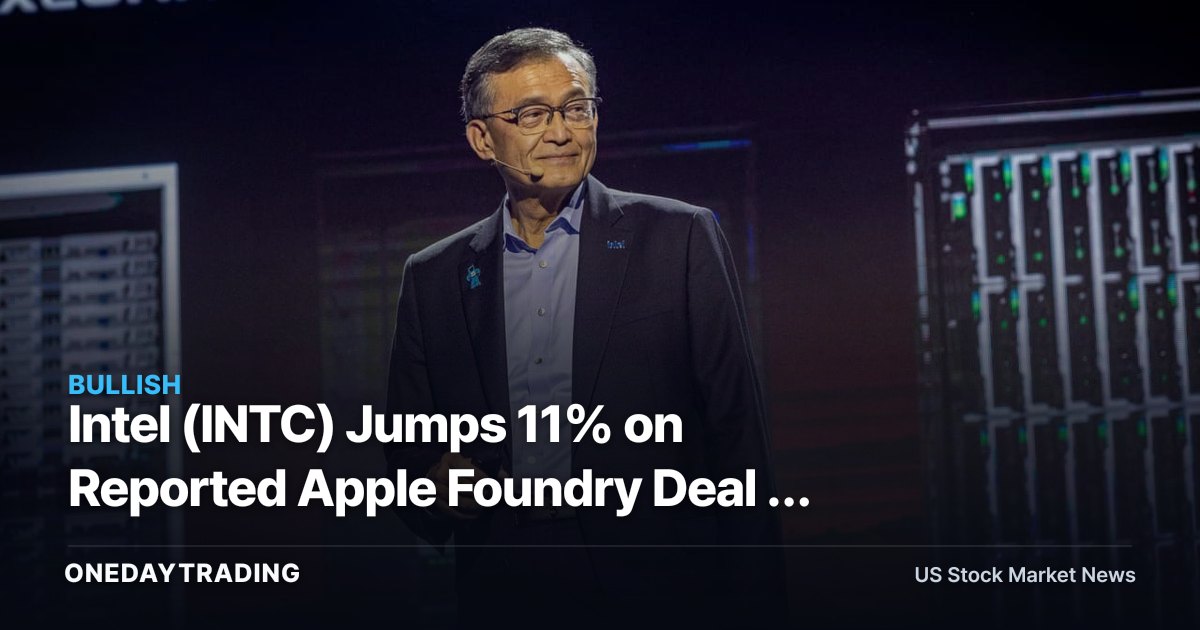
The market reaction is less about volume and more about endorsement. Apple has anchored its custom silicon at Taiwan Semiconductor for years, so any production shifted toward Intel Foundry Services functions as a third-party stamp of approval on Intel's advanced-node roadmap. For a company that has spent heavily to prove it can fab leading-edge chips for outside customers, a marquee logo matters disproportionately to early order size.
Intel's foundry pitch leans on geography as much as technology. A US-based, politically supported manufacturing base appeals to customers seeking supply-chain diversification away from a single Taiwan concentration. An analyst framed Intel as converting political and strategic tailwinds into concrete foundry wins while expanding domestic capacity — the channel here is reshoring incentives and customer risk management, not just transistor performance.
For Apple, even a modest dual-sourcing step reduces dependence on one fab partner and gives leverage on pricing and allocation. That dynamic, if it scales, reshapes who captures advanced-packaging and wafer economics across the ecosystem.
By the Numbers
The headline figure is the 11% single-day move, an outsized reaction for a reported deal that analysts themselves describe as initially small. That gap between price action and disclosed substance tells you sentiment is pricing the option value of future foundry scale, not committed revenue. Until Intel quantifies wafer commitments, node, and timing, the financial contribution remains unmodeled.
Winners & Losers
- Intel (INTC) — Direct beneficiary; a credible external customer strengthens the foundry investment thesis and helps justify capacity spend.
- Apple (AAPL) — Gains supply-chain optionality and negotiating leverage through potential dual sourcing.
- TSMC (TSM) — Modest competitive headwind if customers normalize multi-foundry strategies, though its leading-edge lead remains intact.
- ASML (ASML), Applied Materials (AMAT) — Equipment suppliers benefit from any sustained US capacity expansion regardless of which fab wins the order.
Risk Check
- Deal size is reportedly small; early orders may not move Intel's foundry P&L for several quarters.
- Yield and node-maturity execution remain unproven at scale versus an entrenched TSMC.
- The stock already moved 11%, raising the bar — disappointment on terms or timing could unwind gains.
- Reliance on policy tailwinds introduces sensitivity to shifts in subsidy and trade priorities.
Bottom Line
The pop reflects validation more than dollars: a named customer lends credibility to Intel's foundry turnaround, but with a small starting scope and unproven execution, the upside hinges on whether this seed converts into committed, high-volume wafer agreements that Intel can actually fill.
Market data check: INTC
INTC last traded near $133.85 (+10.53%). Our composite signal — blending price momentum and news flow — reads 🟡 neutral. Price momentum scores 95/100 (firm).
Data as of publication. Price via market feeds; for reference only, not investment advice.
📊 Analysis
Signal Bullish
Why A reported Apple foundry deal validates Intel's external-customer thesis and drove an 11% gain, a positive catalyst despite small initial scope.
Tickers$INTC$AAPL$TSM$ASML$AMAT
This article was independently written by OneDayTrading from public reporting. Read the original (MarketWatch)