Summary
Defense stocks face a firmer Ukraine-war risk premium after CNBC reported that Russian forces intensified attacks in Donetsk, Russia claimed advances toward Sloviansk and Kramatorsk, and Ukraine welcomed a fresh European Union push to unlock frozen Russian assets for Kyiv.
The investor read-through is not an immediate earnings event for Lockheed Martin, RTX, Northrop Grumman or General Dynamics; the source gives no contract value, shipment schedule or budget figure. The signal is policy duration: heavier fighting plus a financing channel can lengthen demand for missiles, air defense, sensors, ammunition and sustainment.
The Full Story
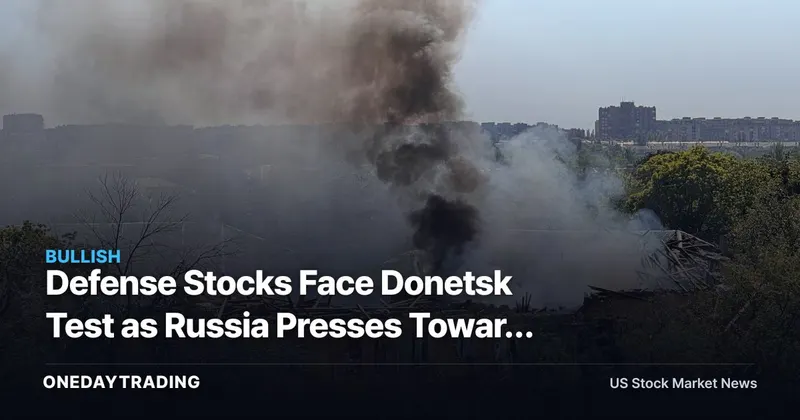
CNBC reported that Russia is escalating attacks in Donetsk while claiming progress toward Sloviansk and Kramatorsk, two eastern Ukrainian cities that matter because control in Donetsk shapes Ukraine's defensive depth and Russia's bargaining leverage.
Frozen Russian assets are state-linked Russian funds immobilized by sanctions, and an EU effort to unlock them would turn a legal and diplomatic balance-sheet question into potential war financing for Ukraine. For U.S. defense investors, the key mechanism is not asset ownership; the key mechanism is whether European funding supports procurement, replenishment and allied military transfers.
The tape usually prices war headlines through prime contractors first and details later. Lockheed Martin benefits most directly when missile defense and precision weapons stay central to Ukraine support, while RTX is exposed through air defense, sensors and munitions supply chains. Northrop Grumman and General Dynamics have a slower but relevant channel through surveillance, command systems, artillery and land systems.
Structural Background
The source does not provide casualty figures, asset values, defense-spending amounts or contract awards, so the clean analytical line is narrow. Intensified Donetsk fighting raises the probability of sustained Western support, but earnings only move when policy converts into appropriations, orders, backlog and deliveries.
That distinction matters because defense stocks trade on multi-year visibility, not single battlefield claims. A claim of advances toward Sloviansk and Kramatorsk can lift perceived urgency, but contractor margins depend on production cadence, input costs, labor capacity and negotiated contract terms.
Stock & Sector Ripple
- LMT: Lockheed Martin is the clearest U.S. defense read-through because Ukraine-related demand often centers on missiles and air defense, but the CNBC report included no new Lockheed Martin contract.
- RTX: RTX has exposure to air defense and sensing systems, so a prolonged Donetsk campaign supports the demand narrative if allied governments fund replenishment.
- NOC: Northrop Grumman ties into surveillance and defense electronics, which matter when a front-line conflict rewards targeting, tracking and command networks.
- GD: General Dynamics has a land-systems and munitions angle, but the stock needs evidence of orders rather than battlefield momentum alone.
- Defense sector: U.S. aerospace and defense primes gain policy optionality if the EU asset push becomes usable funding, while suppliers face capacity and margin execution risk.
Bull vs Bear Scenarios
The bull case is that intensified Donetsk fighting and an EU push on frozen Russian assets extend the Ukraine procurement cycle, supporting backlog visibility across missiles, air defense, surveillance and munitions. The bear case is that legal delays, political resistance or battlefield uncertainty keep the asset plan from becoming funded orders, leaving defense stocks with headline support but no incremental revenue line.
Investor Action Points
- Track whether the EU asset effort becomes a formal funding mechanism with disclosed size, timing and eligible uses.
- Watch the next earnings calls from LMT, RTX, NOC and GD for Ukraine, replenishment, backlog and production-rate commentary.
- Separate battlefield claims near Sloviansk and Kramatorsk from confirmed procurement because stock multiples respond best to funded demand.
- Monitor margin language in defense earnings because higher volume helps only if contractors can source parts, labor and explosives capacity efficiently.
FAQ
Why are defense stocks moving on Donetsk war news?
Defense stocks respond to Donetsk war news because intensified fighting can increase the probability of sustained Western military support for Ukraine. CNBC reported Russian attacks in Donetsk and Russian claims of advances toward Sloviansk and Kramatorsk, but CNBC did not report new U.S. defense contracts.
What does the EU frozen Russian assets push mean for Ukraine aid?
The EU frozen Russian assets push matters because immobilized Russian funds could become a financing source for Ukraine if European policymakers complete the legal and political process. For U.S. defense companies, the stock-market relevance begins only when that financing becomes procurement, replenishment or allied transfer funding.
Which U.S. defense stocks are most exposed to Ukraine demand?
Lockheed Martin, RTX, Northrop Grumman and General Dynamics are the most relevant U.S. listed defense primes for Ukraine-linked demand. Lockheed Martin and RTX have the clearest air-defense and missile read-through, while Northrop Grumman and General Dynamics have exposure through sensors, command systems, land platforms and munitions.
Market data check: LMT
LMT last traded near $567.73 (+0.33%). Our composite signal — blending price momentum and news flow — reads 🟡 neutral. Price momentum scores 53/100.
Data as of publication. Price via market feeds; for reference only, not investment advice.
📊 Analysis
Signal Bullish
Why The report strengthens the defense-demand narrative by pairing intensified Donetsk fighting with a potential EU financing channel, though no company-specific order value was disclosed.
This article was independently written by OneDayTrading from public reporting. Read the original (CNBC)