Project Meridian Puts Technology Selection in the Investor Spotlight
The Pentagon’s 120-day Project Meridian review gives Elon Musk, Palmer Luckey and Newt Gingrich a role in identifying capabilities, technologies and weapons the U.S. military may need in future wars. Announced on 2026-09-30, the initiative matters to investors because Musk leads Tesla and SpaceX, Luckey co-founded Anduril, and both SpaceX and Anduril already have established relationships with the Pentagon.
Project Meridian is a Pentagon initiative intended to examine how warfare could change and determine which capabilities the military may need. The investable thesis is narrower than the strategic language: participation may offer insight into future military requirements, although the available facts do not establish contracts, revenue or procurement advantages arising from the review.
What The Pentagon Asked Project Meridian to Do
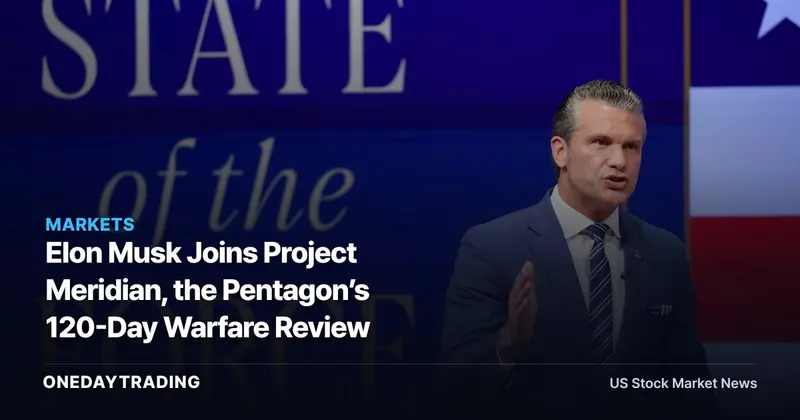
CNBC reported that Project Meridian will spend 120 days looking at future warfare and the capabilities the U.S. military will need. Pete Hegseth announced the initiative during a State of the Force address at Marine Corps Base Quantico in Virginia, while Pentagon technology chief Emil Michael will oversee the work.
Hegseth drew a boundary around the assignment. He said Project Meridian was not intended to develop new strategies or policies, describing its purpose instead as identifying domains and capabilities the military must master. He framed the work around “discovering, developing, and fielding” systems for environments extending “from under the Earth to beyond the moon.”
That wording places the project upstream of procurement. Identifying a capability can influence how military planners frame a problem, but the fact sheet does not specify whether Meridian will issue a report, define technical requirements, recommend programs or produce another form of deliverable. The exact start and end dates within the stated 120-day period are also unknown.
SpaceX and Anduril Enter With Existing Pentagon Relationships
The Space Force awarded SpaceX a $4.16 billion satellite contract in May, according to CNBC. SpaceX also received a $2.29 billion military satellite communications contract days before that May award, establishing that Musk’s company already participates in Pentagon work.
The Marine Corps awarded Anduril a contract worth up to $642 million in 2025 for counter-drone systems, CNBC reported. Anduril develops autonomous weapons and other military technology, giving Palmer Luckey’s participation a direct connection to the capabilities under discussion.
Those relationships create the central investor tension. Existing contractors could understand operational requirements and technology constraints in ways that improve the quality of the review. Their commercial interests also make process details important, especially because the identities of the broader team and the mechanism for adopting recommendations have not been disclosed.
Elon Musk, Palmer Luckey and Newt Gingrich will serve as co-leads, and none has served in the U.S. military. The broader team is expected to draw participants from government, industry, academia and the policy world. That mix could widen the project’s technical perspective, though the fact sheet provides no names beyond the leadership group.
Autonomous Warfare Expands the Strategic Frame
Project Meridian arrives alongside Pentagon plans for a new four-star Autonomous Warfare Command. The command is aimed at scaling autonomous and robotic systems across the military, while Meridian has the broader task of identifying future domains, technologies and weapons.
The distinction is material. A command represents an organizational plan; Project Meridian is an examination of future needs. Neither fact alone establishes which systems will be purchased, which contractors might supply them or how quickly identified capabilities could move from discovery through development to fielding.
For defense-sector analysis, the transmission mechanism runs through future requirements. A clearly defined military need may eventually shape technical specifications and procurement priorities. The present evidence supports attention to that pathway, not an assumption that participation converts automatically into an order, backlog or revenue.
Stock and Defense-Sector Read-Through
- Tesla: TSLA is the available U.S.-listed equity directly connected through Elon Musk, who is CEO of Tesla and SpaceX. The fact sheet identifies no Tesla military award or operating role in Project Meridian, so the initiative does not support a company-specific earnings conclusion for Tesla.
- SpaceX: Its investment relevance comes from existing Pentagon contracts and Musk’s leadership role. The $4.16 billion and $2.29 billion Space Force awards in May show a substantial contractual relationship, while Project Meridian itself is not identified as a new SpaceX award.
- Anduril: The 2025 Marine Corps counter-drone contract worth up to $642 million supplies concrete evidence of defense demand for its systems. Luckey’s co-lead role may sharpen investor attention on autonomous weapons and counter-drone capabilities, without proving additional business.
- Defense technology: The combination of a future-capabilities review and plans for an Autonomous Warfare Command highlights autonomy, robotics and military technology as areas of institutional focus. The sheet does not identify suppliers beyond the companies already named.
The Bull and Bear Cases for Project Meridian
Bull case: Project Meridian could clarify which capabilities the Pentagon considers important across future operating domains. SpaceX and Anduril already hold military contracts, so their leaders bring experience connected to satellite systems, military communications, counter-drone systems and autonomous weapons. More precise capability definitions could make future technology development and procurement questions easier to evaluate.
Bear case: The initiative may remain too far upstream to support a commercial thesis. Its deliverables, adoption process and co-lead compensation are unknown, and no fact in the sheet links the review to a new contract. Participation can signal access to strategic discussion without establishing favorable economics for Tesla, SpaceX or Anduril.
The balanced reading is therefore neutral for TSLA and conditional for the defense-technology theme. The announcement establishes who will help conduct the review and how long the examination will run. It does not establish spending allocations, supplier selection, financial returns or an outcome for any listed stock.
Investor Checkpoints During the 120-Day Review
- Define the output: Look for The Pentagon to specify whether Project Meridian will deliver capability lists, technical requirements, program recommendations or another concrete work product.
- Track adoption: The key policy checkpoint is how Emil Michael and The Pentagon plan to evaluate and use the project’s recommendations.
- Separate review work from awards: Any future contract should be assessed on its named recipient, value, scope and awarding military branch rather than inferred from a co-lead’s participation.
- Watch the corporate response: Anduril, SpaceX and Tesla did not immediately respond to requests for comment, leaving their expected contributions and any internal resource commitments unspecified.
What Project Meridian Does Not Yet Answer
The project’s broader membership, specific deliverables and recommendation process remain undisclosed. Investors also lack information about compensation for the co-leads. Those gaps matter because they determine whether Meridian becomes a defined input into military planning or remains a high-level examination of future warfare.
The next meaningful signal is not a slogan about technological leadership. It is a documented link between an identified capability, a Pentagon adoption decision and a defined procurement path. Until that chain appears, the existing Space Force and Marine Corps contracts are the financial facts; Project Meridian is the strategic variable.
📊 Analysis
Signal Neutral
Why Project Meridian may shape future defense-technology priorities, while its deliverables, adoption process and commercial implications remain undefined.
This article was independently written by OneDayTrading from public reporting. Read the original (CNBC)