At a Glance
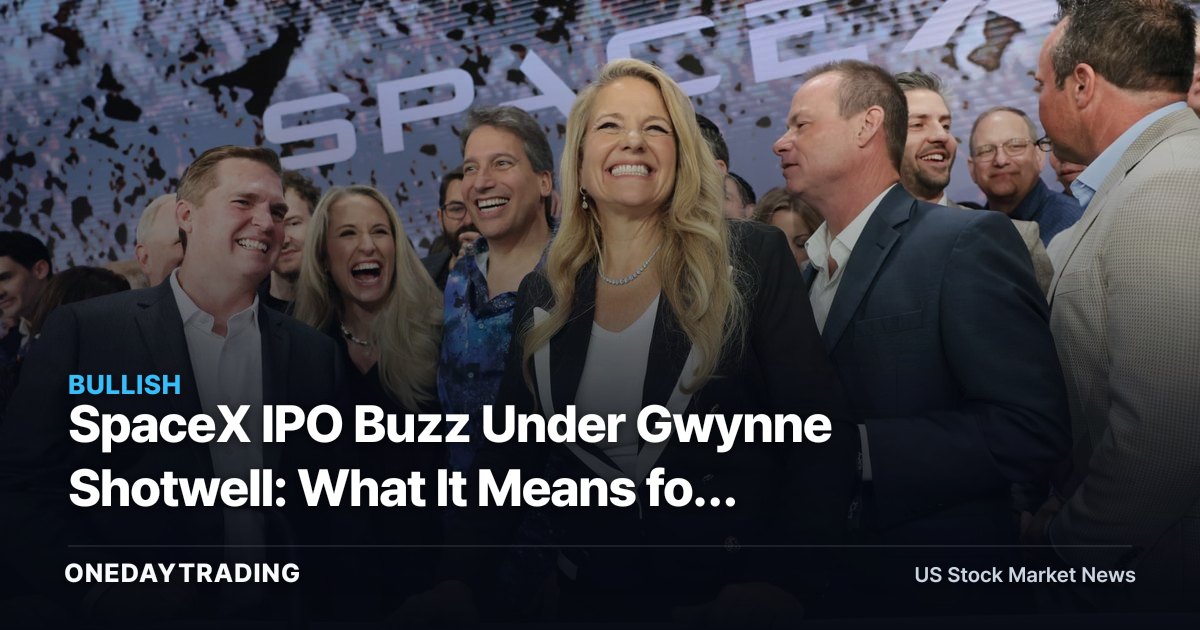
CNBC profiled Gwynne Shotwell, SpaceX president and chief operating officer and Elon Musk's second-in-command, framing her as central to building SpaceX into what the report calls an IPO giant. The story matters less for what it says about one executive and more for what it signals to public-market investors: the most valuable private space company is being discussed in IPO terms, and there is still no clean way to own it on a U.S. exchange.
Why It Matters Now
SpaceX remains private, so the immediate investing question is not whether to buy SpaceX but how its trajectory reprices everything around it. Shotwell runs commercial operations, including the Starlink broadband unit, and Starlink is the part of SpaceX with the clearest standalone-listing logic: recurring subscription revenue is exactly what public markets reward versus lumpy launch contracts. A profile emphasizing IPO readiness reads as soft signaling that a carve-out or listing is being prepared for, even if no date exists.
The read-through runs through three channels. First, validation: a marquee space listing would give public peers a fresh, high-profile comparable, lifting sector multiples. Second, capital flows: a mega-IPO tends to pull generalist money into a theme, benefiting liquid pure-plays before the deal prices. Third, competition: the same listing would hand SpaceX cheaper capital to undercut launch and satellite-broadband rivals, which cuts the other way for those same peers.
FAQ
- Can I buy SpaceX stock today? Not directly on a U.S. exchange. Exposure exists only through private-market vehicles and a few closed-end funds that hold SpaceX positions.
- Is an IPO confirmed? No. The CNBC piece is a profile, not a filing. Treat IPO talk as anticipation, not a scheduled event.
- Which unit would list first? Starlink is the most-cited candidate because subscription revenue suits public markets better than launch services.
- Who is Gwynne Shotwell? SpaceX's president and COO, described as Musk's second-in-command and the operational leader behind its commercial growth.
Related Stocks and Sectors
- Rocket Lab (RKLB) — the closest listed launch pure-play; benefits from sector re-rating but faces a better-capitalized SpaceX after any raise.
- AST SpaceMobile (ASTS) and Globalstar (GSAT) — satellite-connectivity names whose narratives rise and fall with Starlink sentiment and direct-to-device competition.
- Tesla (TSLA) — the listed Musk proxy; SpaceX value creation reinforces the broader Musk-venture halo without giving direct exposure.
- Aerospace and defense primes — incumbents that compete for government launch and satellite budgets a larger SpaceX would contest.
What to Watch
- Any S-1 or confidential filing tied to Starlink as the first hard IPO signal.
- Marks on SpaceX positions in closed-end funds, which hint at private valuation momentum.
- Launch cadence and Starlink subscriber milestones disclosed via contracts or regulators.
- How RKLB and ASTS trade on SpaceX headlines — sentiment proxy versus competitive fear.
Overall Outlook
The bull case is that IPO momentum lifts the entire space-and-satellite complex and finally hands public investors a path to the theme. The risk is twofold: there is no confirmed deal, valuations on space peers already embed optimism, and a freshly funded SpaceX is as much a competitive threat to RKLB, ASTS and GSAT as it is a rising tide. Positioning on a profile piece, rather than a filing, means trading anticipation.
Market data check: RKLB
RKLB last traded near $110.15 (+0.82%). Our composite signal — blending price momentum and news flow — reads 🟡 neutral. Price momentum scores 57/100.
Data as of publication. Price via market feeds; for reference only, not investment advice.
📊 Analysis
Signal Bullish
Why IPO signaling around SpaceX and Starlink tends to validate and pull capital into listed space and satellite peers, even though the deal is unconfirmed.
Tickers$RKLB$ASTS$GSAT$TSLA
This article was independently written by OneDayTrading from public reporting. Read the original (CNBC)