Summary
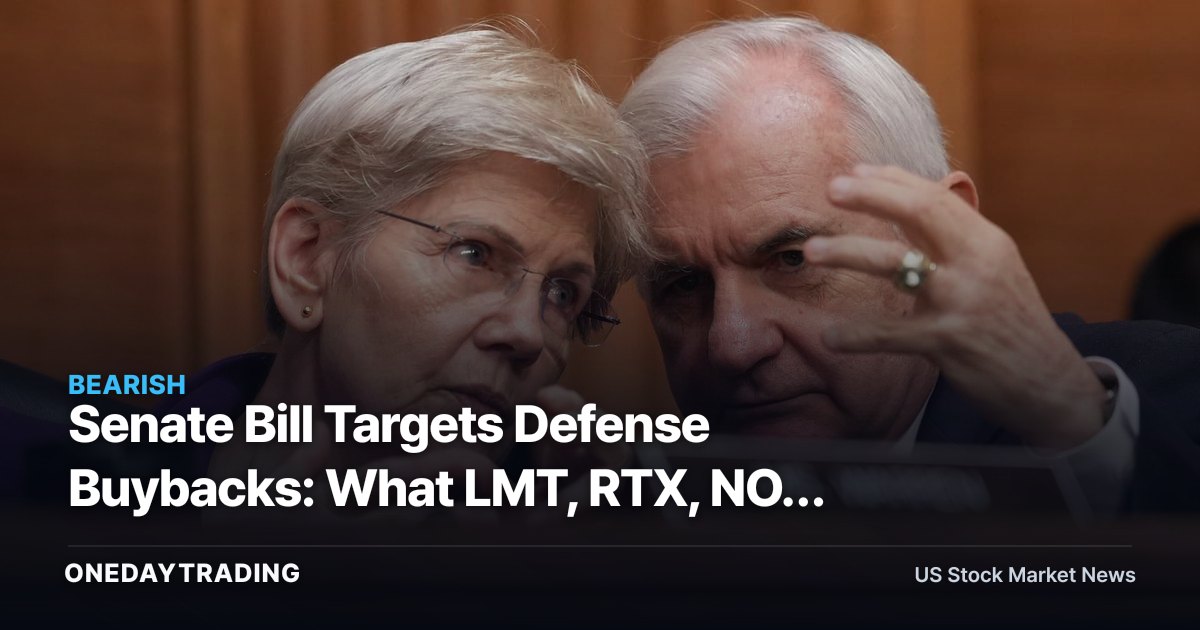
The Senate Armed Services Committee has approved legislation that would bar defense contractors from buying back their own shares without Pentagon sign-off. For an industry that has leaned heavily on repurchases to support per-share earnings, this introduces a new constraint on the primary lever management uses to reward shareholders.
The measure has cleared committee but is not yet law, so the immediate effect is on sentiment and capital-allocation planning rather than reported cash flows.
The Full Story
Defense primes generate steady, government-funded cash flow but have limited high-return organic growth outlets, so they have historically returned the bulk of free cash to shareholders through buybacks and dividends. Tying repurchases to Pentagon approval inserts a political and procedural gatekeeper into that process, and the framing is pointed: lawmakers are signaling that money flowing from defense contracts should be channeled toward capacity, supply chains and research rather than share count reduction.
Because the bill targets the contractors most dependent on federal procurement, the companies with the highest revenue concentration in U.S. defense are the most exposed. Diversified players with large commercial segments would feel a smaller proportional hit, since only the defense-linked portion of their capital strategy is implicated.
Structural Background
Buybacks shrink the share base, mechanically lifting earnings per share even when net income is flat. For mature primes with mid-single-digit revenue growth, repurchases have been a core part of the total-return story that justifies their valuations. A requirement for case-by-case Pentagon approval raises the question of whether capital returns become slower, smaller or politically conditioned.
Stock & Sector Ripple
- Lockheed Martin (LMT): As the largest pure-play prime with heavy U.S. government revenue dependence, it has the least commercial offset and the most reliance on buybacks to support EPS.
- RTX (RTX): A meaningful commercial aerospace segment partly cushions the defense exposure, softening the relative impact versus pure primes.
- Northrop Grumman (NOC): Concentrated in classified and strategic programs funded almost entirely by the Pentagon, leaving capital returns squarely in scope.
- General Dynamics (GD): Its Gulfstream business jets provide a commercial buffer, but defense remains the cash engine.
- L3Harris (LHX): A mid-cap prime that has used repurchases to digest acquisitions, making buyback flexibility strategically important.
Bull vs Bear Scenarios
The bearish read is straightforward: a constraint on the dominant capital-return tool could compress the valuation premium these names carry and slow EPS accretion. The counter-case is that this is still committee-stage language that must survive the full Senate, the House and reconciliation, where it may be diluted or stripped. Dividends remain untouched, record defense budgets and elevated global tensions keep order books full, and capital redirected into capacity could support longer-term contract throughput.
Investor Action Points
- Track the bill's path beyond committee — full Senate floor action and the House version will show whether the buyback language survives.
- Watch the next earnings calls for management commentary on repurchase pacing and any shift toward dividends or capex.
- Compare defense-revenue concentration across names; higher government dependence equals higher exposure to the rule.
- Monitor whether buyback authorizations are paused or reaffirmed in upcoming capital-allocation updates.
Market data check: LMT
LMT last traded near $530 (-1.11%). Our composite signal — blending price momentum and news flow — reads 🟡 neutral. Price momentum scores 41/100.
Data as of publication. Price via market feeds; for reference only, not investment advice.
📊 Analysis
Signal Bearish
Why Restricting buybacks removes a primary EPS-support and capital-return lever for defense primes, a negative for shareholder-return-driven valuations.
Tickers$LMT$RTX$NOC$GD$LHX
This article was independently written by OneDayTrading from public reporting. Read the original (CNBC)