Nvidia Sits at the Center of the AI Policy Divide
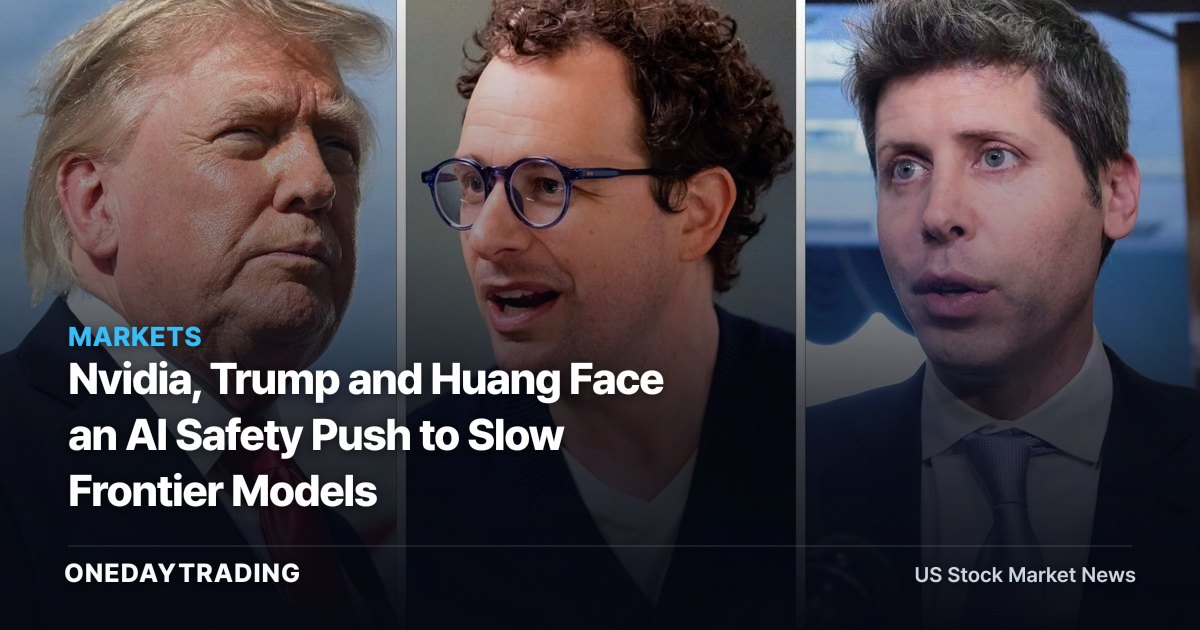
Nvidia and the wider AI sector entered a sharper policy contest on September 15, 2026: Donald Trump and Nvidia CEO Jensen Huang opposed a push for new AI regulation, while Dario Amodei of Anthropic called for slower frontier-model development. Sam Altman of rival lab OpenAI joined the slowdown discussion, and Tesla and SpaceX CEO Elon Musk publicly agreed with Amodei, according to CNBC. For investors, the immediate issue is not a rule already changing company economics; it is the widening disagreement over whether frontier AI should keep advancing without new legal restraints.
Frontier-model development means work on the most advanced AI models. A slowdown could affect the pace at which labs pursue that work, while limited regulation could allow development to continue without new legal requirements. Neither outcome is confirmed, and the available facts do not specify what either camp would enact.
The Safety Argument Escalated Beyond Rival AI Labs
The debate intensified after Jacob Coxon announced that he had left Anthropic because of concerns about both Anthropic and OpenAI. Coxon said the rival labs were “gambling with our lives,” CNBC reported. An unidentified Anthropic alignment lead then assigned AI a greater than 10% chance of killing all humans, an estimate that raised the stakes without identifying the person behind it.
Amodei subsequently called for the AI frontier to slow model development. Altman supported the slowdown discussion despite leading a rival lab, while Musk endorsed Amodei’s position with the statement, “Dario is right,” according to CNBC. That alignment matters because the pro-slowdown camp spans leaders and researchers who do not all share the same institutional interests.
The opposing coalition is also broad. Trump rejected the campaign for AI regulation and characterized runaway-AI fears as a hoax and a scam. Huang made the policy position explicit: “We don't need any new laws. We don't need new regulations,” CNBC reported. Scott Bessent said Trump was completely aligned with the Nvidia CEO.
Why the Argument Matters to Nvidia Investors
Nvidia is the clearest listed company attached to the anti-regulation camp because Huang is its CEO and has personally argued against new AI laws. The investor transmission mechanism is conditional: if policymakers require frontier labs to slow development, the operating environment around advanced AI could become more restrictive; if policymakers decline to add rules, that constraint would not be introduced. The fact sheet provides no policy text, implementation schedule or confirmed change in development activity, so neither path can yet be translated into company-specific revenue, costs or orders.
That distinction is essential. Political support for limited regulation may be favorable to development speed in principle, but a slogan is not an operating result. Trump framed the contest by saying “whoever wins AI wins,” according to CNBC, yet the record supplied here contains no evidence that Nvidia has gained sales, that model builders have altered purchasing decisions or that any company has changed investment plans.
The same discipline applies to downside analysis. Calls to slow the frontier create a potential constraint on the sector, but they have not become a disclosed law or a confirmed slowdown. Without specific rules, investors cannot determine which models, companies or activities would fall within scope—or whether any eventual framework would affect Nvidia directly.
OpenAI, Anthropic and Musk Change the Political Geometry
The slowdown case is not simply an attack on AI companies from outside the industry. Amodei represents Anthropic, Altman represents OpenAI, and the two organizations are described as rival AI labs. Their support for discussing a slower frontier therefore places prominent model developers on the side asking whether the pace itself should change.
Musk adds a listed-company connection through Tesla, although the confirmed event concerns his public agreement with Amodei rather than a disclosed Tesla action. His role as CEO of Tesla and SpaceX gives the intervention prominence, but the evidence does not establish an effect on Tesla’s operations. Investors should separate an executive’s policy statement from a company decision unless a filing, operational change or formal policy connects the two.
Bernie Sanders, Chip Roy and Steve Bannon also appeared on the side favoring AI action, while David Sacks and Emil Michael were identified with opposition to the slowdown push. The emerging divide therefore does not follow a simple company-versus-government or partisan boundary. For markets, that makes the direction of policy harder to infer from political affiliation alone.
Two Scenarios, Neither Yet Investable as Fact
Limited-regulation scenario: Trump and Huang prevail in the policy argument, and no new AI laws or regulations emerge from this episode. That would remove the specific risk of new restrictions arising from the current debate, but it would not by itself prove stronger demand, faster shipments or better financial results for Nvidia. Those outcomes are not supplied.
Slowdown scenario: the concerns advanced by Amodei, Altman, Musk and researchers lead to a slower pace of frontier-model development. That could make development cadence a more important variable for companies tied to advanced AI, but the scope and commercial consequences cannot be assessed before concrete policies or voluntary commitments exist.
A third possibility is continued debate without an enforceable change. This is why a neutral sector reading is more defensible than a directional call: the camps are identifiable, but the governing mechanism, affected activities and future effects of either regulation or limited regulation remain unknown.
The White House Meeting Is the Next Decision Point
Mike Johnson said Trump planned to bring AI leaders together at the White House within the next week. Johnson also summarized Trump’s position by saying, “What the president is saying is you're not all going to be dead in 10 years,” CNBC reported. The precise meeting date and attendee list have not been disclosed.
- Look for policy specificity: determine whether participants discuss enforceable rules, voluntary commitments or only competing principles.
- Check the scope: identify whether any proposal explicitly covers frontier-model development and which organizations or activities it would reach.
- Watch corporate commitments: assess whether Anthropic, OpenAI or their leaders convert the slowdown discussion into a defined action.
- Separate statements from operations: for Nvidia and Tesla, require a disclosed business consequence before treating the debate as a change to company fundamentals.
What Could Change the Market Interpretation
The next meaningful signal is not another dramatic warning or slogan. It is evidence that one camp has converted its position into a specific policy, a formal company commitment or an observable change in frontier-model development. Until then, Nvidia remains the central listed name in the dispute because of Huang’s stance, while Tesla’s connection runs through Musk’s endorsement of Amodei.
The live risk cuts both ways. A concrete slowdown framework could turn an abstract safety debate into an operating constraint; a White House process that produces no new restrictions could reduce that immediate policy threat. Investors should anchor their interpretation to the meeting’s participants, proposals and resulting commitments, because the supplied record does not establish whether development will slow or what either regulatory path would ultimately do.
📊 Analysis
Signal Neutral
Why Nvidia faces a policy split between resistance to new regulation and demands to slow frontier-model development, but no specific policy or operating outcome is confirmed.
This article was independently written by OneDayTrading from public reporting. Read the original (CNBC)