TSMC’s August record tests whether AI demand is converting into sales
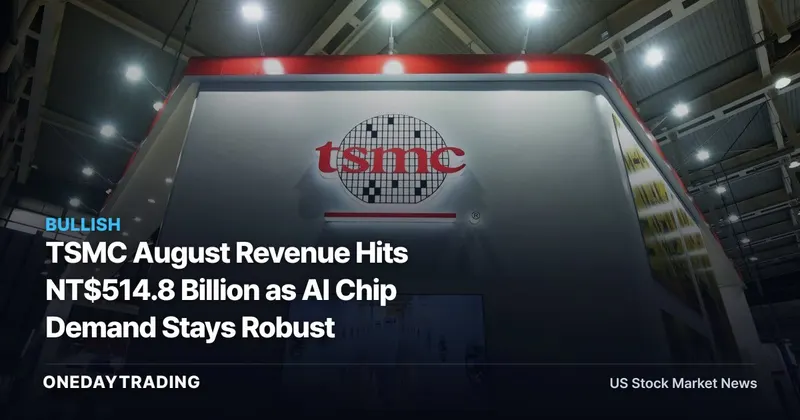
TSMC’s August revenue gives semiconductor investors a hard demand signal: Taiwan Semiconductor Manufacturing Co. reported NT$514.8 billion, or $16.35 billion, in monthly sales on Thursday, Sept. 10, 2026, according to CNBC. The increase of 53.3% from a year earlier and 10.1% from July suggests that orders tied to advanced computing are reaching the foundry’s income statement, even as TSMC shares closed 0.61% lower before the release.
The central read-through is supply allocation. CNBC reported that TSMC’s 5-nanometer, 4-nanometer and 3-nanometer capacity was fully booked in the second quarter as demand for AI server processors remained strong. For investors, that combination matters because advanced nodes are the manufacturing tiers used for the most complex chips; sustained bookings can support revenue visibility, while the report does not disclose margins, customer concentration or the exact amount of second-quarter profit.
What the revenue cadence says about the foundry cycle
TSMC’s monthly revenue has increased for four straight months, CNBC reported. The August result therefore extends an existing run rather than representing a single isolated spike, but the source does not provide a monthly breakdown or explain how much of the change came from volume, pricing or product mix.
The company had already reported a more than 77% year-on-year increase in second-quarter profit and forecast third-quarter revenue between $44.6 billion and $45.8 billion, according to CNBC. August sales are one data point inside that quarter’s outlook; they do not, by themselves, establish whether the company will finish above or below the forecast range.
TSMC described AI-related demand as “extremely robust” during its July second-quarter earnings call, CNBC reported. That statement and the fully booked advanced nodes are consistent with an AI-led demand thesis, but the article supplies no utilization percentage, wafer shipment count or customer-level order data to quantify how durable the acceleration is.
Market structure keeps TSMC at the center of the AI supply chain
TrendForce data cited by CNBC put TSMC’s second-quarter foundry market share at 72.5%. Samsung Foundry ranked second with 5.9%, while China’s SMIC followed with 5.4%; the figures show a wide reported gap between TSMC and the next two named competitors.
The world’s top 10 foundries generated nearly $53.49 billion of combined second-quarter revenue, CNBC reported. That aggregate establishes that the strength was visible across the leading foundries, while the source attributes part of the record to supply constraints for advanced processes used in AI and high-performance-computing processors. A counter-scenario is that supply constraints can lift industry revenue without proving that end-market demand will keep expanding at the same pace.
TSMC and ASML, described by CNBC as a Dutch chip-equipment giant, also announced an initiative to advance next-generation chipmaking. TSMC said it plans to use ASML’s High NA technology in large-scale manufacturing for advanced nodes starting in 2030. The announcement is a future manufacturing plan, not current production or realized revenue, and CNBC did not provide the initiative’s specific terms or scope.
Investor checkpoints and the risk in the headline number
- Third-quarter revenue delivery: Compare reported quarterly revenue with TSMC’s $44.6 billion–$45.8 billion forecast cited by CNBC. August’s NT$514.8 billion is supportive context, but the complete quarter is the relevant test.
- Advanced-node booking evidence: Check whether TSMC again describes 5-nanometer, 4-nanometer and 3-nanometer capacity as fully booked. Any change would alter the interpretation of AI demand’s effect on near-term foundry utilization.
- Profit conversion: The company reported a more than 77% year-on-year second-quarter profit increase, but the exact profit amount is not supplied. Future results should show whether revenue growth continues to translate into earnings growth.
- Competitive share: Track the next TrendForce market-share update against the reported 72.5% for TSMC, 5.9% for Samsung Foundry and 5.4% for SMIC. The source provides no later share figures or evidence of a shift.
The bullish case rests on a coherent chain reported by CNBC: record August sales, four consecutive months of monthly revenue increases, strong second-quarter profit growth and full booking of advanced nodes amid AI processor demand. The risk is evidentiary as much as cyclical: the supplied report does not disclose margins, exact profit, customer mix or the terms of the ASML initiative. The next decisive information is TSMC’s complete third-quarter revenue and earnings disclosure, alongside any updated commentary on advanced-node bookings and the path toward planned High NA manufacturing in 2030.
📊 Analysis
Signal Bullish
Why Record August sales, strong second-quarter profit growth and sustained advanced-node demand provide a positive read-through for TSMC and the foundry sector, although the shares were lower before the release.
This article was independently written by OneDayTrading from public reporting. Read the original (CNBC)