Key Takeaways
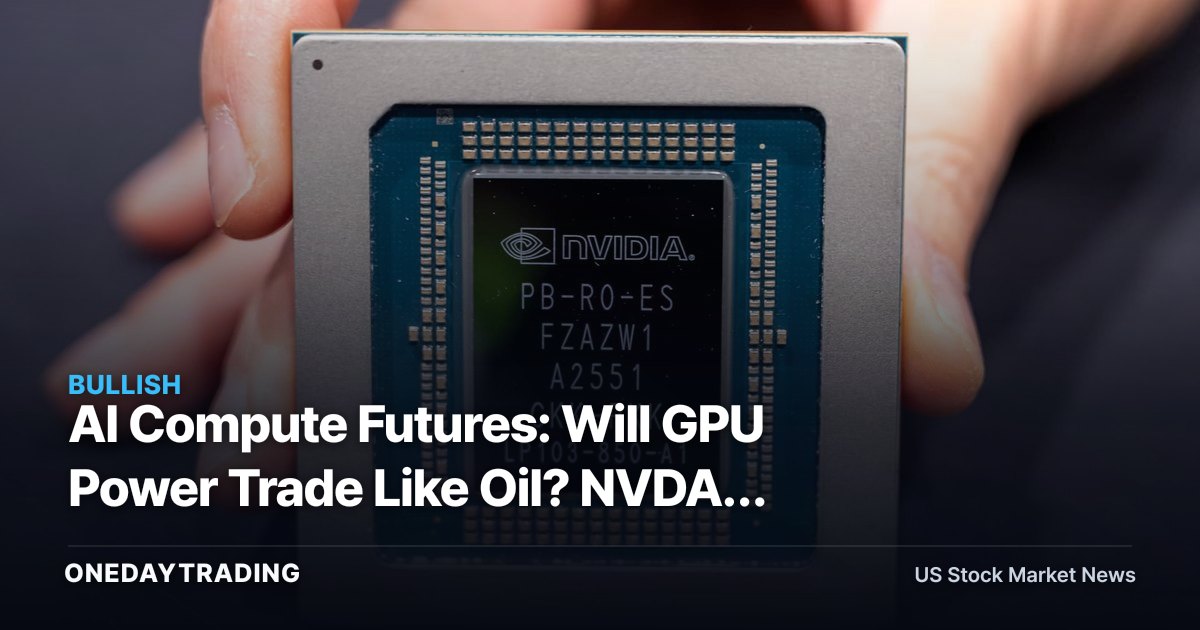
An effort to standardize and trade AI computing power as a commodity could reshape how investors think about the GPU economy — turning a scarce, opaquely priced resource into something with a futures curve. If compute becomes a financial benchmark, the winners are not only chipmakers but the cloud renters, hyperscalers and exchanges that sit on the price-discovery layer. The catch: this is an early-stage thesis, not a live liquid market.
What Happened
Silicon Data's Carmen Li argues that AI compute futures could eventually rival some of the world's largest commodity markets, framing computing power as a new tradeable raw input — the way oil, natural gas or electricity are bought and sold today. The pitch is to convert GPU time into a standardized unit with transparent spot and forward pricing, rather than leaving it locked inside bespoke cloud contracts.
The logic mirrors how other essential inputs matured: once a resource is scarce, costly and economically central, markets tend to build benchmarks, indices and eventually derivatives around it. AI training and inference now consume enormous, unevenly priced compute, and buyers lack a clean way to hedge cost or lock future capacity.
Background and Context
Today GPU access is priced through long-term cloud commitments, scarce high-end accelerators and regional power constraints. A commodity framework would attempt to abstract that into a fungible unit, letting compute consumers hedge volatility and capacity holders monetize idle supply. The comparison to oil is deliberate: a standardized, indexable input large enough to support a deep paper market layered on top of the physical one.
Market and Stock Impact
- NVDA — As the dominant supplier of training-grade accelerators, Nvidia sits at the base of any compute index; transparent pricing could reinforce demand visibility, though commoditization can also compress the rental margins built on its hardware.
- CRWV — GPU-cloud specialists like CoreWeave are the clearest leverage to a compute spot market: their core product literally is rentable GPU time, so a traded benchmark could improve utilization, financing and forward booking.
- MSFT, AMZN, GOOGL — Hyperscalers hold the largest captive compute fleets; a liquid market lets them sell spare capacity and hedge, but also exposes their premium-priced contracts to a transparent reference rate.
- CME, ICE — Exchange operators are the structural beneficiaries if standardized compute futures list, earning fees on a potential new contract category without taking commodity-price risk.
Investor Checkpoints
- Whether a credible, widely cited compute price index or benchmark actually launches and gains volume — the precondition for futures.
- Exchange announcements (CME, ICE) on listed compute or GPU-time contracts.
- GPU-cloud utilization and contract-duration disclosures in CRWV-type earnings, which would signal demand for spot versus locked capacity.
- Nvidia commentary on supply normalization and accelerator pricing, the upstream input to any index.
Outlook
The bull case is structural: compute is scarce, capital-intensive and central to the AI buildout, exactly the profile that historically spawns commodity markets and derivative liquidity. The risks are concrete — compute is harder to standardize than a barrel of oil because performance varies by chip generation, location and power cost, and a thesis from one data provider is far from an established, liquid market. For now this is an optionality on market structure rather than a near-term earnings driver, and adoption depth is the variable that decides which names actually capture it.
Market data check: NVDA
NVDA last traded near $209.3 (-1.48%). Our composite signal — blending price momentum and news flow — reads 🟡 neutral. Price momentum scores 38/100 (soft).
Data as of publication. Price via market feeds; for reference only, not investment advice.
📊 Analysis
Signal Bullish
Why A standardized, tradeable compute market would expand demand visibility and monetization paths for GPU suppliers, cloud renters and exchanges, a net structural positive even if early-stage.
Tickers$NVDA$CRWV$CME$MSFT$AMZN$ICE
This article was independently written by OneDayTrading from public reporting. Read the original (CNBC)