At a Glance
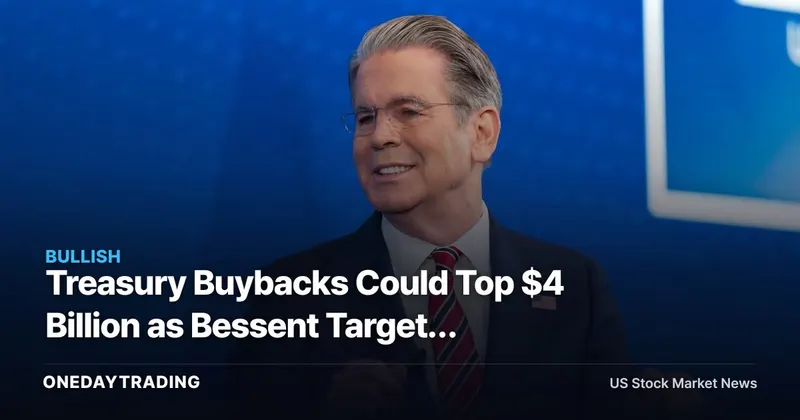
Treasury buybacks matter for U.S. equities because Bessent signaled that the Treasury could run an operation above $4 billion to support longer-dated securities, where rising yields have been pressuring duration assets, equity multiples and rate-sensitive sectors.
Per CNBC's Aug. 20 reporting, Bessent said the Treasury is going to make a market in longer-dated securities after yields in that part of the curve surged lately.
Why It Matters Now
A Treasury buyback is a government operation that repurchases outstanding Treasury securities, usually to improve liquidity in specific maturities rather than to change fiscal policy by itself.
The equity read-through is not that $4 billion changes the debt market mechanically. The read-through is that the Treasury is acknowledging stress in longer-dated bonds, the part of the market that sets discount rates for growth stocks, mortgage rates for housing and hurdle rates for corporate investment.
The tape already prices some anxiety through the source's reference to surging long yields. What the tape may not fully price is whether an official buyer can narrow liquidity premiums without convincing investors that the Treasury is responding to a deeper demand problem.
Key Debates
- Size versus signal: A Treasury buyback above $4 billion is small against the long-end market, but Bessent's market-making language gives investors a policy signal.
- Liquidity versus levels: Treasury buybacks can improve trading conditions in longer-dated securities, but Treasury buybacks do not guarantee lower long-term yields.
- Equity multiples: If long yields stabilize after CNBC's reported Bessent comments, long-duration software, internet and AI shares get valuation relief first.
- Credibility risk: If yields keep rising after a buyback operation above $4 billion, investors may treat the action as evidence that private demand remains weak.
Related Stocks & Sectors
- Software and internet: High-multiple growth shares are sensitive to longer-dated Treasury yields because cash flows sit farther in the future.
- Semiconductors and AI infrastructure: AI capital spending stories depend on multiples that expand when long-rate pressure fades.
- REITs and real estate: Property equities feel long-yield moves through financing costs and valuation cap rates.
- Banks: Financials benefit from higher rates only when funding costs and credit stress do not offset the yield advantage.
- Homebuilders: Mortgage-rate expectations follow longer-dated Treasury yields, so housing demand reacts quickly to curve volatility.
What to Watch
- The final Treasury buyback size, especially whether the operation lands meaningfully above the $4 billion figure in CNBC's report.
- The response in longer-dated Treasury yields after Bessent's market-making comments translate into an actual operation.
- Sector leadership in rate-sensitive equities, especially whether software, REITs and homebuilders outperform after long yields stabilize.
- Liquidity signs in longer-dated securities, because smoother trading conditions matter more than the headline dollar amount.
Overall Outlook
The bullish case is narrow but real: Treasury buybacks above $4 billion can reduce liquidity pressure where long yields have surged, and lower rate volatility supports equity multiples. The risk is equally direct: if long yields keep climbing after Bessent's operation, the market will read the buyback as a limited patch rather than a durable policy backstop.
FAQ
Why do Treasury buybacks affect stocks?
Treasury buybacks affect stocks because longer-dated Treasury yields help set discount rates for equity valuation. If Bessent's Treasury operation reduces pressure in long bonds, growth stocks and REITs get the cleanest valuation channel.
How big could the Treasury buyback operation be?
CNBC reported on Aug. 20 that Bessent said the Treasury buyback operation could be more than $4 billion. The key investor question is whether a buyback above $4 billion improves liquidity in longer-dated securities.
What happens if long-term Treasury yields keep rising?
If longer-dated Treasury yields keep rising after the Treasury buyback, equity investors should assume the market wants more compensation for duration risk. That outcome would pressure rate-sensitive sectors and limit the valuation benefit from Bessent's announcement.
📊 Analysis
Signal Bullish
Why The reported Treasury buyback plan is a modest but positive liquidity signal for longer-dated bonds and rate-sensitive equity sectors if it stabilizes surging yields.
This article was independently written by OneDayTrading from public reporting. Read the original (CNBC)