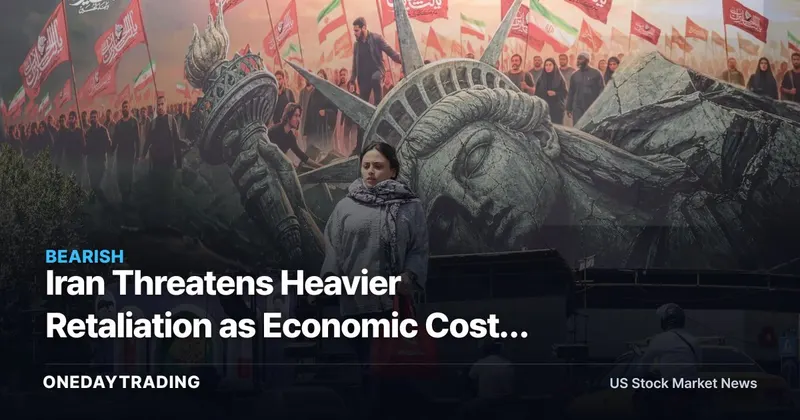
Why could Iran’s retaliation warning move oil and defense stocks?
A geopolitical risk premium is the extra price investors demand when conflict increases uncertainty around energy supply, transportation routes or corporate cash flows. Iran’s warning matters because faster retaliation would shorten the time available for markets and governments to absorb another shock.
The causal chain runs from escalation risk to commodity expectations, then into inflation assumptions, interest rates and equity multiples. Higher expected energy costs would favor producers relative to fuel-intensive transportation businesses, while firmer inflation expectations would pressure long-duration growth valuations through higher discount rates.
By the Numbers
The supplied CNBC description contains no casualty count, oil-price move, production loss, fiscal estimate or retaliation date. That absence is analytically important: the report establishes stronger Iranian rhetoric and mounting economic pressure, but it does not establish measurable damage to global supply or listed-company earnings.
The two explicit changes are directional rather than numerical: Iran warned that retaliation would become faster and heavier, and Iran acknowledged an increasing economic toll from the war. Investors therefore have a catalyst, but not enough data to calculate an earnings revision.
Winners & Losers
- Oil producers: Benefit if escalation creates an enduring crude-risk premium; gains fade if physical supply remains intact.
- Defense contractors: Gain from expectations of replenishment or expanded demand, although the source reports no new orders or appropriations.
- Airlines and transportation: Face pressure if fuel or route costs rise, with no reported disruption yet to quantify the margin effect.
- Rate-sensitive growth stocks: Lose relative support if an energy shock revives inflation risk and lifts discount rates.
Risk Check
- The warning may remain rhetorical rather than operational.
- Economic pressure on Iran could constrain retaliation instead of accelerating it.
- Markets could overprice escalation before any supply, route or earnings impact appears.
- The supplied report gives no asset-price reaction, leaving current positioning unknown.
Bottom Line
The headline is bullish for geopolitical hedges and bearish for fuel-sensitive and rate-sensitive equities only if retaliation reaches the physical economy. The next decisive checkpoints are confirmed attacks, documented energy or transport disruption, and any measurable change in commodity prices or inflation expectations; absent those signals, valuation moves rest mainly on fear.
FAQ
Why could Iran’s warning affect U.S. stocks?
CNBC reported that Iran threatened faster and heavier retaliation against U.S. attacks. If retaliation disrupts energy or transportation, corporate costs and inflation expectations would rise; without disruption, the earnings channel stays limited.
What sectors benefit from Iran-U.S. escalation?
Oil producers and defense contractors would have the clearest positive exposure through commodity pricing and potential demand. The supplied CNBC report identifies no production outage, procurement order or company-specific revenue impact.
What should investors watch after Iran’s retaliation threat?
Investors should track confirmed military actions, physical supply interruptions, transportation constraints and commodity-price reactions. Those metrics separate a temporary risk premium from a shock capable of changing earnings and interest-rate expectations.
📊 Analysis
Signal Bearish
Why Iran’s threat of faster and heavier retaliation increases downside risk for broad equities through potential energy-cost, inflation and valuation channels, although no physical disruption is yet documented.
This article was independently written by OneDayTrading from public reporting. Read the original (CNBC)