S&P 500 Midterm Risk Is About Positioning, Not a Settled Result
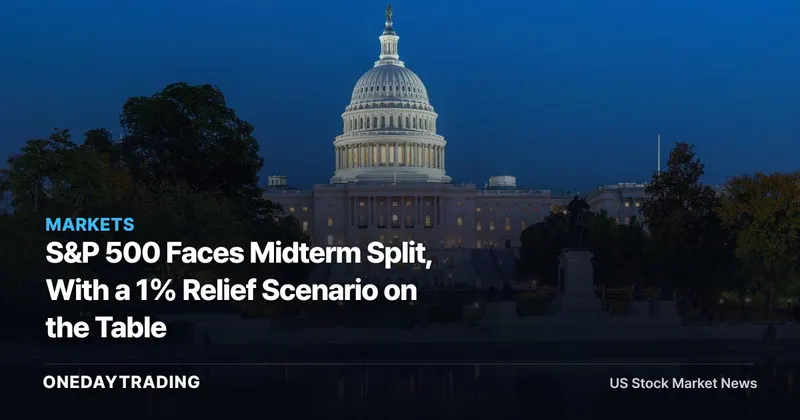
The S&P 500 enters the 2026 U.S. midterm election with investors assessing sharply different implications for the index, financials, healthcare, defense, energy and data centers. CNBC reported on 2026-11-03 that polls pointed to a Democratic victory in the House while describing the Senate as a toss-up. The investable issue is therefore not a confirmed political outcome, but the gap between possible results and portfolios that may not strongly reflect any one of them.
A midterm election is the congressional vote that can change control of the House and Senate, altering the path of legislation and sector policy without determining those policies by itself. Wolfe Research survey data indicated that institutional investors were not strongly positioned for a particular result. Tobin Marcus also said “polling is likely overstating Democratic strength,” reinforcing the possibility that the immediate market reaction depends as much on surprise as on the winning party.
JPMorgan’s 1% S&P 500 Scenario Defines the Short-Term Test
JPMorgan traders projected an S&P 500 increase of up to 1% on Wednesday if Republicans retained the Senate, according to CNBC. That is a conditional estimate, not an observed return. Its importance lies in the implied asymmetry: a result that resolves uncertainty in a familiar direction could produce relief, while an outcome that investors have not positioned for could unsettle the index.
Wells Fargo Investment Institute and Sameer Samana were among the institutions and analysts assessing the election’s market implications. Citigroup strategists described a Republican Senate outcome as “a tailwind for equities into year-end.” Those views establish a possible positive path, although the final election results and the S&P 500’s actual post-election move remain unknown.
The cleanest reading is probabilistic. The market can respond to the difference between the result and existing positioning before any legislation changes earnings expectations. Investors should separate that initial adjustment from a durable sector move, which would require clearer evidence about what Congress may enact.
Jonathan Krinsky’s 14% Drawdown Challenges the Easy Rally Narrative
Historical direction offers support for the constructive case: the S&P 500 was higher one year after every midterm election in the record cited by CNBC. That pattern does not determine the next outcome. It describes what followed prior elections, not what must follow this one.
Jonathan Krinsky of BTIG found that the S&P 500 typically averaged a 14% drawdown at some point in the second half of midterm election years. Krinsky argued that “the opposite is actually more likely” than the consensus post-midterm rally view. The tension is clear: the longer-horizon historical record points upward, while the path around the election has included material declines.
This distinction matters for portfolio construction. A favorable one-year tendency does not eliminate interim volatility, and a short-term relief move does not confirm that the historical pattern will repeat. The next evidence is the index’s actual reaction after the result, followed by whether that move broadens across the sectors exposed to the policy debate.
Data Centers, Healthcare and Defense Carry Different Policy Questions
Data-center policy is one transmission channel under review. Goldman Sachs strategists said a Democratic Congress “might limit data center tax incentives, but a national moratorium looks unlikely in any election outcome.” The first condition could affect expectations around support for investment; the second places a boundary around the scale of the stated risk.
Texas adds a state-level checkpoint because Greg Abbott is among the political figures tied to the election discussion. Rob Rains of Washington Analysis also assessed the implications for data-center development. Investors need the actual election result and any subsequent proposal before translating political concern into an earnings assumption.
Healthcare is another focal point. Tobin Marcus called it “the biggest focus,” while the companies identified for attention include HCA Healthcare, Tenet Healthcare, UnitedHealth and Centene. Jed Ellerbroek of Argent Capital Management was among the investors examining those names. The evidence supports keeping them on the policy watchlist; it does not establish that Congress will pass changes affecting healthcare.
Defense presents a similarly conditional setup. Alex Sagal of Wells Fargo Investment Institute assessed how a substantial Democratic result could intersect with spending, while the eventual policy outcome remains unresolved. Political control may change the debate, but only enacted measures or clearer funding decisions would establish the operating impact.
Financials Face the 10% Credit-Card Cap Question
Financials had risen about 3% year to date in 2026, according to CNBC, after Donald Trump called for a 10% cap on credit-card interest rates. The cap has not been enacted. That distinction is central because a political proposal can influence expectations before it changes the economics of credit-card lending.
Matthew Aks of Evercore ISI examined whether affordability politics could bring support for such a measure. For investors, the analytical chain should remain disciplined: election control may affect legislative attention, legislative attention may produce a proposal, and only an enacted rule would settle the direct policy effect. Skipping those stages would turn political possibility into an unsupported earnings claim.
The relevant checkpoint is therefore concrete. Watch for an introduced measure specifying a 10% credit-card interest-rate cap, evidence of support across the elected government, and an enforceable outcome. Until those steps occur, the financial-sector signal is uncertainty rather than a completed change to lending terms.
Energy Adds an Independent Risk to the Election Trade
Crude oil prices increased more than 10% in October, giving the election discussion a commodity backdrop that can move separately from congressional control. AAA reported nationwide gasoline prices of 4.17 dollars per gallon on Sunday, nearly 40% above the same period last year. Those figures make energy prices an immediate household and market variable rather than a distant policy abstraction.
Patrick De Haan of Gas Buddy addressed the potential for escalation to add upward pressure to prices. Whether Donald Trump will take military action against Iran is unknown, so no military outcome or resulting market move can be treated as established. Energy exposure should be evaluated against observed crude and gasoline prices, not an assumed geopolitical decision.
Evercore ISI also outlined a conditional S&P 500 path to 6,800 index points at the end of the year in a scenario involving higher oil prices and political developments. That level is a scenario, not a forecast already realized. It is most useful as a stress marker showing how election uncertainty and energy risk could combine rather than as a standalone target.
Election-Night Checkpoints for S&P 500 Investors
- Senate control: Compare the final result with JPMorgan’s conditional call for an S&P 500 increase of up to 1% on Wednesday if Republicans retain the chamber.
- Market breadth: Check whether the index reaction extends to financials, healthcare, defense, energy and data-center-related exposures, or remains a short-lived adjustment to positioning.
- Policy text: Require concrete proposals before assigning earnings effects to a 10% credit-card interest-rate cap or changes involving data centers, defense and healthcare.
- Energy prices: Track crude oil after its more than 10% October increase and gasoline after AAA’s Sunday reading of 4.17 dollars per gallon.
The election result is the next trigger, not the end of the analysis. The durable market signal will come from the S&P 500’s observed response, the breadth of sector participation and whether political themes advance into specific policy actions.
📊 Analysis
Signal Neutral
Why Republican Senate control could support a short-term S&P 500 rise, while unresolved election and policy outcomes leave sector direction uncertain.
This article was independently written by OneDayTrading from public reporting. Read the original (CNBC)