What Changes
U.S. debt is the federal government's outstanding borrowing, and the bond market prices that debt through Treasury yields, which influence mortgage rates, corporate funding costs and stock-market valuation multiples.
The message from the Treasury market is not that default is the base case. The message is that policy credibility now carries a higher price, and equities must compete with a risk-free asset whose yield can rise when fiscal concern rises.
That matters because the S&P 500 does not need a recession scare to de-rate. If investors demand more yield to hold U.S. government debt, the discount rate moves first, and the most expensive cash flows get marked down before the income statement changes.
By the Numbers
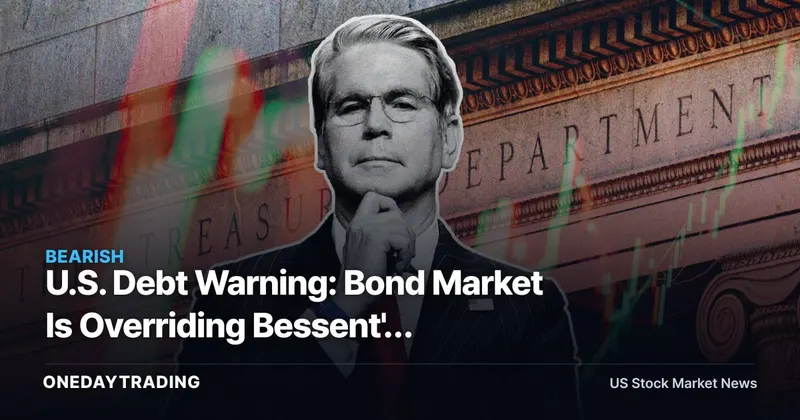
The source gives no yield level, deficit figure, auction size or equity-index move, so the correct analytical move is to avoid fake precision. The hard facts are the issuer, the U.S. Treasury; the policy actor, Treasury Secretary Scott Bessent; and the market channel, bond-market anxiety.
That absence of a single triggering number is itself important. This is not a one-data-point trade like CPI or payrolls; this is a confidence channel where issuance, term premium and fiscal politics can pressure rates even when the Fed is not the immediate catalyst.
Winners & Losers
- Long-duration technology: Software, internet and AI infrastructure stocks are most exposed when higher Treasury yields compress the value of future earnings.
- Banks: JPMorgan Chase and Bank of America can benefit from higher asset yields, but funding-cost pressure and credit risk limit the upside if bond anxiety becomes growth anxiety.
- Defensive cash generators: Consumer staples, healthcare and utilities with visible cash flow can hold up better if investors rotate away from multiple-dependent growth.
- Rate-sensitive housing and REITs: Real estate equities face a direct channel from Treasury yields to mortgage rates, capitalization rates and refinancing costs.
Risk Check
- Policy risk: If Treasury communication restores demand for U.S. debt, the rates shock can fade before earnings estimates move.
- Fed risk: If economic data weaken enough to pull rate-cut expectations forward, lower policy-rate expectations can offset fiscal anxiety.
- Valuation risk: If yields keep rising without stronger growth, equity multiples absorb the pressure before revenue revisions show damage.
- Liquidity risk: If Treasury volatility spills into credit spreads, the market moves from valuation adjustment to financing stress.
Bottom Line
The bond market is telling equity investors that U.S. debt has become a valuation variable, not just a Washington talking point. If Treasury demand stabilizes, the equity damage can stay contained; if yields rise because investors demand more compensation for fiscal risk, leadership narrows toward balance-sheet quality and away from long-duration stories.
FAQ
Why is the bond market worried about U.S. debt?
The bond market is worried about U.S. debt because investors are demanding confidence that Treasury issuance can be absorbed without pushing yields higher. MarketWatch reported that Treasury Secretary Scott Bessent's calming plan is being short-circuited by bond-market anxiety.
How does U.S. debt affect the stock market?
U.S. debt affects the stock market through Treasury yields, which set the discount rate used to value corporate earnings. Higher Treasury yields usually pressure growth-stock multiples and raise borrowing costs for companies, households and real estate borrowers.
What should investors watch after Scott Bessent's Treasury signal?
Investors should watch Treasury yield levels, demand at U.S. debt auctions and the next inflation data that can change Federal Reserve rate expectations. If fiscal anxiety keeps yields elevated, the market will price balance-sheet quality more aggressively than sales growth alone.
📊 Analysis
Signal Bearish
Why Bond-market anxiety over U.S. debt raises the discount-rate and funding-cost burden for equities, especially long-duration and rate-sensitive sectors.
This article was independently written by OneDayTrading from public reporting. Read the original (MarketWatch)