At a Glance
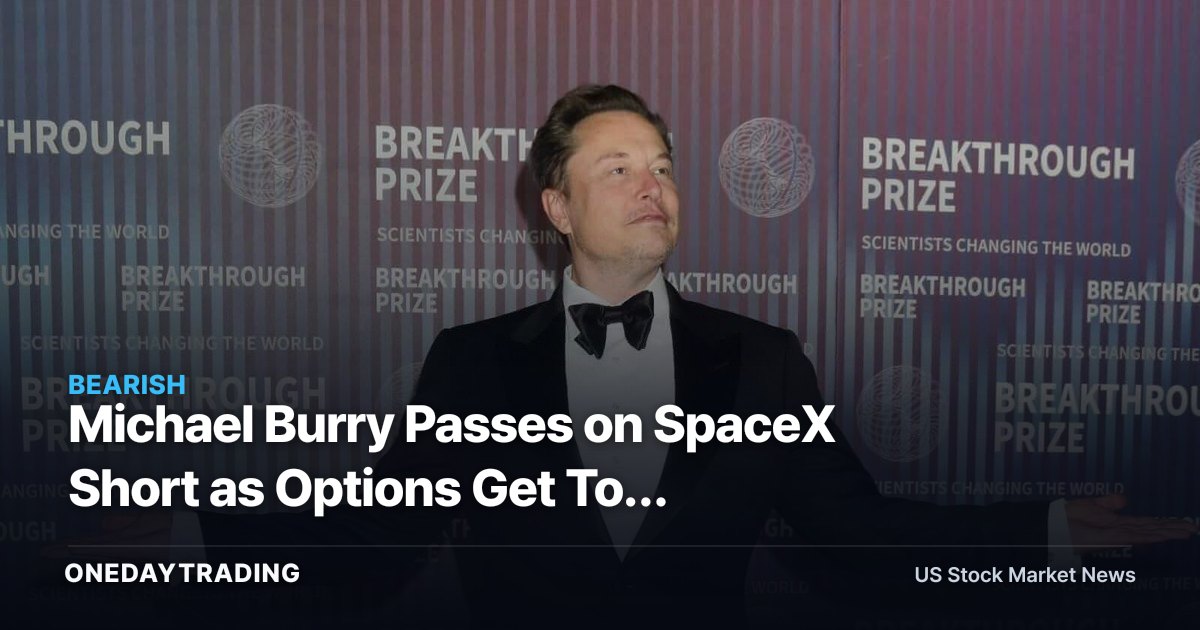
Michael Burry, the investor behind the famous 2008 housing short, reportedly looked at betting against SpaceX but walked away because the options needed to express that view were too expensive. The decision says less about Burry and more about how richly the market is pricing risk around SpaceX exposure.
Why It Matters Now
SpaceX is privately held, so there is no direct stock to short. Any bearish wager has to run through derivatives or listed proxies, and the cost of those instruments is the real signal here. When a contrarian known for finding cheap downside protection concludes the premiums are not worth paying, it tells you implied volatility and demand for exposure are unusually high.
Expensive options pricing typically reflects two things: heavy speculative interest pushing up demand for both calls and puts, and uncertainty about a hard-to-value private asset. For retail investors, the read-across is that vehicles offering SpaceX-style exposure may carry the same froth Burry flagged. Closed-end and venture-style funds that hold SpaceX stakes have at times traded at steep premiums to their underlying net asset value, which is exactly the kind of dislocation a short-seller hunts for and exactly the kind that becomes costly to bet against when everyone else wants in.
The broader space and launch sector inherits this dynamic. Sentiment toward SpaceX sets the tone for listed peers, and a crowded, expensive-to-hedge backdrop can amplify both upside enthusiasm and downside air pockets if funding or launch cadence narratives wobble.
FAQ
- Can you actually short SpaceX? Not directly, since it is private. Bearish bets rely on derivatives or listed proxy funds that hold SpaceX stakes.
- Why did Burry skip it? The options pricing was too expensive, meaning the premium to establish the position outweighed the expected payoff.
- What does expensive options pricing imply? High implied volatility and strong demand, often a marker of speculative froth and valuation uncertainty.
- Is this a buy or sell signal? Neither directly. It is a caution flag about crowded positioning and rich proxy valuations.
Related Stocks & Sectors
- DXYZ (Destiny Tech100) — a listed fund with SpaceX exposure that has historically swung to large premiums over NAV, the dislocation most relevant to a SpaceX short thesis.
- RKLB (Rocket Lab) — the most direct listed launch peer, whose sentiment tracks the space sectors risk appetite.
- TSLA (Tesla) — tied to the Elon Musk halo trade; broad Musk-venture enthusiasm spills across his listed and unlisted ventures.
- ARKK (ARK Innovation) — holds private and thematic growth exposure and reflects appetite for speculative innovation names.
What to Watch
- Premium-to-NAV on SpaceX-proxy funds like DXYZ; a widening gap signals stretched positioning.
- Implied volatility and put-call demand on space and Musk-linked names as a froth gauge.
- Any future SpaceX private funding round valuation, which resets proxy fair value.
- Rocket Lab launch cadence and order updates as a sector sentiment proxy.
Overall Outlook
The bull case is straightforward: demand for SpaceX exposure is intense enough that hedging is costly, and underlying enthusiasm around launch economics and satellite connectivity remains strong. The risk is that the same expensive optionality reflects valuations detached from fundamentals, where proxy premiums can compress quickly. Burry declining the trade on cost is a reminder that even a clear-eyed bear can find the price of being right too high, and that crowded enthusiasm cuts both ways.
Market data check: DXYZ
DXYZ last traded near $27.8 (-3.44%). Our composite signal — blending price momentum and news flow — reads 🟡 neutral. Price momentum scores 22/100 (soft).
Data as of publication. Price via market feeds; for reference only, not investment advice.
📊 Analysis
Signal Bearish
Why Elevated, expensive options pricing flags speculative froth and stretched premiums in SpaceX-proxy vehicles, a cautionary signal even though a noted bear declined to short.
Tickers$DXYZ$RKLB$TSLA$ARKK
This article was independently written by OneDayTrading from public reporting. Read the original (Yahoo Finance)