At a Glance
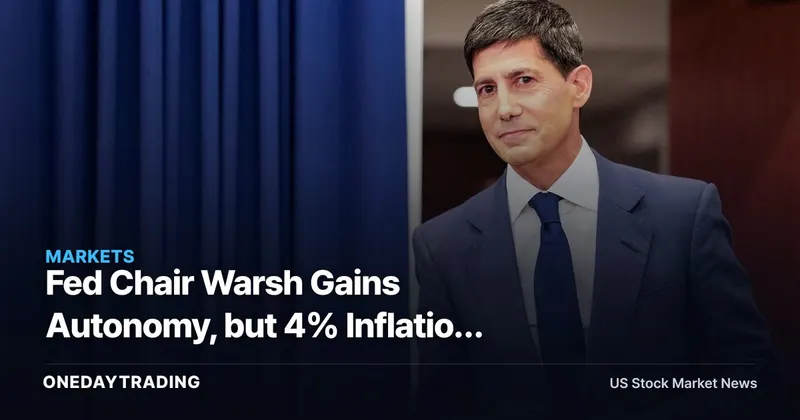
With U.S. inflation running above 4%, the White House decision to give Federal Reserve Chairman Kevin Warsh political breathing room does not open a path to rate cuts — it simply removes one source of noise from a rate environment already constrained by the data. The relevant signal for investors is not the easing of executive pressure but what 4%-plus inflation structurally implies: the long end stays elevated, equity multiples face compression, and the sector rotation from growth to value-cyclicals remains intact.
Why It Matters Now
Inflation at 4% places the Fed in a mechanically difficult position. The central bank's own framework — anchored around a 2% target — leaves almost no theoretical room for easing when price growth runs twice that level, regardless of who occupies the chair. Trump's concurrent public calls for rate cuts create a credibility tension: if Warsh is seen as immune to that pressure, the long end of the Treasury curve will reflect a more independent Fed, keeping 10-year yields firm and the real rate positive. That arithmetic is punishing for long-duration assets — high-multiple growth equities, speculative tech and REITs — where valuation rests on discounted future cash flows.
The mechanism runs directly through sector leadership. Elevated real rates shift the cost-of-capital calculus: banks collecting wider net interest margins on floating-rate books benefit, while capital-light software and consumer discretionary names most sensitive to multiple expansion suffer. The dollar, historically correlated with real-rate differentials, is likely to stay supported as long as U.S. inflation outpaces the Fed's ability to respond — a headwind for multinational earnings translated back from weaker foreign currencies.
The phrase advisors giving Warsh space also carries a conditional quality. Trump continuing to publicly demand cuts signals that the truce is tactical, not structural. Any softening in inflation data — a single cooler CPI print — would likely reignite political demands and inject fresh volatility into rate expectations. That asymmetry means investors cannot simply treat political silence as a durable floor under bond yields.
FAQ
- Does easing political pressure mean rate cuts are coming? No. With inflation above 4%, the Fed's own data-dependency framework rules out cuts absent a sharp deceleration in prices. Political pressure easing removes a risk premium but does not change the inflation math.
- Which sectors benefit most from a higher-for-longer rate environment? Large-cap banks with floating-rate loan books — chiefly the money-center names — see net interest margin expansion. Insurance carriers reinvesting premium income at higher yields also gain. Conversely, REITs, utilities and high-multiple growth tech are structurally disadvantaged.
- How does this affect the U.S. dollar? Positive real rates — nominal rates minus 4%-plus inflation still yielding a positive spread over most G10 peers — tend to support dollar strength, compressing earnings translations for U.S. multinationals and pressuring commodity prices denominated in dollars.
- What is the key risk to the higher-for-longer thesis? A rapid deceleration in inflation, potentially triggered by a tariff-related demand shock or labor market softening, could force a reassessment and accelerate rate-cut pricing — reversing the sector rotation described above.
Related Stocks & Sectors
- JPM (JPMorgan Chase) — Largest U.S. bank by assets; net interest income expands directly with sustained elevated short and long rates, while its diversified fee base provides ballast against credit-cycle risk.
- BAC (Bank of America) — Among the most asset-sensitive major banks, meaning its earnings are disproportionately tied to rate levels; higher-for-longer is a material revenue tailwind relative to peers with fixed-rate book concentration.
- Growth/Software sector (broadly) — Elevated discount rates compress terminal-value multiples most severely for companies trading at high price-to-forward-sales ratios with back-loaded cash flow profiles.
- REITs (broadly) — Cap-rate expansion driven by higher Treasury yields erodes property valuations and raises refinancing costs, squeezing distributions and pressuring book value.
- Consumer Discretionary — Persistent 4% inflation erodes real household purchasing power, reducing discretionary spending capacity and complicating same-store sales growth for retailers dependent on volume rather than pricing power.
What to Watch
- Next CPI release: Any print that shows inflation decelerating toward 3% or below would materially reprice rate-cut expectations and flip the sector leadership narrative; a print holding at or above 4% cements the current regime.
- Warsh public commentary on the neutral rate: His stated view of where rates should settle will be the clearest signal of how much room the Fed actually intends to give the economy — watch for Congressional testimony or FOMC press conferences.
- 10-year Treasury yield level: A sustained move above recent resistance would confirm the higher-for-longer trade is being priced in structurally, not just cyclically — and would accelerate rotation out of duration-sensitive equities.
- Trump tariff developments: Tariff pass-through is a primary driver of above-target inflation; any escalation or de-escalation in trade policy is the single variable most likely to alter the inflation trajectory and thus the Fed's optionality.
Overall Outlook
The bull case for risk assets hinges on a swift disinflationary path — inflation dropping toward 3% by year-end would restore rate-cut optionality and re-rate growth multiples higher. The base case, however, is that 4%-plus inflation proves stickier than consensus expects, keeping Warsh in a holding pattern regardless of political dynamics. That scenario sustains the value-over-growth, financials-over-tech rotation that has characterized this rate cycle. The live risk is the opposite of what markets typically fear: not that political pressure forces premature cuts — Warsh has cover to resist — but that inflation proves self-correcting faster than the bond market anticipates, triggering a violent duration rally that catches over-hedged portfolios off-guard. Position sizing around that tail, rather than the base case, is where active risk management earns its fee.
📊 Analysis
Signal Neutral
Why Political pressure easing is mildly stabilizing for Fed credibility, but 4% inflation structurally prevents rate cuts, creating offsetting sector impacts — banks benefit while growth assets suffer — with no net directional dominance.
This article was independently written by OneDayTrading from public reporting. Read the original (CNBC)