Summary
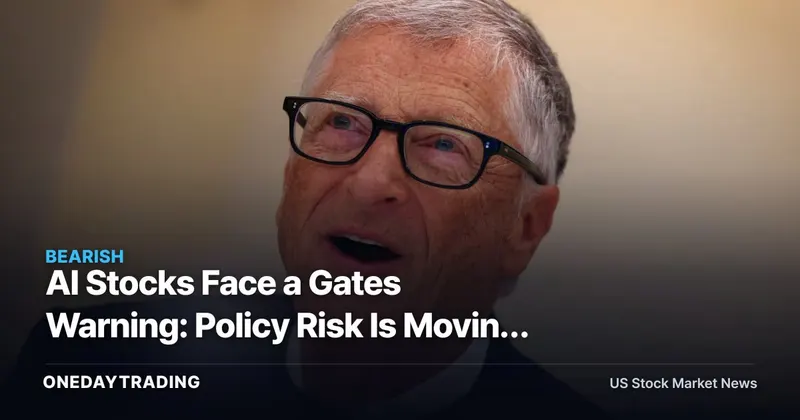
AI stocks face a policy-risk reminder after Bill Gates warned, per CNBC source reporting, that governments are not adequately preparing for AI-driven worker displacement, pressure on social systems and global risks. The investor read-through is not an earnings shock today; the risk is that unmanaged labor disruption can pull regulation, taxation and procurement limits into the AI growth narrative.
Bill Gates is the public technology figure in the CNBC source item, and the subject is artificial intelligence, a software and computing shift that automates cognitive tasks previously handled by workers. For U.S. retail investors, the relevant market question is whether AI adoption remains a productivity story or becomes a political-cost story.
The Full Story
The AI trade has priced speed: faster model deployment, broader enterprise adoption and expanding demand for cloud infrastructure. Bill Gates warning that there is no adequate government plan for AI upheaval adds a different variable: the social absorption rate of the technology.
That distinction matters because AI revenue does not grow in a vacuum. If AI displaces workers faster than governments can retrain labor markets or protect social systems, large AI platforms can face tougher rules on deployment, data use, public-sector contracts and liability.
The CNBC source does not provide revenue figures, job-loss estimates or a policy timetable, so the market impact should not be overstated. The signal is qualitative but material: a prominent technology voice is framing AI as an institutional-preparedness problem, not only an innovation cycle.
Structural Background
AI regulation risk is different from ordinary software compliance because artificial intelligence can touch employment, education, security and public services at the same time. A platform that sells AI tools into enterprises benefits from automation demand, but that same automation can create political pressure if the labor shock becomes visible.
The cleanest investor framework is adoption versus constraint. Adoption lifts cloud usage, model subscriptions and AI infrastructure demand; constraint raises compliance costs, slows enterprise rollouts and can compress valuation multiples for companies priced as if deployment friction stays low.
Stock & Sector Ripple
- Microsoft (MSFT): Microsoft is the most natural U.S.-listed AI software proxy because enterprise AI adoption and cloud usage are central to the investor narrative, while government concern over workforce disruption can affect public-sector and corporate deployment pace.
- Alphabet (GOOGL): Alphabet faces a two-sided AI debate because AI can strengthen search, cloud and productivity tools, while social-risk scrutiny can intensify regulatory attention around data, model behavior and market power.
- Amazon (AMZN): Amazon Web Services benefits when companies run AI workloads in the cloud, but enterprise buyers may move slower if boards treat AI labor exposure as a compliance and reputation issue.
- Nvidia (NVDA): Nvidia remains tied to AI infrastructure demand, yet hardware orders ultimately depend on downstream deployment confidence from cloud and enterprise customers.
- AI software sector: The AI software sector benefits from automation budgets, but the Gates warning points to a margin risk if vendors must spend more on governance, safety testing and customer assurances.
Bull vs Bear Scenarios
The bull case is that Bill Gates highlighting inadequate government preparation accelerates public planning without slowing AI investment, leaving enterprise productivity spending intact. In that scenario, AI platforms can sell governance, security and workflow tools as part of the adoption package.
The bear case is that worker displacement becomes the dominant political frame, and governments respond with rules that slow deployment or raise compliance costs. If that happens, AI stock multiples can reprice before revenue estimates move, because the market usually discounts regulatory friction ahead of reported numbers.
Investor Action Points
- Track the next earnings calls from Microsoft, Alphabet, Amazon and Nvidia for management language on enterprise AI adoption, compliance review cycles and public-sector demand.
- Watch whether policymakers convert AI labor concerns into concrete proposals on worker protection, model oversight or procurement standards.
- Separate AI infrastructure demand from AI deployment risk; chips can remain strong while software rollouts face longer approval cycles.
- Treat valuation as the live variable because the CNBC source gives no numeric timetable for worker displacement or regulation.
FAQ
Why did Bill Gates warn about AI upheaval?
Bill Gates warned, per CNBC source reporting, that governments are not adequately prepared for AI-driven worker displacement, strain on social systems and global risks. The warning frames artificial intelligence as a public-policy problem as well as a technology investment cycle.
What does Bill Gates AI warning mean for Microsoft stock?
Microsoft (MSFT) is not reported by CNBC as the direct subject of the warning, but Microsoft is a major U.S.-listed AI software proxy for investors. If AI policy risk rises, Microsoft investors should monitor enterprise deployment pace, cloud AI demand and management commentary on regulation.
Are AI stocks at risk from worker displacement concerns?
AI stocks are exposed to worker displacement concerns when political pressure changes the cost or speed of deployment. If governments turn labor-market anxiety into binding AI rules, U.S.-listed AI platforms and infrastructure suppliers can face slower adoption assumptions even before reported revenue changes.
Market data check: MSFT
MSFT last traded near $495.14 (+0.70%). Our composite signal — blending price momentum and news flow — reads 🟡 neutral. Price momentum scores 56/100.
Data as of publication. Price via market feeds; for reference only, not investment advice.
📊 Analysis
Signal Bearish
Why The Gates warning is a negative policy-risk signal for AI-linked stocks because unmanaged labor disruption can invite regulation and slow deployment assumptions.
Tickers$MSFT$GOOGL$AMZN$NVDA
This article was independently written by OneDayTrading from public reporting. Read the original (CNBC)