Summary
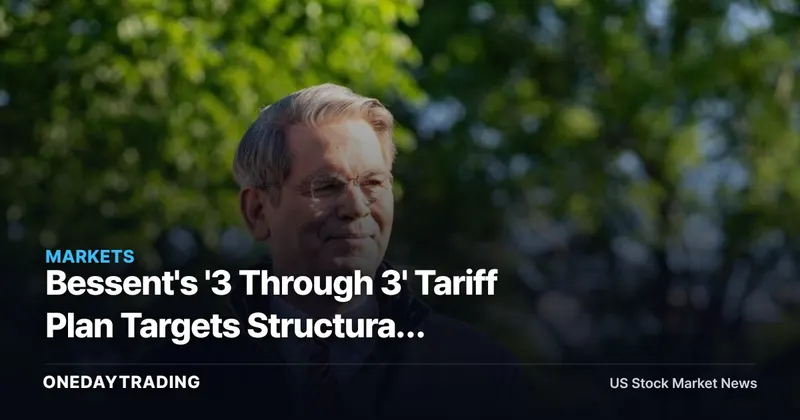
Treasury Secretary Scott Bessent has paired a defense of the administration's tariff reboot with a framework he calls the 3 Through 3 plan, pitched explicitly as a remedy for structural inflation rather than the cyclical kind the Fed targets. The market question is not whether tariffs raise some prices, but whether Washington can lower the persistent, supply-side component of inflation while leaning on import levies. That tension sets the tape for rates, the dollar and the cyclical-versus-defensive rotation.
The Full Story
Bessent's argument reframes the standard objection to tariffs. Critics treat levies as a one-time price-level shock that feeds inflation; he positions them inside a broader program aimed at the durable drivers — energy costs, housing, fiscal slippage — that keep core inflation sticky above target. Branding it 3 Through 3 signals a multi-pronged, sequenced approach rather than a single lever, and it is meant to reassure markets that the tariff agenda is paired with disinflationary offsets, not a standalone tax on consumers.
For investors, the read-through runs through the rate curve. If the plan is credible on structural disinflation, it gives the Fed cover to hold or ease without re-accelerating prices, which compresses term premium and steepens the case for long-duration assets. If markets instead price tariffs as the dominant force, breakevens drift higher, the front end stays anchored hawkish, and multiples on rate-sensitive growth names come under pressure.
The dollar is the second transmission channel. Tariffs are typically dollar-supportive at the margin by shrinking the trade deficit, while a coordinated push to lower structural inflation could argue for a lower real rate path — a cross-current that leaves DXY range-bound until one narrative wins.
Structural Background
Structural inflation is the part of price growth that monetary policy struggles to reach: supply constraints, demographics, energy and housing. By targeting it through fiscal and trade tools rather than rate hikes, the Treasury is implicitly claiming a lane the Fed cannot occupy. That distinction matters because it shifts some inflation-fighting credibility from an independent central bank to the executive — a setup markets historically discount until results show in the data.
Stock and Sector Ripple
- Domestic manufacturers and materials — tariff walls favor onshore producers of steel, autos and industrial inputs by raising the landed cost of imports, a margin tailwind if demand holds.
- Import-heavy retailers — discounters and apparel sellers sourcing abroad face higher input costs and a squeeze on the low-end consumer, the clearest near-term losers.
- Banks — a credible disinflation path that lets the Fed ease without inflation flaring supports net interest margins and loan demand into a softer-landing scenario.
- Long-duration growth and utilities — both rally if term premium falls and real yields drift lower on a believable structural-inflation fix.
- Energy — central to the structural story, since lower input costs are a stated lever; policy aimed at cheaper energy cuts both ways for producers.
Bull vs Bear Scenarios
Bull: The plan lands as a coherent supply-side program, breakevens stay contained, the Fed gains room to ease, and cyclicals plus duration both work as the curve normalizes. Bear: Tariffs prove inflationary faster than the structural offsets bite, breakevens and the long end back up, the consumer absorbs the price-level hit, and the rotation favors defensives over cyclicals. The live variable is timing — price-level effects from tariffs show up in months; structural disinflation, if it works, takes years.
Investor Action Points
- Watch core PCE and CPI prints for whether tariff pass-through outpaces any structural softening — the next two releases set the narrative.
- Track 10-year breakevens and the 2s10s curve as the cleanest gauge of which inflation story the bond market believes.
- Monitor Fed commentary on whether officials treat the tariff plan as inflationary or neutral — that framing moves the front end.
- Map portfolio exposure to import-cost sensitivity: separate onshore-revenue names from those reliant on imported inputs before the next tariff schedule detail lands.
📊 Analysis
Signal Neutral
Why A policy framework with offsetting tariff-inflationary and structural-disinflationary effects leaves the net market direction genuinely two-sided until data confirms which dominates.
This article was independently written by OneDayTrading from public reporting. Read the original (Yahoo Finance)