Federal Reserve Rate Votes: At a Glance
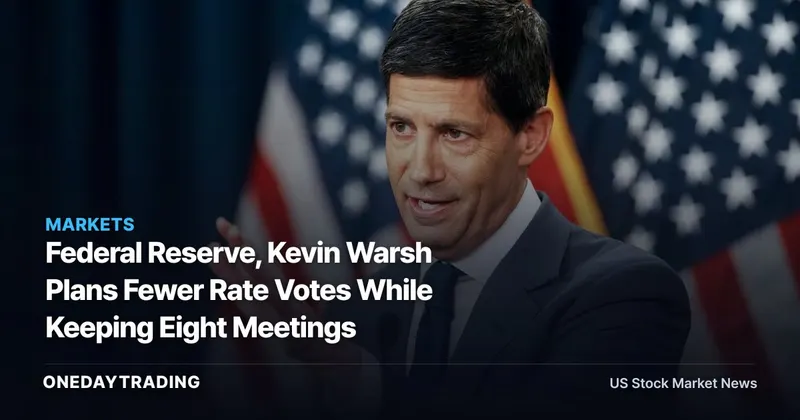
The Federal Reserve kept its benchmark rate steady last week, and Kevin Warsh announced plans to reduce rate-setting votes over the next two years while preserving eight meetings per year. For investors, borrowers and savers, the immediate issue is not a confirmed change in rates; it is whether fewer scheduled decision points alter the timing and visibility of future policy transmission.
CNBC reported that the Federal Reserve voted on Oct. 28 to maintain a target range of 3.75% to 4%. The central bank’s inflation goal is 2%, but the available facts do not establish whether or when policymakers will change the benchmark rate.
A rate-setting vote is the formal opportunity at which the Federal Reserve can decide whether to adjust its benchmark borrowing rate. The distinction matters because the institution will continue to meet eight times a year even as some meetings shift toward strategy rather than a scheduled interest-rate decision.
Kevin Warsh Changes the Decision Calendar, Not the Meeting Count
Next year, the Federal Reserve will hold eight meetings, but one will have neither an interest-rate vote nor a post-meeting statement. That creates a separation between how often policymakers convene and how often they are scheduled to act or formally communicate a rate decision.
The following year, the Federal Reserve plans two strategy meetings, leaving six scheduled opportunities to adjust rates, excluding emergency meetings. The exact dates of the future non-voting strategy meetings are unknown, so investors cannot yet map the change onto a precise policy calendar.
The analytical tension is straightforward. Fewer scheduled votes could create longer intervals between ordinary opportunities for action, particularly if economic conditions change between them. Emergency meetings remain outside that count, and the facts do not show that a changed calendar will necessarily prevent a response.
This is therefore a timing question before it is a direction call. The announced structure does not indicate whether the next rate move will be higher, lower or unchanged, and it does not establish the size of any future adjustment.
Borrowers Face a Transmission Question
Most credit cards carry variable rates tied to the prime rate, giving Federal Reserve decisions a channel into consumer borrowing costs. The facts do not establish how lenders will adjust those costs under the revised voting schedule, so fewer votes cannot be treated as proof that any individual borrower will pay more or wait longer for relief.
James Vrachas, executive director at Post Oak Group, said fewer Federal Reserve meetings with rate votes in 2027 could make consumers wait longer for relief when borrowing costs are elevated. His warning identifies a plausible scheduling risk, not a confirmed outcome.
Jordan Ricciardi, a senior wealth strategy associate at UBS, said consumers could experience longer periods of uncertainty around borrowing costs. That distinction is important: uncertainty may increase when scheduled decision opportunities decline even if the eventual path of the benchmark rate does not change.
Financial institutions can adjust rates whenever market conditions warrant, independent of the Federal Reserve meeting schedule. This creates the principal countercondition to the delayed-relief thesis: fewer central-bank votes do not mechanically freeze every consumer rate between meetings.
The Key Debates Around Fewer Federal Reserve Votes
- Decision speed: Six scheduled opportunities to adjust rates in the following year may create longer ordinary gaps between decisions, while emergency meetings remain possible.
- Policy visibility: Next year’s one meeting without a rate vote or post-meeting statement removes a scheduled decision and its accompanying statement, even though the Federal Reserve still convenes eight times.
- Lender behavior: The revised calendar does not determine how quickly financial institutions will pass through any future change in benchmark borrowing costs.
- Consumer outcomes: The actual effect on individual borrowers is unknown because loan terms and lender responses are not specified in the available evidence.
Credit, Savings and Financial-Sector Read-Through
- Credit cards: Variable rates tied to the prime rate provide the clearest confirmed consumer transmission channel. Matt Schulz is LendingTree’s chief credit analyst, linking the firm’s credit analysis to the borrower side of this debate.
- Borrowing products: A less frequent scheduled voting calendar may extend uncertainty over borrowing costs, according to the cited specialists, although no lender adjustment or borrower outcome has been confirmed.
- Savings accounts: Bankrate data showed that some top-yielding online savings accounts offered interest rates of 4% or more. Elevated savings yields represent the other side of the rate environment: what pressures borrowers can support income for savers.
- Rates-sensitive financial activity: The relevant variable is the timing and extent of lender repricing. The facts support monitoring that channel, not assigning a directional effect to a specific listed company.
What the New Schedule Does Not Prove
Mark Hamrick, founder of The Hamrick Brief, said he would not expect the full range of market rates to change simply because the Federal Reserve votes less often. His view reinforces the boundary between institutional procedure and market outcomes: changing the voting calendar alone does not specify the direction of rates.
The strongest bearish interpretation for borrowers is conditional. If economic conditions support lower borrowing costs and a scheduled vote is farther away, relief could take longer to arrive through the central-bank channel. The counter-scenario is that financial institutions reprice independently or that no benchmark change becomes appropriate, leaving the reduced vote count with limited practical effect.
For savers, the same balance runs in reverse. Bankrate’s 4% or more figure for some top-yielding online savings accounts shows that higher available yields can coexist with elevated borrowing costs. No evidence establishes how long those offers will last or how they will respond to future Federal Reserve decisions.
Next Checkpoints for Federal Reserve Policy
- Implementation details: Identify which meeting next year will omit both the interest-rate vote and the post-meeting statement.
- Following-year structure: Confirm how the two strategy meetings are placed around the six scheduled opportunities to adjust rates.
- Benchmark decisions: At each voting meeting, compare the decision with the 3.75% to 4% target range maintained on Oct. 28.
- Consumer transmission: Check whether lenders change borrowing rates and whether top-yielding online savings accounts continue offering 4% or more.
Overall Outlook for Rates and Consumers
Kevin Warsh’s plan changes the cadence of scheduled Federal Reserve decisions without reducing the institution’s eight annual meetings. That may increase the importance of each voting meeting and the intervals between them, but it does not by itself determine the benchmark rate or the prices lenders offer consumers.
The borrower risk is a longer wait if relief becomes appropriate between scheduled votes. The balancing case is that lenders retain the ability to adjust independently, emergency meetings remain outside the six scheduled opportunities, and the future direction of policy is unknown.
The next meaningful signal will come from the meeting design and subsequent rate decisions, not from the reduced vote count in isolation. Investors should separate three variables: the Federal Reserve’s decision calendar, the benchmark target range, and the speed at which financial institutions translate policy into borrowing and savings rates.
📊 Analysis
Signal Neutral
Why Fewer scheduled votes may lengthen uncertainty for borrowers, while lenders can still change rates and savers may retain access to elevated yields.
This article was independently written by OneDayTrading from public reporting. Read the original (CNBC)