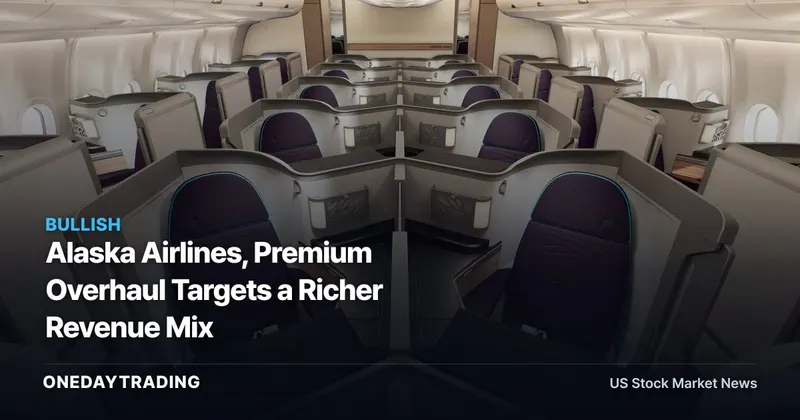
Alaska Airlines Turns Cabin Space Into a Revenue-Mix Test
Alaska Airlines announced on 2026-09-29 that it will overhaul cabins across Alaska and Hawaiian Airlines, add hundreds of high-end seats and build new airport lounges. For airline investors, the central question is not whether the new suites look competitive; it is whether a more premium product can move a larger share of revenue toward the categories management considers more lucrative.
A premium cabin overhaul is a reconfiguration of aircraft interiors that reallocates space toward higher-end seating, including suites and premium economy. The strategy connects the physical product to Alaska Airlines’ broader effort to rely more on premium seats, international flights, its Atmos loyalty program and cargo.
The announcement is directionally constructive because it gives that revenue strategy a tangible product. Its financial weight cannot yet be isolated: the total overhaul cost, exact number of aircraft and seats being upgraded, rollout dates, product pricing and profit contribution specific to the program were not disclosed.
The Revenue Target Behind Alaska Airlines’ New Cabins
CNBC reported that Alaska Airlines expects premium seats, international flights, loyalty and cargo to generate close to 60% of total revenue by 2030, compared with 53% currently. That gap is the clearest operating benchmark attached to the overhaul because it measures whether the business mix is actually shifting, rather than merely whether new interiors enter service.
The company is also pursuing a $1 billion added-profit goal covering the period from the end of 2024 to the end of 2027. Alaska Airlines said Tuesday that it was two-thirds of the way toward that goal, giving investors evidence of progress at the corporate level without establishing how much of the remaining advance will come from cabins or lounges.
The distinction matters. A new seat is a capital and capacity decision; the revenue outcome depends on how much demand moves into the premium inventory and how the product contributes alongside international flying, loyalty and cargo. Because no product pricing or overhaul-specific economics were provided, the close-to-60% revenue target is more useful than any unsupported estimate of returns.
Hawaiian Airlines Trades Seat Count for a Broader Premium Offer
The Hawaiian Airlines Airbus A330 aircraft used on flights to Hawaii, Asia and Oceania will carry 254 seats after the cabin changes, down from 278 before them, according to CNBC. That reduction makes the commercial trade-off visible: fewer total seats create room for a broader premium offering, so execution must be judged through revenue mix and economic contribution rather than seat count alone.
Shane Jones described the current Airbus A330 interiors as “aging interiors.” Refreshing those aircraft therefore serves two purposes supported by the announcement: replacing an older onboard environment and introducing choices ranging from suites to premium economy.
Hawaiian Airlines said more than half of Hawaii’s visitors come from the U.S. West Coast. Diana Birkett Rakow characterized that customer base as “valuable to us from an economic perspective,” citing income, travel budgets, spending patterns and flying patterns; the overhaul gives the airline a way to present more differentiated cabin choices to that established flow of travelers.
Alaska Airlines completed its merger with Hawaiian Airlines in September 2024 and plans to keep the two carriers as separate brands. The cabin program can therefore broaden the combined premium proposition without erasing the brand distinction management has chosen to preserve.
Why Product Timing Could Help—and Where It Could Fail
Henry Harteveldt of Atmosphere Research Group argued that a later mover can study what competitors already offer and try to improve on it. Applied to this overhaul, that view frames timing as a possible product-design advantage, not proof of customer demand or financial success.
The bullish case rests on alignment. Alaska Airlines is adding high-end seats and lounges while explicitly seeking more revenue from premium, international, loyalty and cargo activities. If the physical product attracts spending into those categories, the overhaul could reinforce the mix shift already embedded in the close-to-60% target.
The counter-scenario begins with the same cabin arithmetic. Hawaiian Airlines will have 254 seats where it previously had 278, and the missing pricing and cost data prevent investors from testing whether the redesigned layout will compensate economically for the lower total seat count. A polished cabin can support demand, but the disclosed facts do not establish its payback.
Atmos Loyalty Extends the Strategy Beyond the Aircraft
Alaska Airlines plans to launch a rewards debit card for the Atmos loyalty program early next year. The company said the product “expands the program’s reach beyond traditional credit products,” adding another route into a loyalty system that already includes co-branded cards offered with Bank of America.
The relationship matters because the cabin overhaul and loyalty expansion address different parts of the same commercial model. Cabins and lounges shape the travel product, while Atmos determines how members earn within the program and gives Alaska Airlines another way to connect customers with its rewards proposition.
Starting Thursday, Atmos members must choose whether to earn miles based on distance traveled, ticket price or segments flown. That choice is an immediate checkpoint: it makes the program’s earning structure more explicit at the same time the company is expanding the range of premium products around it.
Southwest Airlines and United Airlines offer similar rewards cards through JPMorgan Chase. That confirmed relationship places the planned Atmos debit card within an established airline-and-bank distribution approach, although the facts provided do not quantify the products’ relative economics or customer adoption.
Investor Checkpoints for the Alaska Airlines Overhaul
- Revenue mix: Track whether Alaska Airlines advances from 53% currently toward close to 60% of total revenue by 2030 across premium seats, international flights, loyalty and cargo.
- Profit-goal progress: Compare future updates with the company’s statement Tuesday that it was two-thirds of the way toward $1 billion in added profit from the end of 2024 to the end of 2027.
- Cabin economics: Look for disclosure of product pricing, total program cost and the overhaul’s specific financial contribution, especially given the Hawaiian Airlines Airbus A330 change from 278 seats to 254.
- Execution scope: Watch for the exact aircraft count, number of seats being upgraded and rollout dates for both the cabins and airport lounges.
- Loyalty development: Assess how the planned Atmos debit card and the new member earning choices fit into Alaska Airlines’ effort to increase reliance on loyalty revenue.
Alaska Airlines’ Bull Case Now Needs Operating Evidence
The announcement strengthens the strategic logic of Alaska Airlines’ revenue-mix plan. The company is pairing cabins and lounges with international flying, Atmos and cargo, while its stated progress toward the added-profit goal provides a broader measure against which management can be judged.
The investable question remains disciplined: does the new product convert aircraft space and customer engagement into the intended revenue mix without undermining the economics through undisclosed costs or weaker capacity productivity? The next useful evidence is not another design reveal. It is disclosure that connects rollout scope, pricing and financial contribution to the 53%-to-close-to-60% revenue transition and the $1 billion added-profit objective.
📊 Analysis
Signal Bullish
Why The overhaul supports Alaska Airlines’ shift toward premium, international, loyalty and cargo revenue, though its cost and specific profit contribution remain undisclosed.
This article was independently written by OneDayTrading from public reporting. Read the original (CNBC)