Summary
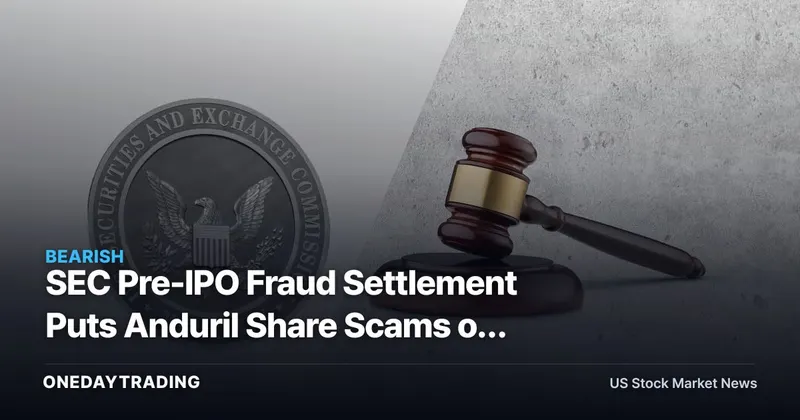
An SEC enforcement settlement targeting an advisor who falsely promised investors pre-IPO shares of Anduril — the Palmer Luckey-founded defense AI company — is the latest proof that surging retail demand for elite private-company access has created a fertile hunting ground for fraudsters. For investors attempting to build exposure to the defense-tech wave outside public markets, the case is a structural warning, not an isolated incident.
Anduril itself is not implicated; the company's private status is precisely what made it exploitable. The SEC action underscores a widening gap: as high-profile private defense contractors delay public listings, the secondary and pre-IPO brokerage market fills with operators whose regulatory oversight ranges from thin to nonexistent.
The Full Story
The core mechanism here is straightforward and increasingly common: a registered or self-styled advisor solicits funds from retail clients on the premise of secured allocations in a coveted private company, collects capital, and delivers nothing — or delivers shares in a vehicle that bears no legal relationship to the underlying company. Anduril, with its high-profile defense contracts and rumored multi-billion-dollar valuation, fits the profile of bait precisely because legitimate access is genuinely difficult and perceived upside is enormous.
The SEC settlement — not a trial verdict — suggests the agency prioritized disgorgement and speed over a prolonged case, a pattern consistent with its enforcement posture on secondary-market fraud. Settlements typically require the advisor to return funds and pay civil penalties, but the deterrence value depends on visibility: investors who never heard of the action remain vulnerable to copycat schemes targeting the next hot private name.
Anduril's business is real and growing — the company holds active U.S. Department of Defense contracts across autonomous systems, border security and electronic warfare — but that legitimacy makes it more attractive as a lure, not less. Defense tech remains one of the few secular growth verticals where bipartisan political support, rising NATO budgets and AI integration are simultaneously pulling capital. That backdrop will not diminish demand for any future Anduril public offering, but it extends the pre-IPO window during which fraud risk accumulates.
Structural Background
The broader context is a decade-long shift in how companies access capital: the median age of a venture-backed company at IPO has risen sharply since 2010, leaving retail investors structurally locked out of the highest-growth phase. Secondary markets and SPVs have emerged to fill that gap, but regulatory coverage remains patchwork. FINRA rules govern broker-dealers; investment advisers fall under the SEC; but unregistered intermediaries — often operating through LLC vehicles and informal networks — routinely solicit retail funds in gray zones. The Anduril case is a reminder that the SEC does eventually reach these actors, but enforcement is retrospective: investors lose money first.
Publicly traded defense primes — Lockheed Martin, Northrop Grumman, RTX — do not compete directly with Anduril in autonomous AI systems in the same way Palantir does, but all benefit from the same DoD spending tailwind. The fraud case puts none of them at risk; if anything, it highlights the liquidity premium embedded in regulated, exchange-listed defense equity. Palantir, which derives roughly half its revenue from U.S. government contracts and competes with Anduril on AI-driven defense intelligence, is the closest public proxy for investors seeking exposure to the autonomous defense theme.
Stock & Sector Ripple
- PLTR (Palantir Technologies) — Closest public analog to Anduril in AI-driven defense contracting; as pre-IPO Anduril access proves legally treacherous, PLTR absorbs redirected institutional and retail capital seeking liquid defense-AI exposure.
- LMT (Lockheed Martin) — Benefits from the same DoD autonomous-systems budget expansion that makes Anduril attractive; no direct fraud exposure, but valuation re-rating risk if congressional defense appropriations stall.
- NOC (Northrop Grumman) — B-21 program and space systems provide defense-tech credibility; investors priced out of private defense names increasingly treat NOC as a blue-chip proxy.
- Pre-IPO broker-dealers and secondary platforms — Legitimate operators (publicly traded examples are limited) face scrutiny overhang; any platform facilitating private-share transactions will now face sharper client due-diligence questions.
- Anduril (private) — Reputational harm is limited since the company is the victim brand, not the perpetrator; however, repeated association with fraud schemes could complicate retail roadshow reception at eventual IPO.
Bull vs Bear Scenarios
Bull: SEC visibility into pre-IPO fraud paradoxically legitimizes the category — enforcement signals the agency is watching, potentially encouraging cleaner secondary-market infrastructure. If Anduril accelerates its IPO timeline (spurred by DoD contract wins or a need for acquisition currency), retail investors who stayed in public-market comps like PLTR or NOC capture the sector re-rating without counterparty risk.
Bear: The SEC settlement resolves one case but the structural incentive for fraud remains: as long as elite private companies stay private longer, bad actors will manufacture access products. A wave of similar enforcement actions could spook retail capital away from the entire defense-tech sub-sector, compressing the valuation premium that currently supports names like PLTR at elevated revenue multiples. Additionally, if Anduril's IPO is further delayed by regulatory complexity or market conditions, the pre-IPO fraud cycle simply repeats with a new lure.
Investor Action Points
- Verify any pre-IPO share offering against SEC EDGAR registration filings and FINRA BrokerCheck before transferring funds — legitimate allocations are documented; promises without paperwork are red flags.
- Track Anduril IPO filing activity via SEC S-1 submissions; that event — not secondary-market rumors — is the only legally reliable entry point for retail investors.
- Monitor PLTR earnings (next report will reflect DoD contract cadence) as the most liquid bellwether for AI-driven defense spending; revenue growth from U.S. government segment is the cleanest read-through to Anduril-adjacent demand.
- Watch for additional SEC enforcement actions in the pre-IPO space — a cluster of settlements would signal a broader sweep that could tighten secondary-market regulation and affect platforms facilitating private-share trading.
Market data check: PLTR
PLTR last traded near $112.93 (+5.28%). Our composite signal — blending price momentum and news flow — reads 🟡 neutral. Price momentum scores 92/100 (firm).
Data as of publication. Price via market feeds; for reference only, not investment advice.
📊 Analysis
Signal Bearish
Why SEC fraud enforcement highlights systemic risk in private defense-tech investing channels, potentially dampening retail appetite for the pre-IPO market and complicating Anduril's eventual public debut.
This article was independently written by OneDayTrading from public reporting. Read the original (Yahoo Finance)