Summary
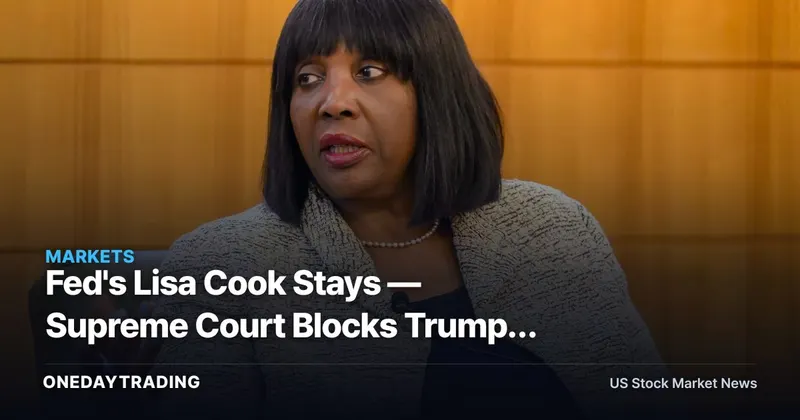
The Supreme Court has temporarily blocked President Trump from removing Federal Reserve Governor Lisa Cook, letting her remain on the Board while her lawsuit proceeds. The ruling is interim, not final — the constitutional question of executive authority over the Fed is still live, and the long end of the Treasury curve has yet to absorb what a final adverse ruling would actually mean for monetary policy credibility.
The Full Story
A Fed governor's 14-year term was engineered by Congress to sever the link between election cycles and interest rate decisions. The Supreme Court's block on Cook's removal does not affirm that design — it suspends the attack on it. That distinction is what rate strategists should be mapping right now. An interim order is not a precedent, and the case's final disposition could redefine how much control the executive branch holds over every Board seat in the Eccles Building.
The transmission mechanism to asset prices is direct. Central bank credibility — the anchor that keeps 10-year inflation breakevens from repricing toward levels inconsistent with the Fed's mandate — depends on investors believing the Fed sets policy on economic data alone. A legal precedent allowing presidential removal of governors for policy disagreement would force the long end of the Treasury curve to incorporate a political risk premium. Higher real yields compress equity multiples, and the S&P 500's current forward earnings multiple already embeds an aggressive Fed pivot timeline with no room for a credibility discount.
The operative phrase from the ruling is 'for now.' The case proceeds, and a final ruling against Cook would represent the most consequential shift in U.S. central bank independence since the 1935 Humphrey's Executor framework — the precedent that first limited presidential removal of independent agency officials to 'for cause.' Ninety years of monetary architecture rest on that foundation. Markets pricing zero probability of its erosion are assuming a legal outcome, not a certainty.
Structural Background
If the Supreme Court ultimately sides with the administration in the underlying case, the president gains functional authority to staff the Federal Reserve with officials aligned to fiscal preferences — an arrangement historically associated with looser monetary policy, wider inflation breakevens, and a weaker dollar. The dollar's reserve currency status carries an implicit central bank independence premium; eroding that premium has compounding effects for U.S. funding costs and international capital flows that go well beyond any single rate decision.
The legal stakes also compound across Board composition. A favorable outcome for the administration would not stop at Cook — it would establish the blueprint for removing any sitting governor whose votes diverge from executive preferences, reshaping the policy committee in ways that no FOMC dot-plot currently reflects.
Stock & Sector Ripple
- JPM, BAC (Banks): Net interest margin modeling depends on a predictable Fed rate path. A politically pliable Fed introduces noise into forward guidance, complicating fixed-income portfolio positioning and net interest income projections across banks with large duration exposure.
- Rate-sensitive Utilities and REITs: These sectors trade as duration proxies. If the long bond reprices upward on central bank independence risk, their multiples compress through the same mechanism as a genuine rate hike — without the economic justification that would accompany one.
- Long Treasuries: The 10-year is the primary instrument through which Fed credibility uncertainty transmits. A final adverse ruling would likely push yields higher as real rates reprice for political risk — not for growth or inflation data, but for institutional uncertainty alone.
- Gold (GC=F): Hard-asset inflation hedges absorb structural flows when central bank credibility is questioned. A ruling that materially weakens Fed independence would be a durable, not tactical, catalyst for gold demand from reserve managers and institutional allocators.
- Broad Equities (^GSPC): The S&P's current forward multiple embeds no political-interference risk premium. A final ruling against Cook would force a discount rate re-rating that earnings revisions alone cannot offset.
Bull vs Bear Scenarios
Bull case: The Supreme Court's willingness to intervene signals judicial discomfort with executive overreach into monetary institutions. If the final ruling upholds Cook's position and reaffirms the Humphrey's Executor framework, the tail risk evaporates entirely. The long end stabilizes, the dollar retains its credibility premium, and the market's current pricing — which ignores the risk — proves accurate. Rate-sensitive sectors reclaim the multiple compression they never actually experienced.
Bear case: The case concludes with a ruling that grants the executive broader removal authority. Even a ruling narrowly limited to governors rather than the Chair would be enough to reprice the 10-year upward by a material increment — a move that mechanically compresses the S&P's forward multiple at current earnings estimates. Dollar weakness would follow as international investors begin discounting the reserve anchor, and inflation breakevens would widen as political easing expectations enter the base case for the first time in a generation.
Investor Action Points
- Track the Supreme Court docket on Cook's underlying lawsuit — the case timeline is the single variable that converts this from background noise into a market-moving event. Any acceleration toward a final ruling warrants re-rating rate-sensitive positioning.
- Watch 10-year Treasury breakevens: a drift above 2.6% without a corresponding CPI or growth catalyst would signal markets beginning to price political risk into the Fed's inflation credibility, not economic fundamentals.
- Monitor the DXY for sustained weakness below key technical support — reserve-currency status carries an independence premium, and dollar deterioration concurrent with this case's progression would confirm that premium is being re-rated lower by international allocators.
- Track any executive action against additional Fed Board members or governors while this case is live — an escalation of that kind would immediately amplify the market's tail-risk probability and serve as the trigger to reassess duration-heavy and rate-sensitive sector exposure.
📊 Analysis
Signal Neutral
Why The interim Supreme Court ruling preserves Fed independence temporarily and removes an immediate catalyst, but the unresolved underlying case sustains a structural tail risk — political authority over the Board — that neither Treasury markets nor equity multiples currently price, leaving no clear directional signal until the final ruling.
This article was independently written by OneDayTrading from public reporting. Read the original (CNBC)